Community Impact
Impact of justice system on communities, includes housing, employment, schools
On this page, the Prison Policy Initiative has curated all of the research that we know of about the impact of the criminal justice system on community well-being. For research on other criminal justice topics, see our Research Library homepage.
 Where people in prison come from: The geography of mass incarceration in Rhode Island Prison Policy Initiative, the Redistricting Data Hub (Peter Horton and Spencer Nelson), Common Cause Rhode Island, and the American Civil Liberties Union of Rhode Island, October, 2023“In Providence, the neighborhoods with the highest incarceration rates in 2020 are also the neighborhoods that were "redlined" in the mid-20th century...becoming home to predominantly non-white residents.”
-
Finding Home: Removing Barriers to Housing for Formerly Incarcerated Individuals Megan Moore and Angie Weis Gammell, September, 2023“Formerly incarcerated individuals have reported that Fair Chance Housing ordinances may actually further complicate their search for housing because they get further in the process, spending additional time and money, before ultimately being rejected.”
-
The Legislative Primer Series on Front-End Justice: Deflection and Diversion National Conference of State Legislatures, August, 2023“Thirty-one states have made significant amendments to, or created new, pretrial diversion programs since 2017.”
-
Where people in prison come from: The geography of mass incarceration in Louisiana Voice of the Experienced, the Redistricting Data Hub (Spencer Nelson and Peter Horton), and the Prison Policy Initiative, July, 2023“The city of New Orleans has an imprisonment rate of 652 per 100,000 residents, but 19 of the city's 72 neighborhoods have imprisonment rates above 1,000 per 100,000. It is not a coincidence that many of these neighborhoods are predominately Black.”
-
Excessive, unjust, and expensive: Fixing Connecticut's probation and parole problems Prison Policy Initiative and the Katal Center for Equity, Health and Justice, May, 2023“Those who are on probation and parole live in fear of arrest and incarceration for nearly any action that could constitute a violation -- a gross misuse of resources and a disservice to families in Connecticut.”
-
Sentencing Reform for Criminalized Survivors: Learning from New York's Domestic Violence Survivors Justice Act Sentencing Project and Survivors Justice Project, April, 2023“Since its passage, the Domestic Violence Survivors Justice Act (DVSJA) has freed people who otherwise would have spent considerably more time behind bars, but compromises...have limited its impact.”
-
Increasing Public Safety by Restoring Voting Rights Sentencing Project, April, 2023“Retaining one's voting rights regardless of involvement in the criminal legal system can be viewed as a public safety strategy.”
-
One Size Doesn't Fit All: A Review of Post-Plea Problem-Solving Courts in Cook County Chicago Appleseed Center for Fair Courts & Chicago Council of Lawyers, March, 2023“Court personnel reported many success stories in their courts...[but] several of these programs are unlikely to meet all of Public Act 102-1041's stated goals.”
-
Coping With Limited Prosecutorial Resources: An Assessment of the Case Processing and Community Impact From...Prosecutors and Staff in a Southeastern County Paywall :( Christi Metcalfe and Joseph B. Kuhns, March, 2023“Results suggested that Mecklenburg County...suffered more broadly from criminal justice funding challenges, and faced staffing shortages and turnover that were perceived as affecting case dispositions, office morale, and community trust.”
-
Neighborhood Incarceration Rates and Adverse Birth Outcomes in New York City, 2010-2014 Louisa W. Holaday et al, March, 2023“In all models, as neighborhood incarceration rate increased, there was an increased incidence rate ratio of preterm birth [and an increased IRR of low birth weight].”
-
Lower-Level Enforcement, Racial Disparities, & Alternatives to Arrest: A Review of Research and Practice from 1970 to 2021 Data Collaborative for Justice at John Jay College, February, 2023(This policy review considers five key models of alternatives to arrest: citations, diversion programs, legalization, police-involved crisis response models, and non-police response models.)
-
Stepping on the Gas: Accelerating Florida's Economic Growth by Restoring the Freedom to Drive Fines and Fees Justice Center, February, 2023“As of November 2022, 716,383 Floridians cannot legally drive because of unpaid fines and fees--1 in 24 driving-age adults.”
-
Moving Justice Forward: A Blueprint for the Connecticut Division of Criminal Justice Center for Justice Innovation, January, 2023“Stakeholders expressed great interest in piloting and eventually expanding the use of restorative justice practices in local courts.”
-
Ticketing and Turnout: The Participatory Consequences of Low-Level Police Contact Jonathan Ben-Menachem and Kevin T. Morris, December, 2022“Few analyses directly investigate the causal effect of lower-level police contact on voter turnout. To do so, we leverage individual-level administrative ticketing data from Hillsborough County, Florida.”
-
The Social Costs of Policing Vera Institute of Justice, November, 2022“[One study found that] people who were stopped and questioned or arrested by the police decreased their formal interactions with important social and welfare institutions such as medical, financial, civic, and educational institutions.”
-
Greening Criminal Legal Deserts in Rural Texas Deason Criminal Justice Reform Center, October, 2022“The shortage of rural criminal lawyers is dire. Fewer than 1% of Texas criminal lawyers have their practice in a rural county.”
-
Voting From Jail (Working Paper) Anna Harvey and Orion Taylor, October, 2022“Registered voters booked into county jails for the full duration of 2020 voting days were on average 46% less likely to vote in 2020, relative to registered voters booked into the same jails within 7-42 days after Election Day.”
-
Traffic Safety Center for Policing Equity, September, 2022“Racially biased enforcement sets into motion a cascade of interrelated harms for millions of people: unaffordable fines and fees, mounting debt, driver's license suspensions, lost employment, unnecessary arrests, and even injury or death.”
-
Where people in prison come from: The geography of mass incarceration in Delaware Prison Policy Initiative, Kyra Hoffner, and Jack Young, September, 2022“Baltimore communities with high rates of incarceration were more likely to have high unemployment rates, low household income, a high percentage of residents with less than a high school diploma or GED, decreased life expectancy...”
-
Where people in prison come from: The geography of mass incarceration in Pennsylvania Prison Policy Initiative and the Public Interest Law Center, September, 2022“We find that incarcerated people in Pennsylvania come from every corner of the Commonwealth: every single one of the 67 counties is missing a portion of its population to prisons.”
-
Crime Survivors Speak: National Survey of Victims' Views on Safety and Justice Alliance for Safety and Justice, September, 2022“According to the Survey, only 1 in 4 victims found the justice system helpful in providing information about recovering from crime or referrals for support services.”
-
Where people in prison come from: The geography of mass incarceration in Washington Prison Policy Initiative and More Equitable Democracy, August, 2022“People living in the Skokomish Reservation and Squaxin Island Reservation experience imprisonment rates of over 1,000 per 100,000 residents, which is almost double the rate of imprisonment in Tacoma and more than 6 times the imprisonment rate in Seattle.”
-
Repurposing Correctional Facilities to Strengthen Communities Sentencing Project, August, 2022“Prison capacity nationwide has been reduced by 81,444 beds [between 2000 and 2022]. Jurisdictions seeking support to finance prison reuse can access federal resources to purchase, construct, or improve designated facilities or provide related services.”
-
Where people in prison come from: The geography of mass incarceration in California Prison Policy Initiative and Essie Justice Group, August, 2022“Some areas of federally recognized tribal land -- including the Fort Mojave Reservation and Big Valley Rancheria -- have imprisonment rates more than five times the imprisonment rate of Los Angeles.”
-
Where people in prison come from: The geography of mass incarceration in Nevada Prison Policy Initiative, Silver State Voices, and ACLU of Nevada, August, 2022“People living in the South Fork Reservation, Ely Reservation, Carson Colony, and the Battle Mountain Reservation experience imprisonment rates ranging from 1,389 per 100,000 to 2,817 per 100,000..”
 Where people in prison come from: The geography of mass incarceration in Colorado Prison Policy Initiative and Colorado Criminal Justice Reform Coalition, July, 2022“The five most populous counties in the state -- El Paso, Denver, Arapahoe, Jefferson, and Adams -- are home to over 65% of the state's imprisoned population (over 9,000 imprisoned people), but are home to only 55% of the state's total population.”
-
Reimagining Restitution: New Approaches to Support Youth and Communities Juvenile Law Center, July, 2022“Across the country, juvenile courts impose restitution orders on youth too young to hold a job, still in full-time school, and often living in families already struggling to get by. This process doesn't work for anyone.”
-
Where people in prison come from: The geography of mass incarceration in Virginia Prison Policy Initiative and New Virginia Majority, July, 2022“More than half of everyone incarcerated from Richmond come from just 22 of the city's more than 140 neighborhoods.”
-
Universal health coverage and incarceration Tyler N. A. Winkleman et al, June, 2022“Particularly in countries with high incarceration rates, failure to include custodial settings in calculations of the service coverage index might result in overestimation of progress towards UN Sustainable Development Goal 3.8.1.”
-
Where people in prison come from: The geography of mass incarceration in New Jersey Prison Policy Initiative and New Jersey Institute for Social Justice, June, 2022“In New Jersey incarcerated people come from all over the state, but are disproportionately from a few specific cities, most notably Camden, Atlantic City, Paterson, Newark, and Jersey City.”
-
Where people in prison come from: The geography of mass incarceration in New York Prison Policy Initiative and VOCAL-NY, June, 2022“The city of Rochester -- the fourth most populous city in the state -- with an incarceration rate of 1,051 per 100,000 city residents, is more than 5 times the rate in New York City.”
-
Where people in prison come from: The geography of mass incarceration in Maryland Justice Policy Institute and Prison Policy Initiative, June, 2022“A number of less populous areas, including Wicomico, Dorchester, and Somerset counties on the Eastern Shore, rank in the top fifth of Maryland counties when it comes to prison incarceration rates.”
-
Fulfilling the Promise of Public Safety: Some Lessons from Recent Research Ben Struhl and Alexander Gard-Murray, Univ. of Pennsylvania Crime and Justice Policy Lab, June, 2022“Countries with much more robust social service provision still have police forces 80-85% the size of American forces. The public safety challenge is sufficiently complex that [we] should all consider multiple kinds of responses.”
-
A community response approach to mental health and substance abuse crises reduced crime Thomas S. Dee and James Pyne, June, 2022“We find that the program led to large and sustained reductions in reports of STAR-related offenses (disorderly conduct, substance use) in treated precincts, while unrelated offenses over the treatment period changed little in those same police precincts.”
-
The Victim/Offender Overlap and Criminal System Reform Cynthia Godsoe, May, 2022“Beyond definitions of what is criminal, recognizing the [victim/offender] overlap complicates and even undercuts traditional rationales for punishment...while also strengthening the calls for a different approach to preventing and redressing harm.”
-
Justice by Geography: The Role of Monetary Sanctions Across Communities Gabriela Kirk et al, January, 2022“Our finding that acquaintanceship density influences both the role and nature of monetary sanctions provides a fuller picture of the factors that lead to varying local legal cultures surrounding monetary sanctions.”
-
Can Restorative Justice Conferencing Reduce Recidivism? Evidence From the Make-It-Right Program (Working Paper) Yotam Shem-Tov, Steven Raphael and Alissa Skog, January, 2022“Assignment to [a restorative justice program] reduces the probability of a rearrest within six months by 19 percentage points, a 44 percent reduction relative to the control group...the reduction in recidivism persists even four years after randomization.”
-
From Reentry to Reintegration: Criminal Record Reforms in 2021 Collateral Consequences Resource Center, January, 2022“The title of this report emphasizes the continuum from reentry to the full restoration of rights and status represented by reintegration.”
-
No Justice, No Resilience: Prison Abolition As Disaster Mitigation in an Era of Climate Change Paywall :( Carlee Purdum et al, December, 2021“Incarceration undermines individual and collective resilience needed to recover from disasters, whereas carceral infrastructure facilitates disaster harm to incarcerated persons and their communities.”
-
A Prosecutorial Solution to the Criminalization of Homelessness Andrew I. Leaf, U. of Penn. Law Review, November, 2021“If prosecutors decline to prosecute, and offer a diversion program to, those who are in or looking to join the workforce, much of the harm antihomeless laws inflict would be alleviated.”
-
Protective State Policies and the Employment of Fathers with Criminal Records Paywall :( Allison Dwyer Emory, November, 2021“Consistent with research linking policies regulating access to records to racial discrimination, black men living in protective states reported this employment penalty even if they did not have criminal records themselves.”
-
How Does Restorative Justice Work? A Qualitative Metasynthesis Masahiro Suzuki and Xiaoyu Yuan Shanghai, October, 2021“Knowledge is scarce as to what elements of restorative justice lead to the positive results, and how.”
-
Automating Banishment Stop LAPD Spying Coalition, October, 2021“Over the past decade, we have been working to build power to abolish LAPD surveillance. This report grew out of that organizing and examines the relationships of policing and surveillance to displacement, gentrification, and real estate development.”
-
Beyond The Record: A Justice-Oriented Approach to Background Checks John Jay College Institute for Justice and Opportunity, September, 2021“This guide contains information about the negative impact of a conviction record, and how background checks often perpetuate the racial disparities within our country's criminal legal system.”
-
Access Denied: Eliminating Barriers and Increasing Economic Opportunity for Justice-Involved Individuals Collateral Consequences Resource Center, September, 2021“The [Small Business Administration] continues to impose extensive criminal record-related restrictions in its general small business loan programs, frustrating lawful efforts by entrepreneurs and employees with criminal histories.”
-
Prisons and Mental Health: Violence, Organizational Support, and the Effects of Correctional Work Paywall :( Amy E. Lerman, Jessie Harney, Meredith Sadin, September, 2021“Correctional workers have a high likelihood of exposure to violence in the workplace. However, empirical literature has largely neglected the mental health consequences of prison work.”
-
Driver's License Suspension for Unpaid Fines and Fees: The Movement for Reform Joni Hirsch and Priya Sarathy Jones, Fines and Fees Justice Center, September, 2021“In Florida, 72% of all driver's licenses suspension notices are issued for nonpayment of fines and fees. That is nearly 1.2 million suspension notices in Florida alone.”
-
Driving Injustice: Consequences and Disparities in North Carolina Criminal Legal and Traffic Debt Duke Law School Wilson Center for Science and Justice, September, 2021“Over 650,000 people, or 1 in 12 adults in North Carolina currently have unpaid criminal court debt. One consequence of unpaid debt is indefinite suspension of driving privileges.”
-
What to Do About Closing Rikers Vital City, September, 2021“Closing Rikers and the policies that make the closure possible will determine whether New York City remains the safest large city in the country with the fewest people jailed per capita.”
-
The Overlooked Victim Right: According Victim-Survivors a Right of Access to Restorative Justice Lynn S. Branham, August, 2021“Criminal justice systems in the United States currently leave victim-survivors with some of their most basic needs unmet or only partially met.”
-
Back-to-School Action Guide: Re-Engaging Students and Closing the School-to-Prison Pipeline Sentencing Project, August, 2021“Unless schools tap the resources of community partners and aggressively embrace promising new approaches, many young people will likely be criminalized or excluded from school due to predictable behavior problems.”
-
Smoke and mirrors: A cautionary tale for counties considering a big, costly new jail Prison Policy Initiative, July, 2021“How law enforcement and jail architects almost duped taxpayers into approving a new jail far bigger than the county needs, by offering biased analysis and misleading arguments.”
-
Inmates May Work, But Don't Tell Social Security Stephanie Hunter McMahon, July, 2021“Despite a prevailing requirement that inmates work and despite them being forced to work under threat of punishment, inmates are not "employees" or "workers" in the commonly understood sense.”
-
Is There a Temporal Relationship between COVID-19 Infections among Prison Staff, Incarcerated Persons and the Larger Community in the United States? Danielle Wallace et al., June, 2021“Even with strong infection control policies in place, correctional staff are associated with infection spread within prisons.”
-
Carceral-community epidemiology, structural racism, and COVID-19 disparities Eric Reinhart, Daniel L. Chen, May, 2021“We find that cycling individuals through Cook County Jail in March 2020 alone can account for 13% of all COVID-19 cases and 21% of racial COVID-19 disparities in Chicago as of early August.”
-
Jails, Sheriffs, and Carceral Policymaking Aaron Littman, May, 2021“Sheriffs have a unique combination of controls over how big and how full their jails are, but this role consolidation does not produce the restraint that some have predicted. Their disclaimers of responsibility are a smokescreen...”
-
Doing Double Time: Women, Incarceration and Employment Discrimination Diane van den Broek, Prudence Black, Nicki (identity protected), April, 2021“Her [Nicki's] story presents a portrait of a woman at the frontline of post-incarceration and employment, where vulnerability and insecurity prevail.”
-
Freedom, Then the Press: New York Media and Bail Reform FWD.us, April, 2021“Media outlets across New York played a major role in generating the fear and backlash that is driving the increase in the jail population and exposing thousands more people to the possibility of illness and death behind bars.”
-
Harm Reduction at The Center of Incarceration Dr. Nneka Jones Tapia, April, 2021“Even when the reality of trauma in correctional institutions is fully appreciated, policies often only focus on programs for people who are incarcerated, as if they are the problem, instead of on the system itself.”
-
Due Process in the Time of COVID: Defenders as First Responders in a Juvenile Court System Struggling with the COVID-19 Pandemic National Juvenile Defender Center, March, 2021“The shift to technology-based communications and remote hearings threatens young people's constitutional rights, including fundamental aspects of effective legal representation, due process, and access to courts.”
-
Social Fabric: A New Model for Public Safety and Vital Neighborhoods The Square One Project, March, 2021“We have models available, but we've never made a sustained commitment to any institution other than the police and the prison system.”
-
Punitive Surveillance Kate Weisburd, March, 2021“"Punitive surveillance" allows government officials and for-profit companies to track, record, search and analyze the location, biometric data and other meta-data of thousands of people on probation and parole, and is subject to almost no limitations.”
-
Understanding the place of punishment: Disadvantage, politics, and the geography of imprisonment in 21st century America Katharine Beckett and Lindsey Beach, February, 2021“Geographic variation in the use of prisons in 21st century America affords an opportunity toassess--and advance--alternative theoretical perspectives on punishment.”
-
New data: The revolving door between homeless shelters and prisons in Connecticut Prison Policy Initiative, February, 2021“1 in 5 people who used homeless shelters in the Connecticut Coalition to End Homelessness' network had been released from prison in the past three years.”
-
Punitive ambiguity: State-level criminal record data quality in the era of widespread background screening Paywall :( David McElhattan, February, 2021“This study develops the concept of punitive ambiguity to characterize the burdens of incomplete criminal records and examines how they vary at the state level, providing evidence that punitive ambiguity is racially patterned.”
-
The Reintegration Agenda During Pandemic: Criminal Record Reforms in 2020 Collateral Consequences Resource Center, January, 2021“In 2020, 32 states, the District of Columbia, and the federal government enacted 106 legislative bills, approved 5 ballot initiatives, and issued 4 executive orders to restore rights and opportunities to people with a criminal record.”
-
The Opioid Epidemic and Homicide in the United States Paywall :( Richard Rosenfeld, Joel Wallman, Randolph Roth, January, 2021“Those who happen to live in communities with high opioid use...suffer from the impact of living in communities with high homicide rates.”
-
Digitizing and Disclosing Personal Data: The Proliferation of State Criminal Records on the Internet Lageson, Sarah, Elizabeth Webster, and Juan Sandoval, December, 2020“These digital disclosures...mean that criminal punishment now includes the deprivation of privacy as the justice system distributes personal information across the Internet.”
-
Legal Ruralism and California Parole Hearings: Space, Place, and the Carceral Landscape Kathryne M. Young, December, 2020“[Parole] commissioners report that prisons' location in rural areas affects the rehabilitative resources available, which are seen as an important aspect of their readiness for release.”
-
A First Step, a Second Chance: Public Support for Restoring Rights of Individuals with Prior Convictions Paywall :( Christina Mancini, Robyn McDougle, and Brittany Keegan, November, 2020“Results suggest most of the public supports expungement reform, but less than 40% support rights restoration generally, with approval levels dependent on specific type of restoration.”
-
Effects of New York City's Neighborhood Policing Policy Brenden Beck, Joseph Antonelli, and Gabriela Piñeros, October, 2020(We find [New York City's)
-
The Many Roads to Reintegration: A 50-State Report on Laws Restoring Rights and Opportunities After Arrest or Conviction Collateral Consequences Resource Center, September, 2020“The area where there is least consensus, and that remains most challenging to reformers, is managing dissemination of damaging criminal record information.”
-
The Science of Solitary: Expanding the Harmfulness Narrative Craig Haney, September, 2020“Solitary confinement represents a particularly toxic, dangerous subset of a much broader, scientifically well-documented, extremely harmful condition--the deprivation of meaningful social contact.”
-
Who Must Pay to Regain the Vote? A 50-State Survey Collateral Consequences Resource Center, July, 2020“In most of the others (16 states), regaining the vote is tied to completion of supervision, which may give courts and supervision officials some discretion to delay reenfranchisement temporarily if LFOs have not been paid, but not to deny it permanently.”
-
Criminal Disqualifications in the Paycheck Protection Program Keith Finlay, Michael Mueller-Smith, Brittany Street, July, 2020“Black and Hispanic men, younger men, and Black women experience higher than average exclusion from PPP eligibility due to higher rates of contact with the criminal justice system in each state.”
-
Police Brutality Bonds: How Wall Street Profits from Police Violence Action Center on Race & the Economy, June, 2020“In the twelve cities and counties included here, we found a total of nearly $878 million in bond borrowing to cover police related settlements and judgments.”
-
Incarceration Weakens a Community's Immune System: Mass Incarceration and COVID-19 Cases in Milwaukee Preliminary Results Measures for Justice, June, 2020“The number of incarcerations is a strong predictor of the number of COVID-19 cases above and beyond the effect of other predictors in the model, including poverty, unemployment, and population not in the labor force.”
-
Criminal Record Stigma in the College-Educated Labor Market Michael Cerda-Jara, Aminah Elster, and David J. Harding, May, 2020“The overall callback rate is 50 percent lower for college-educated men with criminal records compared to college-educated men with no record.”
-
The Case for Clean Slate in North Carolina R Street, March, 2020“1.6 million North Carolinians, or close to one in five individuals, have a criminal record.”
 Mapping disadvantage: The geography of incarceration in New York Prison Policy Initiative and VOCAL-NY, February, 2020“A relatively small number of areas in New York are disproportionately impacted by incarceration, and high imprisonment rates correlate with other community problems related to poverty, employment, education, and health.”
-
Pathways to Reintegration: Criminal Record Reforms in 2019 Collateral Consequences Resource Center, February, 2020“In 2019, 43 states, the District of Columbia, and the federal government enacted an extraordinary 152 laws aimed at reducing barriers faced by people with criminal records in the workplace, at the ballot box, and in many other areas of daily life.”
-
Association of Parental Incarceration With Psychiatric and Functional Outcomes of Young Adults Elizabeth J. Gifford, Lindsey Eldred Kozecke, and Megan Golonka, August, 2019“Parental incarceration is associated with a broad range of psychiatric, legal, financial, and social outcomes during young adulthood. Parental incarceration is a common experience that may perpetuate disadvantage from generation to generation.”
-
Examining the relationship between U.S. incarceration rates and population health at the county level Robert R. Weidner and Jennifer Schultz, August, 2019“Results of our analyses indicate that higher levels of incarceration are associated with higher levels of both morbidity (percentage reporting fair or poor health) and mortality (life expectancy).”
-
Collateral Consequences: The Crossroads of Punishment, Redemption, and the Effects on Communities The United States Commission on Civil Rights, June, 2019“The reach of each collateral consequence extends past people with criminal records to affect families and communities.”
-
Thinking About Emerging Adults and Violent Crime Emerging Adult Justice Project, May, 2019“Viewed through this lens, punishment oriented approaches to violent acts are inadequate. Instead, punitive criminal justice policy often perpetuates violence by adding to the socio-economic disadvantage in which violence can flourish.”
-
A natural experiment study of the effects of imprisonment on violence in the community Harding et al., May, 2019“Being sentenced to prison had no significant effects on arrests or convictions for violent crimes after release from prison.”
-
Prosecutors and Frequent Utilizers: How Can Prosecutors Better Address The Needs of People Who Frequently Interact with the Criminal Justice and Other Social Systems? Institute for Innovation in Prosecution at John Jay College, February, 2019“These considerations shift the focus of prosecution from punishment to problem solving, and metrics of success beyond conviction and recidivism rates to individual and community wellbeing.”
-
Improving Long-Term Employment Outcomes: Promising Findings from New York State Center for Employment Opportunities, February, 2019“12 months post-enrollment [Center for Employment Opportunities] participants were 52% more likely to be employed than their counterparts in the comparison group.”
-
Socioeconomic Barriers to Child Contact with Incarcerated Parents Paywall :( Batya Y. Rubenstein, Elisa L. Toman, Joshua C. Cochran, August, 2018“Analyses suggest that lower income parents are less likely to be visited by their children. We also find that economic disadvantage may condition impacts of other practical barriers, such as distance from home.”
-
Integrated Health Care and Criminal Justice Data Viewing the Intersection of Public Safety, Public Health, and Public Policy Through a New Lens: Lessons from Camden, NJ Harvard Kennedy School, April, 2018(This study suggests that we should shift from reacting to immediate health & crime crises as distinct events to focusing on holistic approaches that result in better individual outcomes, increased public safety, and reduced system costs.)
-
Social Media Monitoring in Boston: Free Speech in the Crosshairs ACLU Massachusetts, February, 2018(From 2014-16 the Boston Police Dept. used a social media surveillance system to gather data irrelevant to law enforcement concerns. It treated ordinary citizens as justifiable targets of surveillance, without deterring or solving serious crimes.)
-
Mass Incarceration: A Major Cause of Hunger Bread for the World Institute, February, 2018(This paper explains how mass incarceration increases food insecurity.)
-
Investing Justice Resources to Address Community Needs Urban Institute, February, 2018(This report provides an overview of a Colorado based program designed to coordinate the flow of resources to community-led organizations providing direct services to formerly incarcerated people navigating the reentry process.)
-
Raising the Bar: Reducing Conflicts of Interest and Increasing Transparency in District Attorney Campaign Fundraising Columbia Law School Center for the Advancement of Public Integrity, January, 2018(This reports provides recommendations on fundraising policies and procedures that are designed to address conflicts of interest and unconscious bias, that may arise when campaign contributors also have business with a district attorney's office.)
-
Civil Asset Forfeiture: Forfeiting Your Rights Southern Poverty Law Center, January, 2018(This report finds that civil asset forfeiture snares mostly low-level offenders and many individuals who are never charged with a crime in the first place into an unequal system that undercuts due process and property rights.)
-
Court Fines and Fees: Criminalizing Poverty in North Carolina North Carolina Poverty Research Fund, January, 2018(In recent decades, the North Carolina General Assembly has levied a costly array of fees on low income Tar Heels and their families, creating massive hardships for those caught in webs of criminal justice debt.)
-
2017 Police Violence Report Mapping Police Violence, December, 2017“Compiling information from media reports, obituaries, public records, and databases like Fatal Encounters and the WashingtonPost, this report represents the most comprehensive accounting of deadly police violence in 2017.”
-
Community and the Crime Decline: The Causal Effect of Local Nonprofits on Violent Crime Paywall :( Patrick Sharkey, Gerard Torrats-Espinosa, Delaram Takyar, October, 2017“We find strong evidence that establishment of community nonprofits had a substantively meaningful negative effect on murder, violent crime, and property crime.”
-
A Place to Call Home: A Vision for Safe, Supportive and Affordable Housing for People with Justice System Involvement Prisoner Reentry Institute, October, 2017(This document makes the case for providing digni ed housing that meets the needs of those with criminal justice histories, and providing it as quickly as possible upon reentry.)
-
The Geography of Incarceration in a Gateway City: The Cost and Consequences of High Incarceration Rate Neighborhoods in Worcester MassINC, September, 2017(The analysis explores the cost and consequences of high incarceration rates in Worcester neighborhoods, offering vital information for policymakers crafting comprehensive criminal justice reform legislation.)
-
The Crisis of Criminalization: A Call for a Comprehensive Philanthropic Response Barnard Center for Research on Women, September, 2017(This report is an urgent call for a comprehensive philanthropic response to the growing crisis of criminalization.)
-
Opening Doors: How to develop reentry programs using examples from public housing authorities Vera Institute of Justice, September, 2017“This guide is designed to support PHAs and other agencies that are beginning to develop new housing strategies and programming to meet the needs of formerly incarcerated people.”
-
Keeping Kids and Parents Together: A Healthier Approach to Sentencing in Massachusetts Human Impact Partners, September, 2017“Increasing judges' discretion to authorize alternatives to incarceration that include treatment instead of prison or jail where appropriate can keep families intact.”
-
Targeted Fines and Fees Against Communities of Color U.S. Commission on Civil Rights, September, 2017(Unchecked discretion or stringent requirements to impose fines or fees can lead to discrimination and inequitable access to justice when not exercised in accordance with ... the Due Process and Equal Protection Clauses of the U.S. Constitution.)
-
Less Is More: How Reducing Probation Populations Can Improve Outcomes Harvard Kennedy School, August, 2017(The decline in the number of people on probation supervision in the U.S. should not only be sustained but significantly increased, with a goal of reducing the number of people under probation supervision by 50 percent over 10 years.)
-
Who Does Civil Asset Forfeiture Target Most?: A Review of the Las Vegas Metropolitan Police Department's Forfeiture Activities for Fiscal Year 2016 Nevada Policy Research Institute, August, 2017“Forfeitures disproportionately target neighborhoods with relatively high levels of minorities and low-income residents.”
-
Freedom To Thrive: Reimagining safety & security in our communities The Center for Popular Democracy, Law for Black Lives, and the Black Youth Project 100, June, 2017“This report examines racial disparities, policing landscapes, and budgets in twelve jurisdictions across the country, comparing the city and county spending priorities with those of community organizations and their members.”
-
Out of Sight: The Growth of Jails in Rural America Vera Institute of Justice, June, 2017“America’s 3,283 local jails are the “front door” to mass incarceration, but for too long have grown outside of public view. Our latest analysis reveals an unexpected finding: there has been a dramatic shift in the geography of incarceration.”
-
The Cost of Crimmigration: Exploring the Intersection Between Criminal Justice and Immigration Justice Policy Institute, June, 2017“While costing counties and cities more, immigration enforcement also undermines public safety as residents fear interacting with local law enforcement, and policing resources are deployed away from more effective crime prevention and enforcement”
-
Peer relations: Review of learning from the Winston Churchill Memorial Trust Prison Reform Fellowships â€" Part 4 Institute for Criminal Policy Research, Birkbeck, University of London, June, 2017(This briefing examines the importance of positive peer relations for promoting desistance and providing moral and practical support to people in prison and on release.)
-
Sense of self and responsibility: a review of learning from the Winston Churchill Memorial Trust Prison Reform Fellowships â€" Part 5 Institute for Criminal Policy Research, Birkbeck, University of London, June, 2017“This report profiles interventions which encourage imprisoned people to develop a positive sense of self and a sense of responsibility for their own lives and towards others.”
-
Criminal Background Checks and Access to Jobs: A Case Study of Washington, DC Urban Institute, June, 2017“Examining local regulations and DC’s labor market reveals that justice-involved people—whether formerly incarcerated or not—face significant challenges finding work in in the city.”
-
Language from police body camera footage shows racial disparities in officer respect Stanford University, June, 2017“Officers speak with consistently less respect toward black versus white community members, even after controlling for the race of the officer, the severity of the infraction, the location of the stop, and the outcome of the stop.”
-
Reducing Youth Arrests Keeps Kids Healthy and Successful: A Health Analysis of Youth Arrest in Michigan Human Impact Partners, June, 2017“We evaluate the health and equity impacts of youth arrest (for kids under the age of 17) in Michigan, with a focus on the city of Detroit, and Wayne and Washtenaw Counties.”
-
America's Toxic Prisons: The Environmental Injustices of Mass Incarceration Earth Island Journal and Truthout, June, 2017“The toxic impact of prisons extends far beyond any individual prison, or any specific region in the United States. Mass incarceration in the US impacts the health of prisoners, prison-adjacent communities, and local ecosystems from coast to coast.”
-
The Devil in the Details: Bail Bond Contracts in California UCLA School of Law, May, 2017“After analyzing the fine print in more than 100 contract documents online corresponding to 10 sureties, we identified 20 problems with bail bond contracts that violate common notions of fairness and justice.”
-
The Price of Prisons: Examining State Spending Trends, 2010-2015 Vera Institute of Justice, May, 2017“Since 2010, 23 states have reduced the size of their prison populations. Vera’s research found that 13 of these states have saved considerably in taxpayer money — $1.6 billion — at the same time.”
-
Getting Tough on Spending: An Examination of Correctional Expenditure in Massachusetts MassINC and the Massachusetts Criminal Justice Reform Coalition, May, 2017“DOC [Department of Corrections] and county facilities combined, the state budget allocation per inmate rose 34 percent between FY 2011 and FY 2016. Over this period, education aid per student increased by only 11 percent.”
-
Leading with Conviction: The Transformative Role of Formerly Incarcerated Leaders in Reducing Mass Incarceration Columbia Law School, May, 2017“This report documents the roles of 48 formerly incarcerated leaders engaged in work related to reducing incarceration and rebuilding communities.”
-
Paying More for Being Poor: Bias and Disparity in California's Traffic Court System Lawyers' Committee for Civil Rights of the San Francisco Bay Area, May, 2017“The available county-level data shows that African-American people in particular are four to sixteen times more likely to be booked on arrests related to failure to pay an infraction ticket.”
-
Selling Off Our Freedom: How insurance corporations have taken over our bail system Color of Change and the American Civil Liberties Union, May, 2017“Fewer than 10 insurance companies are behind a significant majority of bonds issued by as many as 25,000 bail bond agents.”
-
Bail Reform in California UCLA Luskin School of Public Affairs, May, 2017(This report examines California's system of commercial surety bail, recommending that it be replaced with risk assessment tools and non-bail release to improve predictive accuracy, race neutrality, and other outcomes such as fiscal impact.)
-
Racism & Felony Disenfranchisement: An Intertwined History Brennan Center for Justice, May, 2017“One in every 13 voting-age African Americans cannot vote, a disenfranchisement rate more than four times greater than that of all other Americans.”
-
Bullies in Blue: Origins and Consequences of School Policing American Civil Liberties Union, April, 2017“[A]t at its origins, school policing enforced social control over Black and Latino youth who could no longer be kept out of neighborhoods and schools through explicitly discriminatory laws.”
-
Supervision in the Community: Probation and Parole Michelle S. Phelps and Caitlin Curry, University of Minnesota, April, 2017“In the United States, the number of adults on probation and parole supervision increased from one million in 1980 to a peak of nearly 5.1 million in 2007, more than double the number of inmates in local, state, and federal jails and prisons.”
-
Ohio's Statehouse-to-Prison Pipeline: 131st General Assembly (2015-2016) ACLU of Ohio, March, 2017“These laws often use incarceration to address public health issues like addiction, mental health, and poverty, which only serves to exacerbate those problems.”(The ACLU of Ohio reviewed all 1,004 bills introduced during the 2015-2016 legislative session and found nearly one in 10 included language to lock more people up longer.)
-
The Voting Rights of Ex-Felons and Election Outcomes in the United States Tilman Klumpp, Hugo Mialon, Michael Williams, March, 2017“The changes in felony disenfranchisement laws examined are evidence of a growing consensus that lifelong voting bans are not only ethically problematic, but also stand in the way of efforts to reduce recidivism.”
-
It's not just the franchise: Mass incarceration undermines political engagement Prison Policy Initiative, March, 2017“Contact with the criminal justice system impacts not only individual experiences of political participation, but also community-wide political engagement.”
-
Report to the New York City Housing Authority: Applying and Lifting Permanent Exclusions for Criminal Conduct Vera Institute of Justice, February, 2017“The New York Housing Authority has a commitment to maintain the safety of its residents, but must also recognize the important role of families and housing for people involved with the criminal justice system when considering permanent exclusions.”
-
Accounting for Violence: How to Increase Safety and Break Our Failed Reliance on Mass Incarceration Vera Institute of Justice, February, 2017“[J]ust as it would be wrong to excuse people’s actions simply because they were previously victimized, it is also wrong to ignore someone’s victimization because the person previously broke a law or committed harm in the past.”
-
Sentencing Outcomes in U.S. District Courts: Can Offenders' Educational Attainment Guard Against Prevalent Criminal Stereotypes? Travis W. Franklin, Sam Houston State University, February, 2017“[C]ourt actors may be less concerned (or not at all concerned) with factors typically linked to perceptions of dangerousness (e.g., race, ethnicity, age, sex, detention status) when dealing with offenders of higher educational status.”
-
Prisons as Panacea or Pariah? The Countervailing Consequences of the Prison Boom on the Political Economy of Rural Towns John M. Eason, January, 2017“Thus, neither entirely pariah nor panacea, the prison functions as a state-sponsored public works program for disadvantaged rural communities but also supports perverse economic incentives for prison proliferation.”
-
Pretrial Justice: How Much Does It Cost Pretrial Justice Institute, January, 2017“The evidence shows that current pretrial practices--especially those that use money bail and over-use jail beds for lower risk people--are needlessly expensive and doesn’t produce positive results.”
-
Behind the Badge: How Police View Their Jobs, Key Issues, and Recent Fatal Encounters Between Blacks and Police Pew Research Center, January, 2017“27% of all white officers but 69% of their black colleagues say the protests that followed fatal encounters between police and black citizens have been motivated at least to some extent by a genuine desire to hold police accountable.”
 Following the Money of Mass Incarceration Prison Policy Initiative, January, 2017“In this first-of-its-kind report, we find that the system of mass incarceration costs the government and families of justice-involved people at least $182 billion every year.”
-
Beyond Second Chances: Returning Citizens' Re-Entry Struggles and Successes In The District of Columbia Council for Court Excellence, December, 2016“The population of D.C. Code offenders is starkly homogeneous. Although slightly fewer than half of all D.C. residents are black, more than 96 percent of D.C. Code offenders incarcerated at BOP facilities are black.”
-
Repurposing: New Beginnings for Closed Prisons The Sentencing Project, December, 2016“Since 2011, at least 22 states have closed or announced closures for 92 state prisons and juvenile facilities, resulting in the elimination of over 48,000 state prison beds and an estimated cost savings of over $333 million.”
-
Building Trust and Legitimacy Within Community Corrections Harvard Kennedy School Program in Criminal Justice, December, 2016“A shift from incarceration to community corrections could present numerous opportunities for reform of the criminal justice system as well as significant challenges.”
-
Helping Moms, Dads, & Kids To Come Home: Eliminating Barriers to Housing for People with Criminal Records Legal Action Center, December, 2016“America’s “revolving-door” approach to mass incarceration is inextricably linked to the problem of homelessness.”
 Punishing Poverty: The high cost of probation fees in Massachusetts Prison Policy Initiative, December, 2016“Despite evidence that many probationers come from the poorest areas of the state, and the court's ability to waive probation fees, the state manages to collect $20 million per year in fees.”
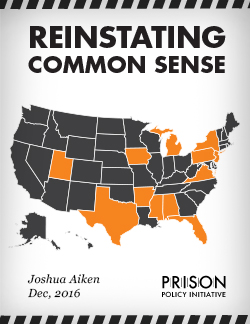 Reinstating Common Sense: How driver's license suspensions for drug offenses unrelated to driving are falling out of favor Prison Policy Initiative, December, 2016“Our criminal justice system should not set people up to fail. Yet that is exactly what mandatory driver's license suspensions do: they introduce new legal, economic, and social barriers for people who are in the midst of reentry.”
-
Connecticut Employer Survey Practices and Attitudes: The Hiring of Formerly-Incarcerated Persons and Recommendations for Driving Better Outcomes Malta Justice Initiative Inc., December, 2016“4 in 10 respondents have no experience in hiring ex-offenders and a quarter say their company has a policy against it. Very few (3%) are actively hiring individuals with a criminal record.”
-
Beyond Bars: Keeping Young People Safe at Home and Out of Youth Prisons The National Collaboration for Youth, December, 2016“The youth prison is the signature feature of nearly every state juvenile justice system even though it is harmful, ineffective and expensive.”
-
Mass incarceration and children's outcomes: Criminal Justice Policy is Education Policy Economic Policy Institute, December, 2016“It is more common for children of incarcerated parents to drop out of school than it is for children of nonincarcerated parents, controlling for race, IQ, home quality, poverty status, and mother’s education.”
-
The Geography of Incarceration: Boston Indicators Project, MassINC, and the Massachusetts Criminal Justice Reform Coalition, November, 2016“Many people of color live in Boston neighborhoods with such highly concentrated rates of incarceration that nearly every street—in some cases every other building— contains a resident who has been incarcerated.”
-
Coming Home: An Evaluation of the New York City Housing Authority's Family Reentry Pilot Program Vera Institute of Justice, November, 2016“The study revealed that participants reuniting with their families both received support and supported others as they took on familial roles, especially as caregivers for elderly parents.”
-
Common Ground: How all of Oregon Contributes to Criminal Justice Reform Vera Institute of Justice, November, 2016“This brief describes how the state of Oregon worked together with its local community and government partners to address its growing prison population.”
-
We are not disposable: The Toxic Impacts of Prisons and Jails Californians United for a Responsible Budget, October, 2016“Pollution and environmental degradation created by prisons and jails exacerbate public health risks for not only incarcerated people but also for the local communities where detention facilities are sited.”
-
Remote Access: Using Video Technology to Treat Substance Users on Probation and Parole in South Dakota Vera Institute of Justice, October, 2016“The state worked with local providers to pilot a teleconferencing program aimed at connecting people to community-based services without the cost and barrier of transportation or other access issues.”
-
Bridging the Divide: Improving Parole Outcomes for Native Americans in South Dakota Vera Institute of Justice, October, 2016“This brief describes the issues that tribal communities face and how they are working together with the state government to provide effective services for Native American people on parole.”
-
Ban The Box In Employment: A Grassroots History All Of Us or None (Legal Services for Prisoners With Children), October, 2016“Today, between all of the states and localities that have Ban the Box, over 185 million Americans now live in areas that have adopted fair chance hiring policies.”
-
The Future of Youth Justice: A Community-Based Alternative to the Youth Prison Model Patrick McCarthy, Vincent Schiraldi, and Miriam Shark, October, 2016“Closing these failed institutions requires a clear-headed, common-sense, bipartisan policy approach, and a commitment to replace these facilities with effective alternatives that are already available.”
-
A Wealth of Inequalities: Mass Incarceration, Employment, and Racial Disparities in U.S. Household Wealth, 1996 to 2011 Bryan L. Sykes, University of Washington and Michelle Maroto, University of Alberta, October, 2016“[A] non-Hispanic white household with an institutionalized member would actually hold more in assets than an otherwise similar black or Hispanic household without an institutionalized member.”
-
Police Violence and Citizen Crime Reporting in the Black Community Professor Matthew Desmond, Harvard University; Professor Andrew Papachristos, Yale University; Professor David Kirk, University of Oxford, September, 2016“This study shows that publicized cases of police violence against unarmed black men have a clear and significant impact on citizen crime reporting.”
-
New Orleans: Who's in Jail and Why? Vera Institute of Justice, August, 2016“This report aims to advance an important public conversation about how we are using our jail and how it impacts safety in our city.”
-
Investigation of the Baltimore City Police Department U.S. Department of Justice Civil Rights Division, August, 2016“[T]he Department of Justice concludes that there is reasonable cause to believe that BPD engages in a pattern or practice of conduct that violates the Constitution or federal law.”
-
Missouri Policy Shortens Probation and Parole Terms, Protects Public Safety The Pew Charitable Trusts, August, 2016“Three years of data show that the earned compliance credit policy significantly reduced the state’s supervised population without jeopardizing public safety.”
-
Profit-Driven Prosecution and the Competitive Bidding Process J. Reuben Clark Law School, Brigham Young University, August, 2016“This Article sheds light on the problems caused by introducing an overtly economic calculation (how cheaply and how profitably the prosecutorial function may be fulfilled) into the criminal adjudicative process.”
-
The Long Road Home: Decreasing Barriers to Public Housing for People with Criminal Records Human Impact Partners, May, 2016(This report assesses the health and equity impacts of public housing admissions screening policies that exclude people with a criminal history from public housing, using the Oakland Housing Authority (OHA) in Oakland, California as a case study.)
-
Stopped, Fined, Arrested: Racial Bias in Policing and Traffic Courts in California Back on the Road California, April, 2016“[T]here are dramatic racial and socioeconomic disparities in driver’s license suspensions and arrests related to unpaid traffic fines and fees.”
-
Forfeiting the American Dream: How Civil Asset Forfeiture Exacerbates Hardship for Low-income Communities and Communities of Color Center for American Progress, April, 2016“The abuse of civil asset forfeiture falls hardest on those who are least able to weather the economic shock of losing a home, car, or financial resources—namely, low-income individuals and people of color.”
-
A Shared Sentence: the devastating toll of parental incarceration on kids, families and communities The Annie E. Casey Foundation, April, 2016“Nationally, the number of kids who have had a parent in jail or prison at some point in their childhood hovers around 5.1 million - a conservative estimate.”
-
Unlicensed & Untapped: Removing Barriers to State Occupational Licenses for People with Records National Employment Law Project, April, 2016“[H]aving a conviction record, particularly for people of color, is a major barrier to participation in the labor market.”
-
Economic Perspectives on Incarceration and the Criminal Justice System White House Council of Economic Advisers, April, 2016“[E]conomics can provide a valuable lens for evaluating the costs and benefits of criminal justice policy.”
-
Multi-Site Family Study on Incarceration, Parenting, and Partnering Assistant Secretary for Planning and Evaluation, U.S. Department of Health and Human Services, March, 2016“Fathers with younger children rated their parental warmth and their relationship quality with their children more highly than did fathers of older children, and they also engaged in more activities with their children.”
-
Children, Parents, and Incarceration: Descriptive Overview of Data from Alameda and San Francisco County Jails Alameda County Children of Incarcerated Parents Partnership; San Francisco Children of Incarcerated Parents Partnership, March, 2016“The survey was structured to gather information to inform program and policy decisions in consideration of the children’s well-being when their parents become incarcerated in local jails.”
-
Is Proposition 47 to Blame for California's 2015 Increase in Urban Crime? Center on Juvenile and Criminal Justice, March, 2016“There are no obvious effects associated with Proposition 47 that would be expected if the reform had a significant and consistent impact on crime.”
-
Criminal (In)justice: A Cost Analysis of Wrongful Convictions, Errors, and Failed Prosecutions in California's Criminal Justice System The Chief Justice Earl Warren Institute on Law and Social Policy, Berkeley School of Law, March, 2016“Criminal (In)justice examines 692 adult felony criminal cases where California missed the mark in public safety by failing to prosecute the right person or by pursuing a flawed or unsustainable conviction.”
-
Roadblock to Economic Independence: How Driver's License Suspension Policies in Indiana Impede Self-Sufficiency, Burden State Government... Health and Human Rights Clinic, Indiana University Robert H. McKinney School of Law, February, 2016“Beside the cost to individuals, driver’s license suspensions significantly impact employers, government resources, and public safety.”
-
Charging the Poor: Criminal Justice Debt & Modern-Day Debtors' Prisons Texas A&M University - School of Law, December, 2015“[M]y Article proposes eliminating egregious sanctions, providing courts flexibility to base fines on earning levels, and establishing procedures to enforce restrictions against incarcerating those who are truly unable to pay their criminal justice debt.”
-
Who Pays? The True Cost of Incarceration on Families Ella Baker Center for Human Rights; Forward Together; Research Action Design, September, 2015“Forty-eight percent of families in our survey overall were unable to afford the costs associated with a conviction, while among poor families (making less than $15,000 per year), 58% were unable to afford these costs.”
-
Public Housing for People with Criminal Histories Vera Institute of Justice, September, 2015“Cities such as New York City, Oakland, and Chicago have implemented reforms in tenant-selection criteria that ensure a person’s application for housing is not negatively impacted by his or her criminal record.”
-
Evaluation of the Los Angeles Gang Reduction and Youth Development Program: Year 4 Evaluation Report Urban Institute, September, 2015“The analyses presented in this report address GRYD’s efforts to impact gang violence at the individual, family, and community levels, paralleling the GRYD program components targeting each of these levels.”
-
Adult Sex Offender Management Office of Sex Offender Sentencing, Monitoring, Apprehending, Registering, and Tracking, July, 2015“This brief has focused on the effectiveness of a number of prominent sex offender management strategies, including specialized supervision, COSA, polygraph, GPS, civil commitment, SORN, and residence restrictions.”
-
Turning on the TAP: How Returning Access to Tuition Assistance for Incarcerated People Improves the Health of New Yorkers Human Impact Partners, May, 2015“Expanding access to college education for people in New York prisons would benefit the overall health and well-being of the communities that formerly incarcerated people return to, as well as the individuals who receive the education, and their families.”
-
Pretrial Release in California Public Policy Institute of California, May, 2015“This report uses newly available data to provide information about pretrial release in California and to give policymakers a better understanding of the defendants who tend to be released and the form of release they secure.”
-
Arrests as Regulation Eisha Jain, April, 2015“When noncriminal justice actors rely on arrests (as proxies for information they value), they set off a complicated and poorly understood web of interactions with the criminal justice system.”
-
Not Just a Ferguson Problem: How Traffic Courts Drive Inequality in California Lawyers' Committee for Civil Rights of the San Francisco Bay Area, March, 2015“As a result, over four million Californians do not have valid driver’s licenses because they cannot afford to pay traffic fines and fees.”
-
Breaking the Cycle: Interrupting Generational Incarceration in Maine Place Matters Maine, 2015“Black or African American and Native American or Indigenous children are disproportionately affected by parental incarceration in Maine.”
-
A Never-Ending Sentence: The Impact of Criminal Conviction in Project-Based Section 8 Housing Tenant Selection Plans in Cuyahoga County Reentry Housing Workgroup of the Cleveland Reentry Strategy Coalition, 2015“The review of [Tenant Selection Plans] shows that criminal convictions, even from misdemeanors, have a long-term impact on access to Project-Based Section 8 Housing in Cuyahoga County”
-
Driving on Empty: Florida's Counterproductive and Costly Driver's License Suspension Practices Fines & Fees Justice Center, 2015“Between 2015-2017, more than 3.5 million suspension notices were issued for unpaid court debt.”
-
Bridging the Divide: A new paradigm for addressing safety, crime, and victimization Equal Justice USA, November, 2014“There is a growing movement to confront the false choice between meeting the needs of crime victims and reforming failed criminal justice and corrections policies.”
-
On Life Support: Public Health in the Age of Mass Incarceration Vera Institute of Justice, November, 2014(Research in epidemiology indicates that had the U.S. incarceration rate remained at its 1973 level, then the infant mortality rate would have been 7.8% lower than it was in 2003, and disparity between black and white infant deaths nearly 15% lower.)
-
Criminal, Victim, or Worker?: The Effects of New York's Human Trafficking Intervention Courts on Adults Charged with Prostitution-Related Offenses Red Umbrella Project, October, 2014(Decreasing the incarceration of people charged with prostitution is a good step forward, but as long as people who are in the sex trades are "rescued" through arrest, they will continue to be re-victimized by the police and the courts.)
-
Public Safety - Municipal Courts Better Together, October, 2014“This means that the municipal courts in the St. Louis region accounted for 46% of all fines and fees collected statewide, despite being home to only 22% of Missourians.”
-
Socio-emotional Impact of Violent Crime Bureau of Justice Statistics, September, 2014“Overall, 68% of victims of serious violence experienced socio-emotional problems as a result of their victimization.”
-
Close-Range Gunfire around DC Schools Urban Institute, September, 2014“Fifty-four percent of DC schools covered by gunfire-detection technology had at least one burst of gunfire occur within 1,000 feet of the school.”
-
Rehabilitating Corrections in California: The Health Impacts of Proposition 47 Human Impact Partners, September, 2014“The key to achieving the full benefits of sentencing reform is funding and implementation of the treatment, prevention, and recovery services called for in the initiative.”
-
Violent Victimization In New And Established Hispanic Areas, 2007-2010 Bureau of Justice Statistics, August, 2014“From 2007 to 2010, new Hispanic areas had a lower overall rate of violent victimization compared to small Hispanic areas that had relatively little growth in Hispanic populations.”
-
Latino Voices: The Impacts of Crime and Criminal Justice Policies on Latinos Californians for Safety and Justice, June, 2014“...the data that does exist — specifically research on Latino victimization rates and their treatment in the justice system — paints a troubling picture of”
-
Predicting Crime through Incarceration: The Impact of Rates of Prison Cycling On Rates of Crime in Communities National Institute of Justice, May, 2014(The study found strong support for the impact of prison cycling on neighborhood crime rates, i.e., when resident removal rates due to incarceration were high, crime rates decreased; when reentry rates were high in a neighborhood, the crime rate increased.)
-
Ten Economic Facts about Crime and Incarceration in the United States The Hamilton Project, May, 2014(The high incarceration rate can have profound effects on society; research has shown that incarceration may impede employment and marriage prospects, increase poverty and behavioral problems among children, and amplify the spread of communicable diseases.)
 Breaking Down Mass Incarceration in the 2010 Census State-by-State Incarceration Rates by Race/Ethnicity Prison Policy Initiative, May, 2014“It is imperative that we are able to measure the extent to which the criminal justice system disparately impacts our communities.”
-
Stakeholders' Views on the Movement to Reduce Youth Incarceration National Council on Crime and Delinquency, April, 2014“From June 2012 through June 2013, NCCD asked juvenile justice stakeholders to describe how youth incarceration was reduced in their jurisdictions.”
-
Criminal Justice Consensus Cost-Benefit Working Group Vermont Center for Justice Research, April, 2014“The State of Vermont needs to reinvigorate its commitment to supporting evidence-based programming in criminal and juvenile justice.”
-
Estimating the Size and Structure of the Underground Commercial Sex Economy Urban Institute, March, 2014“The goals of this study were to: (1) derive a more rigorous estimate of the underground commercial sex economy (UCSE) in eight major US cities and (2) provide an understanding of the structure of this underground economy. To date, no reliable data exist..”
-
Impact of opioid substitution therapy on mortality postrelease from prison: retrospective data linkage study National Drug and Alcohol Research Centre, February, 2014“In New South Wales, Australia, opioid substitution therapy in prison and post-release appears to reduce mortality risk in the immediate post-release period.”
-
Voices from the Field: How California Stakeholders View Public Safety Realignment Stanford Criminal Justice Center, January, 2014“What is the result of California's great prison experiment? Even after conducting 125 interviews with agencies across California, it remains a challenge to adequately summarize the changes that Realignment (AB 109) has wrought across the state.”
-
Neither here nor there: Incarceration and family instability Kristin Turney, University of California, Irvine, January, 2014“[F]indings suggest that, regardless of level of relationship commitment, maintaining relationships while one partner is behind bars is difficult.”
-
Redefining Relationships: Explaining the Countervailing Consequences of Paternal Incarceration for Parenting Turney, Kristen, January, 2014“In this paper, we consider the countervailing consequences of paternal incarceration for a host of family relationships, including fathers' parenting, mothers' parenting, and the relationship between parents.”
-
Justice in Washing State Survey, 2012 Revised and Updated 2014 The Washington State Minority Health Commission, The Washington State Center for Court Research, 2014“When we asked about their personal encounters with police officers and the courts, we found substantial differences between Whites and African Americans in terms of the frequency of negative encounters.”
-
Virginia's Justice System: Expensive, Ineffective, and Unfair Justice Policy Institute, November, 2013“Despite some recent small progress in the areas of post-incarceration reentry, particularly felony disenfranchisement, the state continues to suffer under misguided policies and practices of the past.”
-
A Lifetime of Punishment: The Impact of the Felony Drug Ban on Welfare Benefits The Sentencing Project, November, 2013“... there is little reason to believe that barring individuals with felony drug convictions from receiving welfare benefits deters drug use or crime.”
-
Wanted: Accurate FBI Background Checks for Employment National Employment Law Project, July, 2013“About 1.8 million workers a year are subject to FBI background checks that include faulty or incomplete information. 600,000 of those workers may be prejudiced in their job search when reports do not include up-to-date/accurate information.”
-
Impact of Realignment on County Jail Populations Public Policy Institute of California, June, 2013“Between June 2011 and June 2012, the state prison population declined by 26,600 inmates. Concurrently, California's county average daily jail population grew by about 8,600 inmates...”
-
Children with Incarcerated Parents - Considering Children's Outcomes in the Context of Family Experiences University of Minnesota, June, 2013“Given the potential long-term consequences of parental incarceration for child and adult health, targeted, evidence-informed prevention and intervention efforts are sorely needed.”
 Please Deposit All of Your Money: Kickbacks, Rates, and Hidden Fees in the Jail Phone Industry Prison Policy Initiative, May, 2013“This report is the first to address in depth the many fees prison phone customers must pay. Fees have an enormous impact on prison phone bills, making up 38% of the $1 billion annual price of calling home.”
-
Fostering Change: How investing in D.C.'s child welfare system can keep kids out of the prison pipeline Justice Policy Institute, April, 2013“In 2010, parental incarceration surpassed parental substance abuse as the third highest reason for District children entering care, and in 2010, one in every six kids entering foster care had an incarcerated parent.”
-
Operation Ghetto Storm Malcolm X Grassroots Movement, April, 2013“There is no centralized database that keeps track of extrajudicial killings by police... With no numbers, there can be no studies, no analysis of trends and no accountability.”
-
Communities, Evictions & Criminal Convictions Public Housing and Disparate Impact: A Model Policy Formerly Incarcerated & Convicted People's Movement, April, 2013“The focus of this report is to isolate and clarify one element of housing discrimination: excluding people with criminal records, and their whole families, from public housing.”
-
The Dose-Response of Time Served in Prison on Mortality: New York State, 1989-2003 Evelyn J. Patterson, University of Vanderbilt, March, 2013“After controlling for a variety of demographic and offense-related factors...each year in prison increased the odds of death by 15.6% in this 1989 to 1993 parole cohort...an increased odds of death of 78% for somebody who spent 5 years in prison.”
-
Beyond Realignment: Counties' Large Disparities in Imprisonment Underlie Ongoing Prison Crisis Center on Juvenile and Criminal Justice, March, 2013“High-imprisonment, state-dependent jurisdictions consume excessive prison space, contribute to overcrowding and lawsuits, and create higher state taxpayer liabilities than do low-imprisonment, self-reliant counties that manage more offenders locally.”
-
Blueprint for a Public Health and Safety Approach to Drug Policy New York Academy of Medicine and the Drug Policy Alliance, March, 2013“This report finds two clear themes: 1) structural issues (like income disparities, education, & opportunity) profoundly shape experiences of drug policies; 2) when problematic drug use does occur, our response should involve help instead of sanctions.”
-
"Picking up the Pieces": The Rights and Needs of Children and Families Affected by Imprisonment Irish Penal Reform Trust, November, 2012“Child impact statements would be one practical approach which would permit the voice of the child to be heard, as outlined under the United Nations Convention on the Rights of the Child (UNCRC), when considering putting a parent/parents into custody.”
-
Treatment Instead of Prison HIA (Case Story) Human Impact Partners, November, 2012“Expanding alternatives to incarceration would reduce the prison population, reduce crime, lower recidivism, and strengthen families by keeping up to 1,600 parents a year out of prison each year.”
-
Video Visits for Children Whose Parents Are Incarcerated In Whose Best Interest? Sentencing Project, October, 2012“Children may benefit from video visitation if it increases opportunities for them to communicate with their parents. But video visitation is not a substitute for in-person contact visits, particularly for infants and young children.”
-
The Affordable Care Act Implications for Public Safety and Corrections Populations Sentencing Project, September, 2012“The expansion of Medicaid means that states can essentially use federal Medicaid funds to increase treatment services that could reduce incarceration and recidivism and, in doing so, potentially lower associated local and state corrections expenditures.”
-
Supportive Housing for Returning Prisoners Outcomes and Impacts of the Returning Home-Ohio Pilot Project Urban Institute, August, 2012“The Returning Home-Ohio program resulted in clear reductions along several key recidivism measures while also increasing state‐billable service use; the latter outcome is arguably a benefit of program participation.”
-
Families and Reentry Unpacking How Social Support Matters Urban Institute, June, 2012“Our analysis [...] shows that while family members' reported that number of activities performed together increases significantly over time, as formerly incarcerated persons are in the community for longer the number of hardships [...] also increases.”
-
The Continuing Challenge of CORI Reform Implementing the Groundbreaking 2010 Massachusetts Law The Boston Foundation and The Crime and Justice Institute at CRJ, May, 2012“This report provides information about reactions to whether the implemented elements of the CORI reform law have had the intended impact, and what the public should expect going forward.”
-
Housing as a Platform for Formerly Incarcerated Persons Urban Institute, April, 2012“While housing for formerly incarcerated persons is a source of necessary shelter and residential stability, it can also serve as the literal and figurative foundation for successful reentry and reintegration for released adults.”
-
Public Housing transformation and Crime Making the Case for Responsible Relocation Urban Institute, April, 2012“Overall, our findings show that a substantial majority of neighborhoods [...] were able to absorb public housing relocation voucher households without any adverse effect on neighborhood conditions.”
-
Community Reentry After Prison Drug Treatment Learning from Sheridan Therapeutic Community Program participants Illinois Criminal Justice Information Authority, January, 2012“Younger participants engaged in criminal activity and relapsed sooner than older participants. Younger participants also reported being less engaged in the Sheridan program than older participants.”
-
Moving Beyond Sides The Power and Potential of a New Public Safety Policy Paradigm Partnership for Safety and Justice, December, 2011“The goal of the paper is to explore the untapped potential of a more holistic analysis and strategy that connects traditional criminal justice reform organizations with victim-oriented advocacy groups to work for progressive public safety policy.”
-
Rethinking the State-Local Relationship Public Policy Institute of California, August, 2011“The legislature has passed and Governor Jerry Brown has signed legislation (AB 109) to send roughly 30,000 prisoners to county jail rather than state prison.”
-
The Early Release of Prisoners And its Impact on Police Agencies and Communities in California Police Executive Research Forum, May, 2011“...there is research indicating that enforcement alone is ineffective in lowering recidivism rates, and in any case, prisons are far too expensive to be used as a default sanction for many criminal offenders.”
-
Misplaced Priorities Over Incarcerate, Under Educate NAACP, April, 2011“During the last two decades, as the criminal justice system came to assume a larger proportion of state discretionary dollars, state spending on prisons grew at six times the rate of state spending on higher education.”
-
Children on the Outside Voicing the Pain and Human Costs of Parental Incarceration Justice Strategies, January, 2011“Too often, society dismisses the children of incarcerated parents as future liabilities to public safety while overlooking opportunities to address the pain and trauma with which these children struggle.”
-
Communities Inmates Released to in 2009 Massachusetts Department of Correction, October, 2010“Massachusetts Department of Correction Releases to the Street 2009: Top Ten Release Address (Cities/Towns)”
-
Political Consequences of the Carceral State Political Consequences of the Carceral State, September, 2010“Encounters with criminal justice institutions can negatively affect perceptions of government, rates of political participation and engagement in civic life.”
-
Collateral Costs Incarceration's Effect on Economic Mobility Pew Charitable Trust, Economic Mobility Project, September, 2010“Serving time reduces hourly wages for men by approximately 11 percent, annual employment by 9 weeks and annual earnings by 40 percent.”
-
Incarceration and Social Inequality Bruce Western & Becky Pettit, August, 2010“The social inequality produced by mass incarceration is sizable and enduring for three reasons: it is invisible, it is cumulative, and it is intergenerational.”
-
Drawing Blood from Stones: Legal Debt and Social Inequality in the Contemporary United States Alexes Harris, Heather Evans, and Katherine Beckett, University of Washington, May, 2010“[F]indings suggest that monetary sanctions create long-term legal debt and significantly extend punishment's effects over time.”
-
Indicators of School Crime and Safety: 2009 Bureau of Justice Statistics, December, 2009“This annual report examines crime occurring in school as well as on the way to and from school. It... provides the most current detailed statistical information on the nature of crime in schools and school environments and responses to violence and crime.”
-
The Consequences of Dropping Out of High School Joblessness and Jailing for High School Dropouts and the High Cost for Taxpayers Center for Labor Market Studies, Northeastern University, October, 2009“Nearly 1 of every 10 young male high school dropouts was institutionalized on a given day in 2006-2007 versus fewer than 1 of 33 high school graduates.”
-
Fact Sheet on FY2010 Department of Justice Budget Justice Policy Institute, May, 2009(The Factsheet on 2010 Department of Justice Budget finds that the 2010 DOJ budget directs more money to law enforcement than prevention with the likely long-term outcome being increased arrests, incarceration, and money spent on corrections.)
-
Bearing Witness Baltimore City's Residents Give Voice to What's Needed to Fix the Criminal Justice System Justice Policy Institute, April, 2009(Bearing Witness captures the perspectives of the people of Baltimore City impacted by the criminal justice system and their suggestions for alternatives to addressing social problems.)
-
The Impact of Mass Incarceration on Poverty Crime and Delinquency, February, 2009“From an empirical standpoint, the results from the current analysis are quite clear; mass incarceration has played a major role in increasing poverty rates.”
-
A Report on the Collateral Consequences of Criminal Convictions in Maryland University of Maryland School of Law, 2009“Despite the lasting and sometimes permanent effects that collateral consequences impose upon ex-offenders and their families, no formal mechanism exists for defendants in Maryland, or any other state, to be informed of these consequences.”
-
Phantom Constituents in Tennessee's Boards of County Commissioners Prison Policy Initiative; Peter Wagner and JooHye DellaRocco, February, 2008“[This report] identifies 10 Tennessee counties in which the use of flawed Census data to draw county commissioner districts has created substantial inequities in political power within the counties.”
-
Parole, Desistance from Crime, and Community Integration (2007) National Research Council of the National Academies, July, 2007“[T]he first days and weeks out of prison are the riskiest for both releasees and the general public.”
-
DTAP (Drug Treatment Alternative-to-Prison) Sixteenth Annual Report Kings County (Brooklyn) District Attorney, April, 2007“In its sixteenth year of operation, DTAP continued to maintain high treatment retention and low recidivism rates and to produce enormous cost savings.”
-
The Housing Landscape for Returning Prisoners in the District Urban Institute, March, 2007“This report examines the housing landscape of prisoner reentry in the District of Columbia through an analysis of neighborhoods that had high rates of returning prisoners and a survey of housing-related providers.”
-
Informing and Engaging Communities Through Reentry Mapping Urban Institute, January, 2007“This brief is designed to equip organizations with strategies for effectively disseminating local reentry-related mapping and analysis findings and engaging community members on the topic of reentry.”
-
Reducing the Incarceration of Women: Community-Based Alternatives National Council on Crime and Delinquency, December, 2006“Typically nonviolent low-level offenders, women have been hit particularly hard by California's sentencing and correctional policies and practices.”
-
Incarceration as Forced Migration: Effects on Selected Community Health Outcomes James C. Thomas and Elizabeth Torrone, October, 2006“High rates of incarceration can have the unintended consequence of destabilizing communities and contributing to adverse health outcomes.”
-
Cleveland Prisoners' Experiences Returning Home Urban Institute, September, 2006“This research brief is intended to serve as a foundation for policy discussions about how released prisoners can successfully reintegrate into their communities, whether in Cleveland or in similar cities around the country.”
-
Community Survey on Public Safety National Council on Crime and Delinquency, June, 2006“Forty-three percent (43.8%) of survey respondents report feeling somewhat unsafe or unsafe in their neighborhood.”
-
The Collateral Effects of Incarceration on Fathers, Families, and Communities Council on Crime and Justice, April, 2006“Incarcerating large numbers of men from one community is seen as a threat to both individual and community economic stability.”
-
Community Residents' Perceptions of Prisoner Reentry in Selected Cleveland Urban Institute, March, 2006“This report presents findings from community focus group discussions in three Cleveland neighborhoods that are home to a large number of returning prisoners.”
-
Chicago Communities and Prisoner Reentry Urban Institute, September, 2005
-
Chicago Prisoners' Experiences Returning Home Urban Institute, December, 2004“We present key findings on a range of reentry challenges and describe the factors related to postrelease success or failure[.]”
-
When Violence Hits Home: How Economics and Neighborhood Play a Role National Institute of Justice, September, 2004
-
Reforming California's Youth and Adult Correctional System Corrections Independent Review Panel, July, 2004
-
Prisoner Reentry and Community Policing: Strategies for Enhancing Public Safety Urban Institute, May, 2004
-
Borrowing Against the Future: The Impact of Prison Expansion on Arizona Families, Schools and Communities Grassroots Leadership and Arizona Advocacy Network, April, 2003
-
The Vicious Circle: Race, Prison, Jobs and Community in Chicago, Illinois, and the Nation Chicago Urban League, 2002
-
Trading Classrooms for Cellblocks: Destructive Policies Eroding DC Communities Justice Policy Institute, March, 1997
-
Crime and Neighborhoods Bureau of Justice Statistics, June, 1994“compares victimization levels and perceptions of neighborhood crime”
Pages Updated On: 25-Apr-2024 - 17:04:12
Links Engine 2.0 By: Gossamer Threads Inc.


