Phones archives

Peter and Leah wrote a new Huffington Post piece about the start of the FCC's inter-state prison phone rate regulation on Tuesday.

by Leah Sakala, February 13, 2014

To celebrate the FCC’s inter-state prison phone call charge regulation going into effect on Tuesday (just in time for Valentine’s Day!), Peter and I wrote a new piece for the Huffington Post.

The FCC’s regulation is a huge milestone in the decade-long fight for fair phone charges for the families of incarcerated people, and there’s lots more to be done. As we wrote:

…the fight for fair phone charges is one that the families of the 12 million people cycling through jails each year can’t afford to lose. Interstate rate regulation was a huge step forward that must now be defended in court, and the FCC and state and local governments need to keep going in order to protect all families, regardless of whether their loved ones are incarcerated in the same state or elsewhere. Our movement is strong, and we’re committed to ensuring that all parents, partners, and kids can afford to affirm their love for one another over the phone next Valentine’s Day.

We also spoke with American Public Media’s Marketplace yesterday for a story on the FCC’s prison phone regulation.

For more on what this regulation means for families and friends, check out the Campaign for Prison Phone Justice’s great new FAQ.


The two largest prison phone companies, mislead correctional facilities and federal regulators by acting like communications technology is stuck in the 1950s.

by Peter Wagner, February 11, 2014

Today is a historic day: the Federal Communications Commission’s new rules take effect that cap the cost for inter-state calls home from prison and jail at a still-expensive but much-improved rate of 21 to 25 cents per minute. The FCC is exploring expanding its regulation to apply to the bulk of calls which are in-state in nature, and other important proposed restrictions have been stayed by the federal courts while prison telephone giants like Securus and its corporate allies sue the federal government for daring to end the industry’s monopolist price gouging.

As we’ve demonstrated in several lengthy reports and filings to the FCC, the high cost of phone calls from prison is driven by a kickback system in which private companies get monopoly contracts in exchange for sharing the majority of the revenue with the same correctional agency that awarded the contract.

So while Securus sues to protect its windfall profits off the backs of families, I’d like to point out just how far out of step rates like $1/minute are in a world of modern electronic communications.

Contrary to what the phone companies would have you believe, important security technology isn’t what’s driving the cost of these calls. In fact, a call home from New York State prisons costs 4.8 cents a minute because that state refuses kickbacks and negotiates the contract on the basis of the lowest cost to the consumer. But the very same company charges close to $1/minute in other states. As we’ve said again and again, it’s all about the profit.

But aside from the contemporary arbitrariness of the charges in this industry, taking a look at the historical perspective sheds some additional light on why the FCC has to drag this industry kicking and screaming into the 21st century. You see, Securus and Global Tel*Link, the two largest prison phone companies, mislead correctional facilities and federal regulators by acting like it’s still the 1950s, when transmitting a long-distance call was a deeply expensive and laborious manual process.
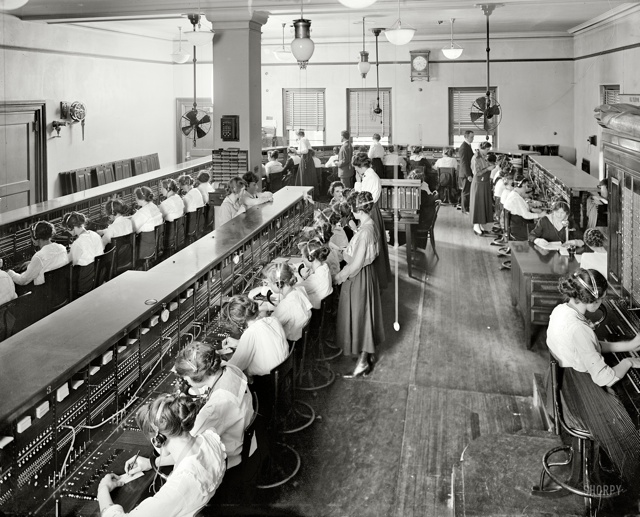
room with phone operators in 1919 Why do most prison and jail phone contracts assume that a long distance call requires an army of telephone operators like the ones in this photo from 1919?

The phone companies profit by pretending it’s the 1950s.

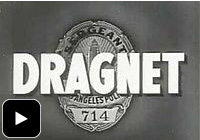
Dragnet audio clip Download (1.5MB, 1:30)

Check out this radio dramatization from Dragnet of a long distance call in 1954. That tedious 1 minute 22 second process wasn’t much better than the very first inter-continental telephone call in 1919, which took 5 operators 23 minutes to connect Alexander Graham Bell with his former assistant Thomas Watson. Fortunately technology has vastly improved since then, and these days prison and jail telephone companies sell digital communications products for which distance is simply not a factor. These companies know, however, that it’s in their best interest to leave sheriffs in the dark about these 21st century technological advances. With the possible exception of some of the smaller companies that are pushing one-size-fits-all “postalized” rates, the phone corporations don’t appear to be lifting a finger to educate the sheriffs about the real cost of the telephone services being contracted.

The industry’s lack of transparency about the actual cost of providing telephone service is quite similar to its practice of hiding fees, which we discussed in detail in our second report. Essentially, the phone industry rakes in additional profit by tacking on extra fees and hiding them from the commission system. As a result, the sheriffs are led to believe that they have negotiated a good deal with the phone company, but the hidden fees preserve far more profit for the industry than it lets on. That’s why our report included an appendix with questions that the sheriffs should ask about fees when negotiating these contracts.

So, at the end of the day, how far out of whack is a $1 a minute phone call? We did some research to figure out the last time a regular U.S. long distance phone call cost $1 per minute. Adjusting for inflation, a call hasn’t cost that much since 1950:
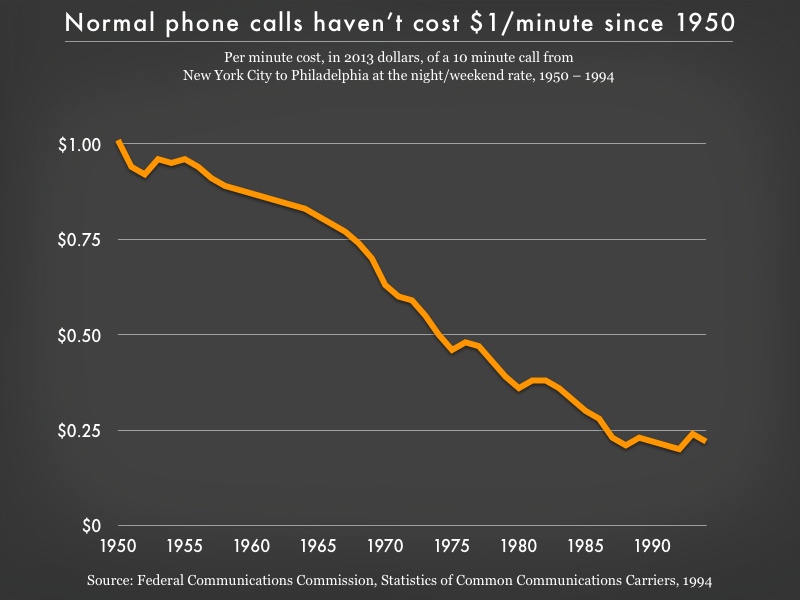
Long-distance phone call cost since 1950


We asked The New York Times consumer protection columnist the Haggler to investigate the broken prison phone industry. He did!

by Leah Sakala, February 3, 2014

New York Times thumbnail

We asked The New York Times consumer protection columnist David Segel (AKA “the Haggler”) to look into the outrageous charges that families are forced to pay to speak on the phone with incarcerated loved ones.

And he did! Peter’s letter and the Haggler’s investigation were printed in yesterday’s paper.


We submitted additional comments to the FCC confirming more kickbacks, and urging the FCC to keep protections in place for people in jail.

by Aleks Kajstura, January 15, 2014

The prison and jail phone industry has been busy recently, urging the Federal Communications Commission to roll back regulations and allow companies to charge exorbitant rates and fees for calls. Meanwhile, we’ve submitted a few comments of our own, highlighting bloated payment fees and showing that phone services in jails require regulation just like in the prisons.

Although we, and the FCC, have suspected that phone companies take a cut of the fees charged by third party payment services such as Western Union, we were finally able to confirm the practice. On Monday we submitted a comment that documents the kickbacks from Western Union.

The FCC also sought additional information on the differences between jails and prisons, and whether the new phone regulations should protect people from unconscionable prices no matter where they, or their family members, are incarcerated. We demonstrated the industry’s inability to articulate a good reason to roll back regulations of jail phone services, and we urged the FCC to continue its protection for people confined in jails.

We also signed on to -->


Court orders stay on some of the FCC's new prison phone regulations, but caps on call rates still go into effect on February 11th.

by Aleks Kajstura, January 14, 2014

Recently, prison phone companies took the FCC to court for the right to charge the families of incarcerated people exorbitant rates for talking to their loved ones in prison. (Securus Technologies v. FCC and United States of America (D.C. Cir. Docket No. 13-1280)). Yesterday, the U.S. Court of Appeals granted a partial stay of the FCC’s new prison phone regulations, but allowed the new rate caps to take effect on February 11.

Communications Daily reports that the Court

kept in place the interim rate cap of 21 cents per minute for debit and prepaid calls, and 25 cents a minute for collect calls. It put on hold three other sections of the FCC’s rules: the requirement that rates and ancillary services be “cost-based”; low safe-harbor rates that presume charges are reasonable; and the annual reporting requirement.

The article quotes Peter Wagner’s analysis of the order:

It is important that the court left intact the most important and immediate of the FCC’s reforms… [b]ut I’m disappointed that the court stayed three sections of the FCC’s order, including the section that reined in the fees….Those fees can double the price of a call…. With new fairer rates, Global Tel*Link will make far more from deposit fees than from multiple 15-minute calls.

Several FCC commissioners were also disappointed in the ruling, but optimistic. Chairman Tom Wheeler, Commissioner Mignon Clyburn, and Commissioner Jessica Rosenworcel issued a joint statement highlighting how even having the partial regulation remain in effect is still a significant stride toward more reasonable phone bills:

We are pleased that millions of families will finally see relief from outrageous rates for inmate calling services when the interim rate caps… go into effect in February 2014. These families have been forced to pay exorbitant rates for far too long. Although we are disappointed that the court granted a partial stay on other aspects of the Inmate Calling Services Order, we look forward to a hearing on the merits soon, and to adopting further reforms quickly.

We are among the organizations intervening in the lawsuit, stay tuned for updates!


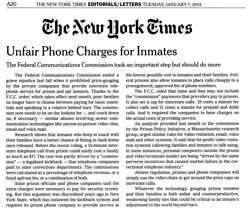
"…the Prison Policy Initiative, a Massachusetts research group, urged similar rules for video visitation, email, voice mail and other systems."

by Leah Sakala, January 7, 2014

New York Times thumbnail

Today the New York Times issued a strong editorial praising the Federal Communications Commission for acting to regulate inter-state prison phone call charges, and proclaiming:

The commission now needs to be on the lookout for — and crack down on, if necessary — similar abuses involving newer communication technologies like person-to-person video chat, email and voice mail.

The editorial cites our recent submission to the FCC detailing why it should keep an eye on the prison and jail video communication and email markets:

An analysis provided last month to the commission by the Prison Policy Initiative, a Massachusetts research group, urged similar rules for video visitation, email, voice mail and other systems. It said that for-profit video visitation systems (allowing families and inmates to talk using, in some instances, personal computers outside the prison and video terminals inside) are being “driven by the same perverse incentives that caused market failure in the correctional telephone industry.”

Absent regulation, prisons and phone companies will simply use the video chats to get around the price caps on interstate calls.

Whatever the technology, gouging prison inmates and their families is both unfair and counterproductive, weakening family ties that could be critical to an inmate’s adjustment to the world beyond bars.

If you’d like to weigh in, too, please do so on the FCC’s website before the current comment period closes on Monday, January 13.


Increasing the number of ways that families can stay in touch is a good thing. But allowing companies to exploit families and undercut the FCC's efforts to bring fairness to this industry is not.

by Leah Sakala, December 23, 2013

When the Federal Communications Commission approved its first regulation of the prison phone industry in August, the Commissioners put out a call for additional information on the rise of alternate forms of electronic communication in prisons and jails.

We just submitted a comment to the FCC detailing some of our disturbing findings about the burgeoning prison and jail video communications market, and urging the FCC to keep tabs on non-phone forms of communication in future rulings.

Here’s a summary of what we found (but check out the whole submission for examples and footnotes):

  1. Some jails are using video visitation, which is often fee-based, to replace, rather than supplement, free in person visits.
  2. Like the prison and jail phone industry, the video communication industry is rife with technical malfunctions and usability issues that need to be addressed.
  3. In many cases, video communication customers are subject to hefty fees and high rates, and a portion of the proceeds goes to site commissions. (Sound familiar?)
  4. FCC failure to regulate prison and jail video communication charges will leave this industry with a ready method to instantly circumvent FCC phone charge regulation simply by replacing facilities’ current telephones with video phones and labeling the verbal communications that take place as “video calls”. This would, of course, defeat the FCC’s mission to relieve families from having to pay astronomical phone bills.

We also noted that more and more correctional facilities are adopting email service, which has the similar potential to replace other critical forms of communication and carries similar risks of financial commission-fueled consumer abuse.

As our submission demonstrates, video visitation is here to stay. Increasing the number of ways that families can stay in touch is a good thing. But allowing companies to exploit families and undercut the FCC’s efforts to bring fairiness to this industry is not.


We're partnering with SumOfUs to collect petitions supporting the FCC's next steps in regulating the prison phone industry.

by Aleks Kajstura, December 4, 2013

We’re partnering with SumOfUs to help you take advantage of the Federal Communications Commission’s call for comments on its proposal to extend its new prison phone regulation to in-state calls.

Last year SumOfUs members submitted 36,690 petitions, which were cited in the FCC’s recent historic ruling capping the price of interstate calls, so their help — and yours will make a great difference for families who need to make in-state calls, which still remain unregulated!

Sign the petition today and please share with your networks so that the FCC hears us loud and clear by its December 13th deadline!


The FCC denies prison phone companies’ petitions to delay implementing fair rates, reiterating the need for regulation.

by Aleks Kajstura, November 26, 2013

Before the FCC’s new regulations lowering the price of calls home from prison even hit the Federal Register, the two largest prison phone companies (Securus and GTL) filed petitions to delay implementation of the new rules while they fight the regulations in court.

But the FCC isn’t backing down. The FCC denied the companies’ petitions, reiterating the need for regulation. Here are the highlights:

As the Commission stated in the Inmate Calling Report and Order and FNPRM, current interstate ICS rates are, in most cases, greatly above costs, and as such, “place an unreasonable burden on some of the most economically disadvantaged people in our nation.” The Commission noted that excessively high ICS rates “discourage communication between inmates and their families and larger support networks.” (¶ 48)

Section 201 of the Communications Act of 1934, as amended (Act) requires that all carriers’ interstate rates be just and reasonable. To be just and reasonable, rates must be related to the cost of providing service. Section 276 additionally requires that payphone rates be fair. Yet for many years, interstate ICS rates have been unreasonably high, unfair, and far in excess of the cost of providing service. Excessive rates have been driven largely by substantial commission payments ICS providers have agreed to make to prison authorities. The Commission relies in the first instance on competition when it can do so to ensure just and reasonable rates. In the Inmate Calling Report and Order and FNPRM the Commission found that “competition for ICS contracts may actually tend to increase the rate levels in ICS contract bids where site commission size is a factor in evaluating bids.” As such, the Commission found that the market forces in the interstate ICS market actually fail to constrain ICS rates. In fact, because the benefits of any “competition” in the ICS market ran to the facility rather than the inmate or their family (i.e., the party who actually paid for the service), rates in many cases were being driven higher. (¶ 3)

The Order also makes clear that regulating ancillary fees “was a necessary aspect of our cost-based reforms, as otherwise providers could simply increase their ancillary charges to offset lower rates subject to our caps.” (¶ 15)

Securus argues that it will suffer significant lost revenues under the new ICS rate regime. The new rules may reduce Securus’ revenue compared to pre-reform levels. But, to the extent that is true, it is because its current revenues are the product of unlawfully high rates. (¶ 35, emphasis added)

And on a technical note, the FCC points out Securus’ hypocrisy:

While Securus faults the Order for ignoring record evidence that the cost of serving some of its facilities is higher than the interim rate caps, Securus’ own cost study underscores the fact that averaged pricing is commonplace among ICS providers, as it is among communications providers generally. The Siwek Report shows that the rates Securus charges for the highest cost institutions fail to recover its self-identified costs of serving those institutions. It indicates that the average cost for “Low 10” group of institutions it serves is $1.71 per minute but that on average Securus charges only $1.10 per minute for calls from these same institutions. Securus does not contend that it is not profitable as a whole or that because its current rates do not cover the cost of serving its Low 10 facilities, it will be obliged to cease serving these locations. (¶ 27)


PPI submits letter to Alabama Public Service Commission supporting proposed regulations to reign in exorbitant costs jails and prison phone calls.

by Aleks Kajstura, November 14, 2013

The Alabama Public Service Commission is still seeking comments on a recent order proposing to cap all prison and jail call rates and place strict limits on fees and other charges (summarized here).

Yesterday, we submitted the following letter in support of the Commission’s proposed regulations:

November 13, 2013

Walter L. Thomas, Jr., Secretary
Alabama Public Service Commission
P.O. Box 304260
Montgomery, AL 36130

Dear Commissioners:

We are writing in support of your Order Proposing Revised Inmate Phone Service Rules (Oct. 7, 2013, Docket 15957).[1] As the Executive Director and Legal Director of the Prison Policy Initiative, we have investigated the high cost of calls from correctional facilities and would first like to thank you for addressing the issue of fees in your proposal.

We believe that regulating fees is an integral part of comprehensive regulation of prison and jail phone companies, and we commend Alabama for being the first state to, in our knowledge, directly address this major but hidden part of the industry.

Our research found that fees make up 38% of the $1 billion customers spend on prison and jail phone calls each year.[2] Your action to address fees is essential because simply capping rates would, as our report argues, be ineffective at protecting consumers if the industry was still free to continue to create additional fees out of thin air.

We agree with your conclusion that commissions paid to correctional facilities are ultimately to blame for both the high rates and fees charged by prison and jail phone companies. For that reason, the Prison Policy Initiative supports the proposed rules that would reign in both the exorbitant rates and fees now charged to Alabama consumers.

Sincerely,

Peter Wagner, Executive Director
Aleks Kajstura, Legal Director

[1]Our legal director, Aleks Kajstura, reviewed your proposal in light of our own findings on the high costs of prison and jail phone calls in “Alabama seeks to curb high cost of prison and jail phone calls” available at http://www.prisonpolicy.org/blog/2013/10/09/alabama-proposes/.

[2] Please Deposit All of Your Money: Kickbacks, Rates, and Hidden Fees in the Jail Phone Industry, by Drew Kukorowski, Peter Wagner, and Leah Sakala (May 8, 2013), available at http://www.prisonpolicy.org/phones/pleasedeposit.html and attached.

The deadline for submitting comments is December 6, 2013.


Stay Informed


Get the latest updates:


Share on 𝕏 Donate