Hiding in Plain Sight: How local jails obscure and facilitate mass deportation under Trump
The Trump Administration’s mass arrest and deportation agenda is made possible by federal prosecutors, but they generally need the collaboration of local jails. Until this report, the actual scope of this collaboration — and the true scale of immigrant arrests and detentions — has not been publicly available.
By Jacob Kang-Brown
July 2025
Press release
Note: In December 2025, we released a briefing that provides updated data on the role of jails in the Trump administration's deportation agenda. That data and analysis does not replace the analysis in this report, but rather provides additional context that you may find useful.
- Table of Contents
- Local jails provide ICE with detention space and people to arrest
- Arrests at local jails
- Detention at local jails
- Many more people are in detention for immigration reasons than appear in ICE data alone
- Crimmigration has escalated quickly
- State and local policy can serve as bulwarks
- Local communities have significant power in the face of Trump’s agenda
- Opportunities to refuse collaboration
- Florida’s extreme model
- Conclusion
- Appendices
- Methodology
- Conclusion
- Local jails provide ICE with detention space and people to arrest
- Arrests at local jails
- Detention at local jails
- Many more people are in detention for immigration reasons than appear in ICE data alone
- Crimmigration has escalated quickly
- State and local policy can serve as bulwarks
- Local communities have significant power in the face of Trump’s agenda
- Opportunities to refuse collaboration
- Conclusion
- Appendices
- Methodology
Get our latest data & analysis in your inbox!
Local jails have become an essential part of implementing President Trump’s mass arrest and deportation agenda. That’s because in most states, local jails are the only facilities available for holding people arrested by Immigration and Customs Enforcement (ICE) and the U.S. Marshals Service — the agency responsible for handling the pretrial detention of people facing federal criminal charges.
This essential collaboration between local jails and federal agencies has helped the Trump administration overcome resistance to mass deportation.1 Immigration rights advocates have long sought “sanctuary” policies that limit collaboration with federal immigration authorities by restricting counties’ ability to contract with ICE or by otherwise eliminating ICE detention facilities in their state.2 Yet the Trump administration’s prosecution priorities have created a situation in which every county with a U.S. Marshals contract is effectively signed up for his mass detention and deportation agenda regardless of whether they have sanctuary policies on their books.3 That’s because of a longstanding loophole: ICE and other federal agencies can refer people for federal prosecution on immigration-related “crimes”4 and thus use contracted local jails in sanctuary cities, counties, and states. In doing so, the Trump administration is transforming what are normally civil immigration matters into more serious federal crimes. This shift hides the true scale of immigrant detention from public view, which is often reported as only those in ICE custody and does not include those facing criminal prosecution.
While ICE detention data recorded 57,200 people on average in June 2025, a broader count of people detained shows the overall crimmigration system is 45% larger, at around 83,400 people.5 This conservative estimate is likely an undercount, meaning far more immigrants are in detention than previously understood. The vast majority of the people detained off of ICE’s books are being held in order to face the onslaught of criminal immigration charges described above.6

Beyond obscuring the scale of immigrant detention, this tactic has serious consequences for people ensnared in the system. Federal prosecutors can threaten people arrested by ICE with federal charges carrying years in prison and large fines, discouraging immigrants from making asylum claims or asserting their rights and securing due process in immigration court.7 This threat is similar to the well-known “trial penalty” in the criminal legal system that forces people to plead guilty in cases that they might otherwise win because the sentence at trial would potentially be three times the length of the plea offer. In the immigration context, the threat of federal criminal prosecution effectively coerces people into compliance and speeds up the racist deportation machine.

How many people have actually been swept into detention for immigration-related crimes? How have arrests and detention under ICE and the U.S. Marshals changed since Trump returned to office? And how many people are now serving sentences in federal prison for what once would have been handled as civil matters? To answer these questions, we analyzed ICE arrest data compiled by the Deportation Data Project and obtained previously unreported data on the U.S. Marshals to shine a light on how mass arrests have been carried out in the opening months of the Trump administration.8 We found that tens of thousands of people arrested by ICE or other federal police were transferred into the federal criminal detention system under trumped-up immigration-related charges in the first five months of 2025.9 The data (which we are publishing in appendix tables accompanying this report) also provide a fuller picture of how and where local law enforcement get involved in ICE detention and the criminalization of immigration. In the end, we argue that those who want to end federal raids in their community should work to limit all federal access to local jails.
Get our latest data & analysis in your inbox!
Local jails provide ICE with detention space and people to arrest
Since Trump returned to office, ICE has heavily relied on local jails to carry out immigration enforcement in two main ways: (1) ICE arrests people after they’ve been booked into custody by local law enforcement, and (2) ICE relies on the renting of jail space on a flexible, contract basis10 to hold people with immigration cases. However, sanctuary policies have constrained the number of jails that can collaborate with immigration authorities. In response, the federal government has sought to get around these limitations by outright criminalizing immigrants instead.

At first glance it may appear that arresting people out of jails is proof that Trump is fulfilling his promise to target “criminals” for deportations, but minor traffic violations or driving without a license are all that ICE needs to make an arrest. And in general, most people in jails have not been convicted of a crime: Over 80% of people in jails have not been convicted and are legally presumed innocent. Additionally, most are held for low-level offenses like loitering and public intoxication, not violent crimes.
ICE arrests at local jails
A large share of ICE arrests rely on collaborations with local law enforcement. According to our analysis of ICE arrest data from January 20 to June 26, 2025, 45% of all ICE arrests were transfers from local jails.
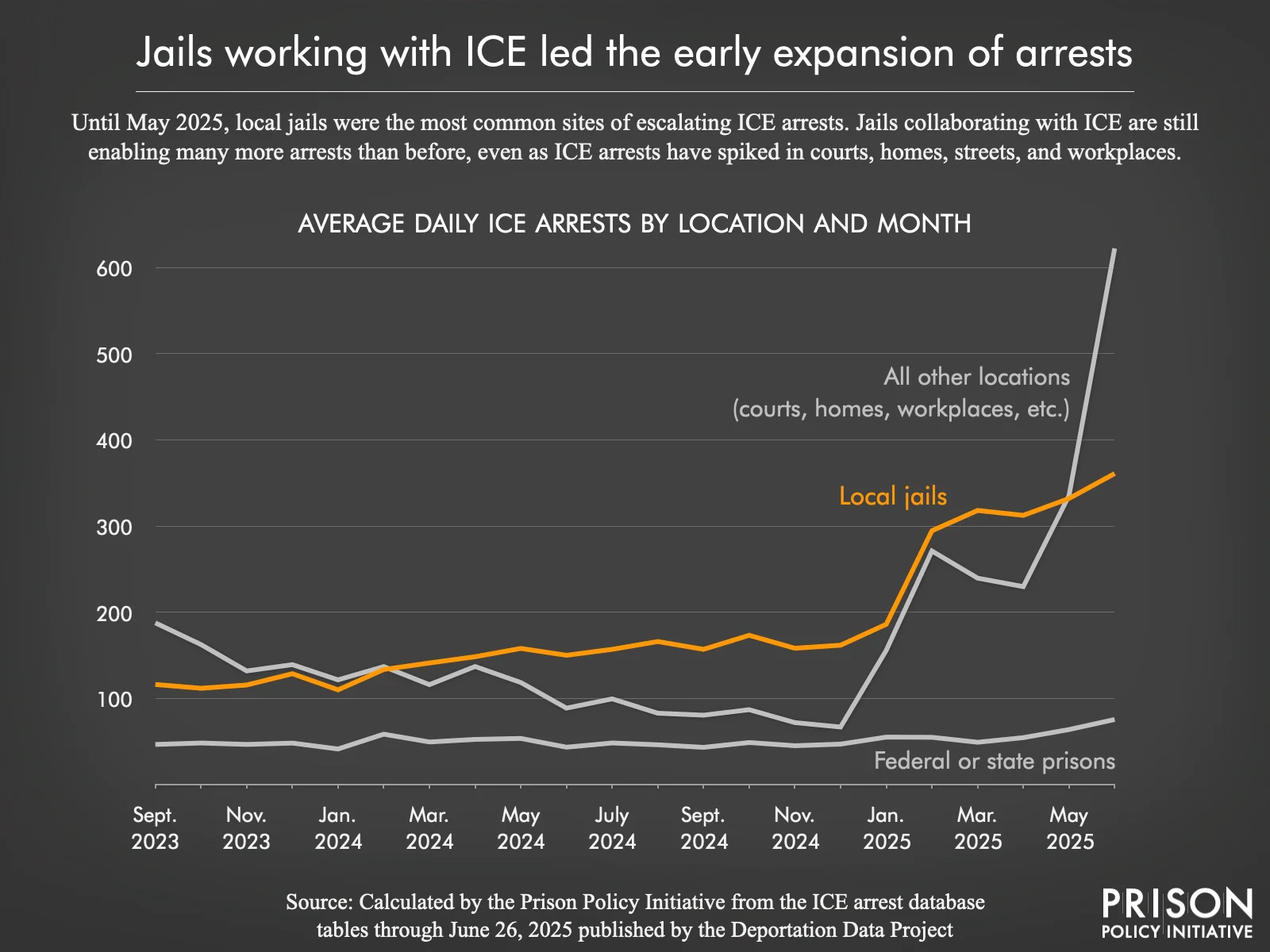
Federal laws incentivize local law enforcement to act as jailers on the behalf of immigration authorities.11 Sometimes this takes the form of 287(g) agreements that essentially deputize local law enforcement to enforce immigration laws for ICE, but these agreements are not necessary for ICE to request jail “holds” or make arrests at local jails. Some states limit this collaboration with immigration authorities while other states have sought to make it mandatory.12 In most states, these jail collaborations are essential for ICE arrests. These arrests frequently occur after local police stop people for traffic offenses like driving without a license — offenses that would typically incur a fine for a U.S. citizen but are used to criminalize drivers without valid paperwork.13 Additionally, they often involve people who have only been accused (but not convicted) of crimes. Those who have previously been convicted often have a low-level criminal history.14 Of course, the seriousness of one’s record does not matter to people seeking mass deportations: Under recently passed, bipartisan federal law, ICE is required to detain people who’ve been arrested for something as minor as shoplifting if they lack legal status.
Data from the first months of the second Trump administration show that the distribution of arrest tactics varies widely across states: It appears that efforts to limit ICE arrests at jails have kept the overall criminalization of immigration lower in states like California, Illinois, Massachusetts, and New York. But states are still vulnerable to large-scale federal raids like those that took place in Massachusetts in May, and in California and elsewhere since June, as well as arrests at immigration court buildings.15

These jail-based ICE arrest collaborations are so essential for the deportation agenda that some federal prosecutors have sought to create workarounds in places with non-cooperation policies. For example, the U.S. Attorney in Los Angeles (a sanctuary city) created a special inter-agency unit for finding people that are incarcerated in local jails, issuing federal arrest warrants to charge them with immigration crimes like illegal reentry, and then arresting them out of the local jail for a federal crime.
ICE detention in jails
ICE also depends on local jails for detention space, and transfers people across the country to local jails to hold them as needed. Jails are incentivized to collaborate with ICE through contracts to rent bedspace to the federal government, both for longer stays (while people’s immigration or asylum cases are active) and shorter stays (as a waypoint in transit). According to our analysis of ICE detention management records, there were 12,000 people held under formal contracts in 135 jails in August 2019, when ICE detention last peaked at over 55,000 people. While more people have been locked up by ICE in 2025 compared to 2019, not nearly as many jails have been involved this time around: Between May 24 and June 5, there were an average of 10,547 people held in 80 local jails for ICE on contracts. In other words, the jail network ICE relies upon is more concentrated than it was before; fewer jails are involved but the number of people detained at each one is higher on average.16
Some states and local governments have cancelled contracts that make local jails part of the ICE detention facility network. Most recently, in June 2025, Glendale (a suburb of Los Angeles) cancelled an ICE contract that allowed use of their local jail. Vermont’s contract with ICE is up for renewal in August 2025 and is currently facing local opposition.
In addition to contracted capacity, ICE relies on jails to hold people pending arrest by immigration authorities. Local jails often detain people for additional days after they would have been released when ICE requests that the jail hold them until its agents can arrest them at their convenience, also known as a “hold” or “detainer.” These holds are the result of police sharing information with federal agencies about who has been arrested, and they are meant to last for no longer than 48 hours. Holds also distort data on the actual number of people in ICE detention, leading to undercounts.17 People incarcerated on these holds are not tracked in ICE detention management public data even though stays can be lengthy — much longer than the formal “48-hour hold” is meant to allow.18
Analyzing ICE collaborations with local jails in isolation, however, provides only a partial view of the mass arrest and deportation campaign. When a person is charged with a federal immigration crime, they enter U.S. Marshals jurisdiction until the criminal case is resolved. ICE arrests them again directly from jail or prison after their case is dismissed or they serve a sentence, and they re-enter immigration detention. To fully understand the federal criminalization of immigration, it is therefore necessary to assess federal pretrial detention data from the U.S. Marshals as well.
Many more people are in detention for immigration reasons than appear in ICE data alone
Our analysis is the first to surface the number of people detained for immigration reasons in the federal criminal system. Documents obtained by public records request from U.S. Marshals Prisoner Operations Division indicate that close to 20,000 people have been booked into federal pretrial detention for immigration cases between Trump’s inauguration in January and the end of May 2025.19

In June, ICE incarcerated 57,200 people on an average day. However, when we add to this an estimated 26,200 people currently detained or awaiting transfer — 19,600 of which are held under the U.S. Marshals or Bureau of Prisons on criminal immigration charges — this changes the low-end estimate of people in immigrant detention from 57,200 to 83,400.20 Beyond the federal criminal legal system, the remaining people are held in state-operated immigration detention in Florida and Texas (around 850), ICE hold rooms (around 650) or local jails on “holds” for ICE (around 5,200).21
While ICE has referred more people for federal prosecution for immigration-related offenses in 2025 than in the past, the lion’s share of people ushered into the system under these charges have been arrested by other federal law enforcement agencies. While we could not locate data showing the number of federal arrests by other specific agencies or inter-agency task forces, ICE data indicates only about one in four appear to have been transferred directly from ICE detention.22
As a result of the rapidly-expanding federal criminalization tactic, the number of people serving sentences in federal prison has also grown quickly. The majority of people facing federal immigration-related charges do not reach ICE detention until after prosecution (and any sentence) is complete, but they should still be included in any comprehensive count of people locked up for immigration reasons.
Crimmigration has escalated quickly, but federal cases appear to be abuses of power and a waste of public resources
If the quality of cases chosen for federal prosecution is fairly represented by those selected for press releases, many involve regular working people who clearly have a life and loved ones in the U.S. and have re-crossed the border after being deported years ago, some with no reported criminal history other than driving without a license.
Thus, in Trump’s topsy-turvy mass arrest agenda, federal prosecutors on these immigration-related cases have been pulled in from the major crimes unit in Boston to hammer immigrants in plea negotiation facing multiple years in federal prison and large fines. An ICE spokesperson, James Covington, indicated in an email that these cases would not have been criminalized previously.23 While people are still in ICE custody, it stands to reason (and isolated reports suggest) that there are even more threats levied than cases filed: People are threatened with federal criminal prosecution as a way to encourage them to waive rights in immigration court.24
The aggressive prosecution of federal immigration charges has led to a 9% jump in people serving time in federal prisons for these charges over just four months, on top of the growth in local jail detention.25
State and local policy can serve as bulwarks against mass deportation
In most states, police agents from the Department of Justice and the Department of Homeland Security cannot arrest and detain people for prosecution or deportation without a vast network of local jails at their disposal.26 As is the case with ICE, jails rent space to the U.S. Marshals and other federal agencies as a contract service, for a daily, per-person fee. Because many sanctuary policies only block ICE from renting jail space and ignore the U.S. Marshals, they leave the door open to immigration detention through federal criminalization.

This network of jails, while critical to the federal government, is voluntary in nature.27 Across the U.S., the level of local jail involvement in the federal detention network varies. In 25 states, jails provide the only detention space used by federal agencies, according to our analysis of U.S. Marshals and ICE reports for April 2025. In almost all remaining states, local jails may not be the only detention provider, but they remain an essential part of the network.28

Cutting federal agencies off from local jails would cause significant problems for the Trump administration. Though the federal government has other detention options, each has major weaknesses in terms of staffing, transportation, and capacity. The administration would have to use federal prisons, contract with private prison companies, or transport people to farther-away facilities that have space available. However, the crisis-plagued Bureau of Prisons faces major staffing and retention issues, maintenance problems, and closed units due to unsafe conditions. Because of access to capital markets and large federal contracts, private prisons might be able to expand relatively quickly, but they face the same staffing challenges as well as additional local and state regulatory obstacles. And any new construction costs will be much higher than in previous years: The already-high costs of prison construction have skyrocketed in many states. Transportation of any distance requires additional staffing and vehicles: While ICE Air has grown quickly for deportation and transfer flights, it relies heavily on regular airports and private companies, which may be a point of weakness given increasingly organized opposition.
During the opening months of 2025, local jails saw the largest share of growth in U.S. Marshals detention. Renting jail space to the Marshals has been key to overcoming sanctuary policies amid the upsurge in immigration arrests so far, and likely is essential to plans for further criminalization using the bloated ICE detention budget.
Local communities have significant power in the face of Trump’s agenda
Because the federal government relies on their voluntary cooperation to arrest and detain people for breaking federal laws, state and local governments hold the power to meaningfully support or oppose the Trump administration’s agenda. The federal detention network in the United States is big — bigger than many realise — but if they want to arrest and detain so many people, they will have to use local jails, and in most places, those jails can refuse.

Nationally, there’s a lot of surplus, flexible capacity in local jails to incarcerate people on federal immigration charges. Counties have continued to build and expand jails over the last decade, and according to the latest national statistics, there’s a lot of rated capacity that is unused. If the analysis is limited to jails that were less than 85% full in 2023, there was space for 252,000 additional people in jails. While there’s been a Trump incarceration bump, there’s still capacity waiting in the wings.
There are opportunities to refuse collaboration with immigration enforcement
In states like Florida, Georgia, Louisiana, and Texas, officials have sought to force local agreements with ICE that require law enforcement to hold people in jail when they would otherwise be released if there is an ICE hold or detainer request.29 In Florida, all sheriffs have entered these agreements but some cities have resisted. In New Orleans, the sheriff has an existing federal consent decree about timely releases from jails when ICE makes a detainer request, and this provides some protection for people released from jail there.30
Other places are fighting back by ending their 287(g) agreements (which allow state and local law enforcement to act as immigration enforcement agents) or cancelling ICE detention contracts. In Glendale, California, after protests in early June 2025, the City Council cancelled their contract with ICE that allowed use of the local jail.
Vermont’s local jails and state prisons are both operated by the Department of Corrections. That means there is just a single contract with ICE in the state rather than contracts with individual facilities. With that one contract up for renewal in August 2025, there is a debate in the state about whether to stop providing jail space to ICE.36 Local advocates and policymakers can do more to oppose their public resources being used this way by also cancelling U.S. Marshals contracts.
Conclusion
With multiple waves of large-scale ICE arrests, the number of people in ICE detention on an average day has spiked to record highs. Unless local officials take action to stop it, ICE and the U.S. Marshals can use their contracts with local jails to detain many more thousands of people.
Now, with the new Trump budget, ICE has intensive funding for the next few years to expand detention: $45 billion to spend until September 2029, or $14.6 billion a year — nearly three times what it has been spending. The U.S. Marshals will have $2.5 billion to spend on pretrial detention — 20% more funding in the fiscal year ending in 2026 compared to 2024. A few years ago, a large share of a much smaller detention budget went to local jails (around $1.3 billion a year from ICE and the U.S. Marshals). If sheriffs have any say, a large chunk of ICE’s detention budget will continue to go to jails, whatever else happens with new detention camps like the one being built in the Everglades.
For local governments, there are benefits to restricting and ending these federal detention contracts beyond limiting their capacity to support ICE raids specifically. By holding people for federal authorities, local jail crowding and staffing issues will become more acute, making things worse for local residents in the jail. This also creates the risk of more lawsuits — the federal contracts do not cover legal expenses, nor do they indemnify local staff. Further, local facilities may have to jump through hoops to accommodate people held for federal agencies, at the expense of locals.
Finally, if counties decide to build larger jails to accommodate federal demand, even using federal dollars, they will be stuck maintaining them — and there are far better uses of public money to improve public safety locally than large jails.
Appendices
- Appendix table 1:
Average daily population for federal detention by month (October 2024 – May 2025) - Appendix table 2:
Booking reason for people entering U.S. Marshals custody by month (October 2024 – May 2025) - Appendix table 3:
Percent of people held for ICE and U.S. Marshals by type of facility and state, Apr. 2025 - Appendix table 4:
Average daily population and per-diem rates in federal detention for U.S. Marshals and ICE, by facility (January and April 2025) - Appendix table 5:
ICE Arrests by apprehension location, rate per 100,000 residents (January 20 – June 26, 2025)
Methodology
Presenting the full scope of crimmigration detention in the U.S. requires working with data from federal agencies in the Department of Justice (e.g., the Bureau of Prisons and U.S. Marshals Service) and Department of Homeland Security (e.g., ICE), as well as data from local jails and state prisons. This means combining information about people detained for federal criminal charges, such as illegal reentry, as well as those that are in detention for a civil immigration matter, like overstaying a visa or failing to maintain proper immigration status. These systems differ widely in terms of access and right to counsel, their judicial and appeals processes, and oversight and detention standards. But in terms of locations where people are locked up, it’s often the same facilities that detain people. Private prisons and local jails are heavily involved in both ICE detention and federal pretrial detention under the U.S. Marshals, and ICE has started using Bureau of Prisons facilities (typically only used for people in pretrial detention or serving prison sentences) for immigration detention in a number of different states.
This report uses the most recent data available on the number of people in the crimmigration detention system. We gathered data that was available online and supplemented it with more detailed information that we requested under the Freedom of Information Act. Because ICE, the U.S. Marshals, Bureau of Prisons, and local jails are covered by different data collections and databases and have different transparency practices, this report reflects population data collected between 2019 and 2025. Furthermore, because not all types of data are updated each year, we sometimes had to calculate estimates; for example, we measured the number of people detained in local jails on ICE holds using data from 2019, when immigration detention was at a similar level. For this reason, we chose to round most labels in the graphics to the nearest 50 or one hundred. This rounding process may also result in some parts not adding up precisely to the total. For detailed data see the appendix tables.
Our data sources and estimation methods are described below.
Immigration
Immigration arrests
The Deportation Data Project has secured an ICE arrest database table through June 26, 2025. Building upon this important work, we calculated arrest rates, grouped apprehension locations by broader categories, and filled in missing apprehension state data where possible. ICE arrests do not include all immigration-related arrests. For example, they do not include Customs and Border Patrol arrests, which are especially common in some states along the U.S.-Mexico border, or in places like Vermont or Upstate New York.
The categories for apprehension location are as follows: The Jails category includes local police lockups or municipal jails as well as county jails, county prisons, county detention centers, and parish facilities in Louisiana. Thus, this is broader than ICE’s so-called “criminal alien program,” listed in the source data as “CAP Local Incarceration.” State prisons are what ICE calls “CAP state prisons,” and Federal prisons are “CAP federal prisons.” Immigration court arrests were identified by coding arrests that involved a mention of a non-detained docket arrest, and may be under-inclusive. The category, “Workplaces, homes, courts, and others” is a residual, catch-all category. For the visualizations, we combine immigration court with the residual category.
State locations were filled in by the combination of the ICE office area responsible and the information provided about specific arrest locations. This was not sufficient to identify a clear estimate for Washington D.C. Arrest rates were calculated using 2024 state population estimates from the U.S. Census. Additional data are available upon request.
Immigration detention
ICE Detention Management statistics reports cover the majority of immigration detention, and their publication has been required by Congress since the fiscal year ending in 2019. These provide data for individual detention facilities, as well as aggregate detention numbers. Turning ICE official reports into monthly average daily population estimates involves comparing across multiple reports to identify changes in the average daily population estimate for the Fiscal Year to date. This intuitive method is described by other researchers in detail as the interval method. These reports have the same limits as other ICE official statistics reports and do not include people that are held overnight in ICE office buildings or those awaiting transfer into ICE custody while detained on an ICE hold at a local jail.
The Deportation Data Project has collected more detailed database tables that include individual data that can be matched across tables detainers, arrests, detentions, as well as other datasets on deportations, encounters, and other immigration-related data from the federal government.
State-operated immigration detention: Texas set up a separate and unequal system for detaining people caught up in Operation Lone Star, with soft-sided tent booking facilities next to local jails in Val Verde County and Jim Hogg County. After arraignment and bail setting via video appearances, people were detained in three state prison units used as pretrial facilities. In July 2025, 129 people were detained there in the pretrial prison units, although the population peaked at 1,015 people in August 2023, according to current population reports from the Texas Commission on Jail Standards.
Florida’s detention camp in the Everglades is less transparent but a July 2025 lawsuit said at least 700 people were detained there.
Estimates for ICE hold rooms: The Deportation Data Project’s detailed detention data include records for people that ICE has arrested and processed but not yet transferred out of their hold room offices to other detention locations. As of the most recent available data from June 26, 2025, there were 634 people at midnight in those hold facilities. Of those, 201 people were detained in Los Angeles and 113 in New York City in federal buildings. This marks a significant jump in the number of people in hold rooms in mid-2019, when there were only 24 people in hold rooms across the entire country.
Estimates of people in jails on ICE holds: The official ICE Detention Management statistics also do not count people held in local jails on ICE “holds” or detainers. Looking at a time period when ICE detention was similar to summer 2025, the previous peak in summer 2019, we estimate that there were 5,166 people on ICE holds. No recent comprehensive data collection is available.
To calculate these estimates, we used data on ICE detention in local jails from the Department of Justice’s Bureau of Justice Statistics (BJS) data collections on jails, the Census of Jails and the Survey of Jails. These data are updated annually but at some time lag. Combined with the detailed detention records from the Deportation Data Project, we calculated the number of people that were likely in jails on holds.
The BJS data collections on jails asks questions about ICE confinement that can be used to produce estimates of holds. For example, the Census of Jails from June 2019 asked respondents whether they held people for ICE and how many. The question text was “On June 28, 2019, how many persons CONFINED in your jail facilities were held for… U.S. Immigration and Customs Enforcement (ICE)?”
Almost all jails in the United States responded. Many people were detained in jails that are not in ICE detention data, but show up in ICE arrest data. In the 2019 Census of Jails, 429 jails reported holding 3,277 people for ICE, but ICE did not have these jails in their detention database. A further 102 jails, which did appear in ICE’s database, reported holding 12,680 people for ICE. However, the FOIA detention tables from the Deportation Data Project for those jails showed just 10,791 people detained there, indicating that there may have been 1,889 additional people there on ICE holds.
Comparison to other data sources supports this interpretation of ICE detainers being widespread and unmeasured in ICE data but reported fairly accurately in BJS survey data. For example, in June 2023, Collin County, Texas indicated it held an average of 56 undocumented people in jail that had immigration detainers in a report to the state commission on jail standards but only reported four as held for ICE in the BJS Annual Survey of Jails. McLennan County, Texas in the same report had 123 people with detainers on average in June 2023, and six held for ICE in the BJS survey. These numbers suggest that county jails report people as held for ICE in BJS surveys only when they are not detained pretrial or pursuant to a sentence, and would otherwise be released. Finally, according to a lawsuit settlement there were almost 21,000 people detained on immigration related detainers in New York City from 1997–2012, who were held on average eight days beyond the detainer’s 48 hours. This works out to an average of 30 people incarcerated for ICE at Rikers with no legal basis, every day, for 15 years.
None of these jurisdictions appear in ICE detention spreadsheets or databases.
Estimates of length of stay for ICE holds after people would otherwise be released: Litigation across the United States from Los Angeles, New Orleans, to New York has identified people that were detained long after they should have been released from local jails due to a “hold” from ICE, including U.S. citizens.
Using the estimated average time in jail method from the Bureau of Justice Statistics (calculated as the sum of the confined population each day for a 12-month period, divided by the number of admissions during the period), we can calculate average time in jail on hold status with a few assumptions and data on ICE arrests from jails. This requires assuming that the number of arrests and number of holds are relatively stable across the year. Using our estimate for people on ICE holds in the 2019 Census of Jails (5,166) and the number of arrests via ICE’s “CAP local incarceration” in July 2019 (4,722), we reach an estimated time in jail of around 34 days.
Federal criminal legal system
Federal incarceration
The Bureau of Prisons provides some information on immigration incarceration through their website, but it is not comprehensive and generally requires direct requests to get more information. For example, as of mid-July 2025, 7,222 people were serving a sentence for immigration charges under the jurisdiction of the Bureau of Prisons, according to the website. We received prior months of data by most serious charge by request to the Bureau's Office of Public Affairs.
Federal pretrial detention
We received records from the U.S. Marshals with information on the average daily population under their jurisdiction, which is almost exclusively pretrial detention, and has risen between January and May 2025. These people are held on behalf of the U.S. Marshals in local, private, and federal facilities. We received a table that provided facility-level monthly summary data, along with per diem rates charged by jails through April 2025.
We also received records on the number of people booked into U.S. Marshals custody, broken out by most serious criminal charge and by non-criminal, judicial reasons like writs or material witness orders. This includes all bookings, regardless of whether the people are kept in local jails, private prisons, or federal facilities. In May 2025 alone, federal agents booked 6,501 people into federal pretrial detention to face charges solely related to immigration, amounting to more than half of all federal criminal arrests.
We were not able to get current reports or documents indicating how many people were held in U.S. Marshals custody facing immigration charges (in other words, we did not receive a one-day count of the detention population by charge type). But using other information, we were able to create an estimate.
Thus, we estimate that about 12,350 of the average 56,805 people in federal pretrial detention on a given day in May were there with a lead charge related to immigration. Public statistics on these matters are limited, but the U.S. Attorneys regularly release a case file database that provides an indication of how many people are detained while facing immigration charges. Using simple exclusion to only look at active cases that were created in the system on January 20, 2025 or later, where defendants have not been indicated as released, and where the lead charges are immigration-related, shows 12,350 records in the system at the end of May 2025. This is a rough estimate, but provides a way to quantify the number of people facing immigration charges in U.S. Marshals custody. Further refinements might increase or decrease this number, but given there were more than 20,000 people booked between January 20, 2025 and the end of May, with 6,500 in May alone, it seems to be a plausible, data-driven estimate. Judges in federal cases may grant pretrial release even when defendants face some immigration charges or have an immigration detainer from ICE. However, court watchers have indicated that this is quite rare and federal prosecutors request pretrial detention more frequently for noncitizens; many people are detained and not given an opportunity to be released while their case proceeds.
Timely aggregate statistics on federal prosecution of immigration crimes also indicate increased case filings in recent months, especially in districts that are not along the U.S.-Mexico border. For more, see the data published by the Department of Justice via the Office of U.S. Attorneys, Prosecuting Immigration Crimes Report.
We use estimates because of the lack of transparency from the U.S. Marshals and the Department of Justice, who declined to provide details outside of those responsive to our records requests. The exact number of people currently detained by the U.S. Marshals on federal charges related to immigration — like failure to register or illegal reentry — remains unknown, because some have been transferred to serve sentences in federal prisons or have been transferred to ICE for immigration detention or deportation.
Footnotes
Generally, these jails are run by local sheriffs and hold people who could not get bailed out while county prosecutors seek a guilty plea in a criminal case, or who are jailed as a consequence of unpaid fines and fees. But local jails can also serve as contract facilities for other counties, state prison systems, or federal agencies. ↩
For example, Oregon has had sanctuary policies since 1987, and Illinois has continued to strengthen their policies, addressing the role of local jails in providing detention space for ICE in 2021. ↩
Since 1950, all contracts between local governments and the U.S. Marshals (for pretrial detention) have been written generically to also cover people held for civil immigration violations that are not facing federal criminal charges. Almost a thousand counties have detention space contracts with the U.S. Marshals, although as Appendix table 4 shows, only 734 counties were actively providing bedspace as of April 2025. ↩
Immigration is by and large a civil, administrative — not criminal — legal matter. Non-criminal violations of immigration laws include things like being in the U.S. without proper authorization (“unlawful presence”), overstaying or violating the terms of a visa, and knowingly employing undocumented workers. Federal crimes related to immigration laws are not necessarily all that different in character from those violations, but include things like improper entry, illegal reentry after deportation, and engaging in marriage or other fraud to circumvent immigration laws. ↩
This estimate includes people in state-operated immigration detention facilities or prisons pursuant to state immigration criminalization efforts in Texas and Florida. In July 2025 in Texas, 129 people were detained in three state prison units used as pretrial facilities, although the population detained under Operation Lone Star peaked at 1,015 people in August 2023, according to current population reports from the Texas Commission on Jail Standards. The estimate also includes people at the state-operated detention camp in the Florida Everglades. A July 2025 lawsuit said at least 700 people were detained there. ↩
ICE Detention Management statistics are the basis of almost all public reporting on immigration detention in the U.S., but they also don’t count people moved into the federal criminal legal system to face immigration charges. These include people held by the U.S. Marshals (an estimate of 12,350 people at the end of May) or the Bureau of Prisons (7,222 people in mid July). ICE official statistics also do not count people detained in local jails on ICE “holds” or detainers, nor people in ICE offices. We estimate around 5,200 people held in local jails on ICE “holds,” and recent data shows that 634 people were held overnight in ICE offices on June 26, 2025, with 201 people detained in Los Angeles and 113 in New York City, respectively. (This is up from 24 people in hold rooms across the entire country in mid-year 2019 when ICE detention last peaked at over 55,000 people.) These estimates are drawn from documents received from the U.S. Marshals, Bureau of Prisons, analysis of public federal datasets, and the ICE database tables released by the Deportation Data Project. For details on how these estimates were calculated and sources, see the Methodology ↩
Given access to legal representation, people have made successful claims in court to legalize their immigration status. Additionally, immigration-related federal criminal charges — like the failure to submit to Trump’s immigrant registry or for illegal reentry when people try to come home and rejoin loved ones in the U.S. after being previously deported — have been successfully defended against in court. ↩
Currently, the U.S. Marshals are even less transparent than ICE about federal detention. ↩
Attempts to use criminalization to fix the broken immigration system in the 1980s and 1990s led to the creation of immigration-related federal crimes (like the criminalization of border crossing) and the massive expansion of immigration detention and deportation. Immigration attorneys are quick to point out that having an asylum claim or other kind of immigration case is a civil legal matter and not a criminal prosecution. But federal prosecutors are using their discretion to turn many of these cases into criminal prosecutions. ↩
Generally speaking, local jails provide flexible capacity because there are many of them distributed across the country, and their bedspace can be made available or decommissioned rapidly. Federal prisons and detention facilities, on the other hand, are comparatively few and far between, and adding capacity to them takes a substantial investment of time and money. ↩
Generally, local police are not responsible for suspected immigration or federal criminal law violations. In many states, these arrests remain the responsibility of the federal police agencies in the Department of Justice and Department of Homeland Security. These agencies range from DHS’s Customs and Border Patrol (CBP) and Immigration and Customs Enforcement (ICE) to DOJ’s Bureau of Alcohol, Tobacco, Firearms and Explosives (ATF), the Drug Enforcement Agency (DEA), Federal Bureau of Investigation (FBI), and U.S. Marshals Service (USMS). However, the federal government subsidizes many local jail budgets through the Department of Justice’s pejoratively-named “State Criminal Alien Assistance Program” if they incur costs related to incarcerating non-citizens with particular criminal charges. ↩
Since February 2025, Florida has required local agencies to collaborate with ICE and develop agreements to serve as deputized agents. Georgia, Louisiana, and Texas have similar policies. ↩
Commonly driven by racial profiling rather than any articulable suspicion, these arrests have been found to be illegal in many courts. Local, state, and federal agencies are prohibited from this kind of suspicionless search, but many violate the law and do so anyway. The notorious Sheriff Joe Arpaio in Arizona was prosecuted and convicted in federal court for defying court orders to stop these kinds of detentions and arrests. Arpaio was pardoned in 2017, and has remained an inspiration for those who seek immigration raids nationally. Most recently, federal agencies were prohibited from these kinds of arrests in and around Los Angeles, even as Florida highway patrol officers were expanding their involvement. ↩
Our analysis of the 56,066 people in ICE detention on June 26, 2025 found that 73% had no criminal convictions. Only 3% of people in ICE detention had been convicted of what the FBI calls “Part I violent crimes” (aggravated assault, robbery, sexual assault, and robbery). In contrast, 6% of people had a most serious offense that was either a vehicle ticket or traffic-related offense. This was followed by people convicted of drug charges, which amounted to around 3% of people detained. ↩
According to our analysis of the ICE arrest database published by the Deportation Data Project, 1,208 people were arrested after showing up for their immigration court hearings in New York alone, accounting for one-third of all ICE arrests in the state between January 20 and June 26. This practice of arresting people from the non-detained docket was also common in Arizona, California, Maryland, Oregon, and Washington. For more information on ICE arrests by apprehension location, see appendix table 5. ↩
See appendix table 4 for information about facilities involved in the ICE and U.S. Marshals detention network. ↩
Looking at a time period when ICE detention was similar to summer 2025, the previous peak in summer 2019, we estimate that there were 5,166 people on ICE holds. The average length of stay on these holds appears to be quite long, somewhere around 30 to 34 days. For more information on how we calculated these estimates, see the Methodology. ↩
According to a 2024 legal settlement, in New York City alone, there were almost 21,000 people detained on immigration related detainers from 1997–2012, who were held on average eight days beyond the detainer’s 48 hours. (Some were held much longer: The lead plaintiff in the case who had been arrested for driving without a license was detained for 41 days on Rikers Island.) This works out to an average of 30 people incarcerated for ICE at Rikers with no legal basis, every day, for 15 years. ICE does not usually pay for the cost of these longer stays. However, they can be subsidized by the Department of Justice’s pejoratively-named “State Criminal Alien Assistance Program,” which partially explains why people are kept in jail for no legal reason: federal kickbacks from the Justice Department. ↩
In May 2025 alone, federal agents booked 6,501 people into federal pretrial detention to face charges solely related to immigration, amounting to more than half of all federal criminal arrests (see appendix table 2). For timely aggregate statistics on federal prosecution of immigration crimes, see the data published by Department of Justice via the Office of U.S. Attorneys, Prosecuting Immigration Crimes Report. To read about our sources and calculations, see the Methodology. ↩
For details on our estimates drawn from analysis of documents from the Bureau of Prisons, U.S. Marshals, and the Office of U.S. Attorneys, see the Methodology. ↩
ICE Detention Management statistics are the basis of almost all public reporting on immigration detention in the U.S., but they do not count people detained overnight in ICE office “hold rooms” that are awaiting transportation to another facility, people detained in state-operated immigration detention facilities, nor people held in local jails on ICE “holds” or detainers. For details on our estimates drawn from analysis of public federal datasets, and the ICE database tables released by the Deportation Data Project, see the Methodology. ↩
We estimate from ICE Detention Management statistics that the number of people transferred from ICE to the U.S. Marshals to face federal criminal charges related to immigration doubled from levels seen under the Biden administration. Yet between January and May, this was only about 5,000 people, a relatively small share of the more than 20,000 people booked into U.S. Marshals custody for immigration-related criminal charges by federal agents. Because border crossings have been exceptionally low in Customs and Border Patrol statistics, these arrests are unlikely to be solely border-related arrests, as many were during Trump’s first term (to much controversy about family separation). For timely aggregate statistics on federal prosecution of immigration-related crimes, see the data published by the Department of Justice via the Office of U.S. Attorneys, Prosecuting Immigration Crimes Report. ↩
In the Massachusetts district, U.S. Attorneys filed cases against 43 defendants in June, after averaging two filings in 2023 and 2024. For basic information on select immigration-related criminal prosecutions, see https://www.justice.gov/usao/resources/PICReport. Comprehensive public data on federal prosecutions published by TRAC only runs through March 2025, but shows a rapid rise in the volume of cases where the lead charge is immigration-related, primarily illegal reentry cases. On a smaller scale, but more troubling in their novelty, are the federal criminal prosecutions (which have produced some guilty pleas) for failure to register as an undocumented immigrant. ↩
One example of these threats following an immigration raid in Los Angeles County in June: A U.S. citizen detained by Border Patrol was taken to the federal jail in downtown LA and told that he faced years in prison on federal charges before eventually being released and told that he had never even been arrested. ↩
The number of people held by the federal Bureau of Prisons for immigration-related sentences increased from 6,556 at the end of February to 7,222 by mid-July. The number of people held by the Bureau of Prisons under most other offense types changed much more slowly. For example, the next highest increase by general offense type was sex offenses, which grew at one-tenth of the pace of immigration offenses. ↩
For example, the lower Manhattan federal jail, for instance, is currently closed due to disrepair. The U.S. Marshals instead send people to a federal facility in Brooklyn, as well as local jails in Newark, New Jersey and the Hudson Valley. ↩
While federal law cannot require counties to participate, state law may. At least one state appears to require counties to house U.S. Marshals detainees. Missouri has an 1822 law requiring jails in the then two-year-old state to house “prisoners” on behalf of the federal government. ↩
Two states have no local jail involvement in mass deportation: Hawai‘i (because of sufficient federal facilities) and Delaware (due to proximity to other nearby detention options). Less than 1% of people detained for the federal government in Arizona are in local jails. For more details, see appendix table 3. ↩
The Texas law, which goes into effect in January 2026 also includes grant funding for counties to cover some costs of participating in ICE enforcement. ↩
The federal consent decree in New Orleans came out of litigation over a former policy of detaining people for months after their release date on an ICE hold. ↩
During the Biden Administration, Texas developed Operation Lone Star, which included new state crimes related to immigration, tried to require all local police to arrest suspected undocumented immigrations, and set up a separate and unequal criminal legal system. The $11 billion spent on this effort by the state will be reimbursed by the Trump Administration under the 2025 budget bill.
In 2024, Georgia required all local jails to enter into agreements with ICE and detain people until they could be arrested by ICE. This became the foundation of the bipartisan 2025 federal law that requires detention of undocumented people who are arrested on minor crimes, the Laken Riley Act. Florida’s 2025 law added additional detention requirements to a prior set of anti-sanctuary laws that required collaboration with ICE and created new penalties for sheriffs or police that do not collaborate. ↩
Gov. DeSantis has already removed prosecutors that sought to make common-sense reforms to drug prosecution or refused to prosecute people for seeking reproductive health care or gender-transition treatment. ↩
This is our analysis of ICE detention files in the Deportation Data project, and includes the federal jail in Miami, as well as 14 other county jails in the state. ↩
For example, Polk County Sheriff Grady Judd, chair of the Council, said at their May meeting, “I think that our ICE partners have been as transparent as they can be. Obviously, they’re not going to give up the big bosses in the system, but I’m telling you, they have been game on everything that I’ve asked them to do. They are just handcuffed and shackled at the ankles […] I’ve got 200 beds. I’m not going to house folks under those onerous federal regulations, they’re out of control crazy. They’re woke, left insane regulations. And quite frankly, if our county jails under the Florida Model Jail Standards are good enough to house non-convicted U.S. citizens, certainly it ought to be good enough for illegal immigrants with a deportation order.” One Trump administration official, the White House “border czar” Tom Homan, announced in February that he would seek to lower detention standards. ↩
For example, see the argument from Thomas Giles, a high-level employee at ICE, about the Florida concentration camp: “If Florida decides to detain any illegal aliens at the TNT Detention Facility, they would do so under the authority delegated pursuant to section 287(g) of the Immigration and Nationality Act, codified at 8 U.S.C. § 1357(g).” ↩
In addition to the usual complaints, emails published by a local news outlet, VTDigger, have shown that Vermont Department of Corrections staff were concerned that ICE agents have made unreasonable demands, provided false information, and created safety problems in the facilities. ↩
About the author
Jacob Kang-Brown is a Senior Researcher at the Prison Policy Initiative. He was previously a Senior Researcher at the Vera Institute of Justice where he specialized in analyzing incarceration trends. In addition to authoring publications, including a briefing on the public health impacts of county jail incarceration, Jacob provides additional support for the research team’s use of large datasets and quantitative analysis.
About the Prison Policy Initiative
The non-profit, non-partisan Prison Policy Initiative was founded in 2001 to expose the broader harm of mass criminalization and spark advocacy campaigns to create a more just society. Alongside reports like our Mass Incarceration: The Whole Pie that help the public more fully engage in criminal justice reform, the organization leads the nation’s fight to keep the prison system from exerting undue influence on the political process (a.k.a. prison gerrymandering) and has played a leading role in protecting the families of incarcerated people from the predatory prison and jail telephone industry and the video visitation industry.
Acknowledgments
All Prison Policy Initiative reports are collaborative endeavors, and this report is no different. The author would particularly like to thank current staff members for their insights and guidance, as well as Jack Norton and Silky Shah for sharing insights as we conducted our research. Lastly, we would like to thank our donors who make this work possible.
Recommended Reading:

50 state incarceration profiles
All of our recent reports about prison/jail growth, racial disparities, and more, re-organized by state.

Research Library
We curate a searchable database of 4,000+ original research reports, organizing each entry by topic and adding brief summaries.

Mass Incarceration: The Whole Pie
The U.S. incarcerates nearly 2 million people. Where are they locked up and why? Read our report.

Bad Behavior
This national report explains how prison disciplinary policies manufacture misconduct and severly punish incarcerated people.