Uncategorized archives

Alabama’s new rules will force prison phone industry to end kickbacks from Western Union/MoneyGram.

by Peter Wagner, July 21, 2014

On July 7, the Alabama Public Service Commission announced new rules to go into effect on October 1 to cap the rates and fees charged by the prison and jail telephone industry operating in that state.

The new rules are notable for addressing not just the high rates charged to families for each phone call, but also for the comprehensive way in which Alabama addresses the additional fees that families must pay to open accounts, deposit money, have accounts, and receive refunds. Fees are complicated and get less attention than the rates, but fees are important. As we explain in our Please Deposit All Your Money report, we found that fees account for 38% of the money spent on calls from correctional facilities.

The final rules largely resemble the proposed rules we analyzed and praised last year. And the new order confirms that the phone companies are not somehow exempt from unclaimed property laws, and must refund unused pre-paid funds to the customers or hand it over to the State as well as imposing new rules that discourage jails from banning in-person visitation to replace it with paid video visitation.

And most notably, the new rules significantly strengthen the Alabama Public Service Commission’s finding that many parts of the industry are receiving secret kickbacks from payment processors like Western Union and MoneyGram and creates a solution that should have an immediate nation-wide impact.

The final rules require all companies operating in Alabama to submit to the Commission by October 1 the fees charged by third party companies like Western Union and MoneyGram to send payments to that company. If the fee is more than the more typical charge of $5.95:

the provider shall submit a sworn affidavit signed by the provider’s Owner, President, or Chief Executive Officer and notarized, affirming that the ICS provider, its parent company, nor any subsidiary/affiliate of the provider or its parent company receives no portion of the revenue charged the provider’s customers by the listed third-party payment transfer services. For any payment transfer fee that exceeds $5.95, the ICS provider shall also provide to the Commission a copy of the provider’s contract with the third-party payment transfer service and shall justify to the Commission in writing, signed by the provider’s Owner, President, or Chief Executive Officer, why it is unable to arrange for payment transfer services at fees that do not exceed $5.95. (¶ 8.20)

Assuming that the companies aren’t willing to commit perjury, the companies will have three choices:

  1. Renegotiate the contract like NCIC did to lower the price charged to families.
  2. Renegotiate the contact just for payments in Alabama, thereby admitting to every other state that kickbacks are in place elsewhere.
  3. Give up the Western Union and MoneyGram kickbacks nation-wide.

Given that poor people often don’t have access to banks and credit cards and must instead rely on services like Western Union and MoneyGram, this order will have a massive impact, leaving families with more money to spend on the actual phone calls or other family needs. Bravo Alabama!

Other states: What are you waiting for?


Our report goes viral and takes down our website. This is a good problem to have.

by Sarah Hertel-Fernandez, June 27, 2014

Prisonpolicy.org was down for almost four hours on Thursday afternoon. The cause? Our report showing each U.S. state’s use of the prison into an international context, released two weeks ago, had gone viral in an unprecedented way. With 185 requests every second, the website couldn’t keep up. This was a good problem to have….

The report vividly illustrates that, when compared to the rest of the world, the United States is quite literally off the charts:

The National Institute of Corrections says of our “excellent” graphic and report:

“This is required reading for those people striving to reform the correctional system in the United States…. or anyone concerned with issues related to confinement…. It definitively shows that the use of incarceration by individual states dwarfs the utilization of imprisonment around the world.”

It was gratifying to see so many people and organizations use the data to draw their own connections and conclusions:

Brian Smith wrote a great piece for MLive.com about the report:

Michigan’s rate is below the national rate, at 628 inmates per 100,000, but that’s still high enough to exceed every other country in the world.

Vox’s German Lopez wrote an article pairing the chart with information about the rise of incarceration in the U.S. and its causes.

“Even the most liberal state in America has a higher incarceration rate than most other countries around the world… Vermont, the state with the lowest incarceration rate, still imprisons people at far higher rates than countries like New Zealand, the UK, and even conflict-torn Israel.”

And others offered international context:

It was particularly exciting to see some of the articles emphasize the report’s methodology and indirectly refer to our work urging the Census Bureau to count incarcerated people as residents of their legal home addresses instead of their remote prison cells. See this example from Eileen Shim on Mic.com:

One important thing to keep in mind is that these numbers are taken from the 2010 US Census, which counts inmates as residents of the states where they are behind bars. As such, it does not accurately reflect where the inmates are actually from, since a large portion of the incarcerated population happen to be in federal or state prisons in states they are not originally from. Still, as Prison Policy Initiative notes, “State politics certainly influence whether and where federal prisons are built,” and it’s worth knowing which states decide to open their doors to more inmates.

So if you haven’t had a chance to check out States of Incarceration: The Global Context, a collaboration between Executive Director Peter Wagner and Senior Policy Analyst Leah Sakala at the Prison Policy Initiative and Data Artist Josh Begley, now is the time.

And if you enjoyed the report, please consider making a donation today to help us pay for the server upgrade we need keep producing this kind of content and sharing it with the world.


RRASC intern Sophia Robohn sums up the social media response to PPI's new 50-state incarceration profile series.

by Sophia Robohn, June 16, 2014

2 weeks ago, Prison Policy Initiative staff Peter Wagner and Leah Sakala released two briefings on profiles they created of national and state incarceration rates, a task previously performed by the federal government. The reports revealed the significant role that states play in determining what mass incarceration looks like.

Peter’s briefing, Tracking State Prison Growth in 50 States, focuses on the increasing rates of incarceration nationally and by state, dating back several decades. Leah’s briefing, Breaking Down Mass Incarceration in the 2010 Census: State-by-State Incarceration Rates by Race/Ethnicity, gives us grave figures to begin to comprehend racial disparities in every states’ prisons and jails.

For many, these conclusions are not new; but this data presented by PPI are the first intensive reports of this kind, and it is sparking new conversations about how to shape perception of mass incarceration. Prison Policy Initiative also created a set of state profiles that combines the material presented in the reports, making it easier to interpret at the state level. Supporters on social media are starting these discussions using the reports and profiles.

Piper Kerman, author and creator of Orange is the New Black, called the reports “excellent” and tweeted both the profiles and reports to her followers:

Commenting on the size and value of this data, Philip Cohen, sociologist and demographer at the University of Maryland also posted about it (which was then retweeted by Katrina vandenHeuvel, editor and publisher of The Nation):

Social justice organizations are also tweeting about the state profiles to their followers. Creating smaller community understandings of these large sets of data can help relate the work back to people, as demonstrated by these groups:

The Women’s Prison Association in New York City, an advocacy group for women in the criminal justice system, tweeted:

State advocates and civil rights group, The ACLU of Louisiana, also tweeted:

The reports also sparked some great articles. Nicole Flatow, a writer with ThinkProgress.org, highlighted our findings about state roles in incarceration rates and the hidden roles of local jails, in an article called “The Exponential Growth of American Incarceration, in Three Graphs”:

But for all the talk these past few months about the federal prison population — and the concerns there are urgent — these charts call out the major perpetrators of the prison explosion: the states, where incarceration rates have increased more than fourfold.

While the report does not focus on local jails, they make up some 30 percent of U.S. incarceration by PPI’s count. People in jails are typically held for shorter periods of time, either while awaiting trial or for less serious crimes. But these jails will also come into play as states consider reducing mass incarceration. Many put behind bars for marijuana possession, for example, end up in local jails. And Alabama earned the distinction last year of detaining the only U.S. journalist incarcerated for doing his job in a county jail.

Pete Brook wrote a great piece on his Prison Photography blog that summed up his excitement for the reports and Prison Policy Initiative’s entitled “Every Graph, Stat and Data Point You Need For Research on U.S. Mass Incarceration,” writing,

Not content with *only* filing lawsuits, pressing states to move away from Prison Based Election Gerrymandering; battling corrupt and expensive jail phone systems; and protecting prisoners’ rights to communicate unhindered by letter, PPI is committed to providing fellow prison reformers with accurate up-to-date data on mass incarceration. We cannot rely on the government to provide recent data.

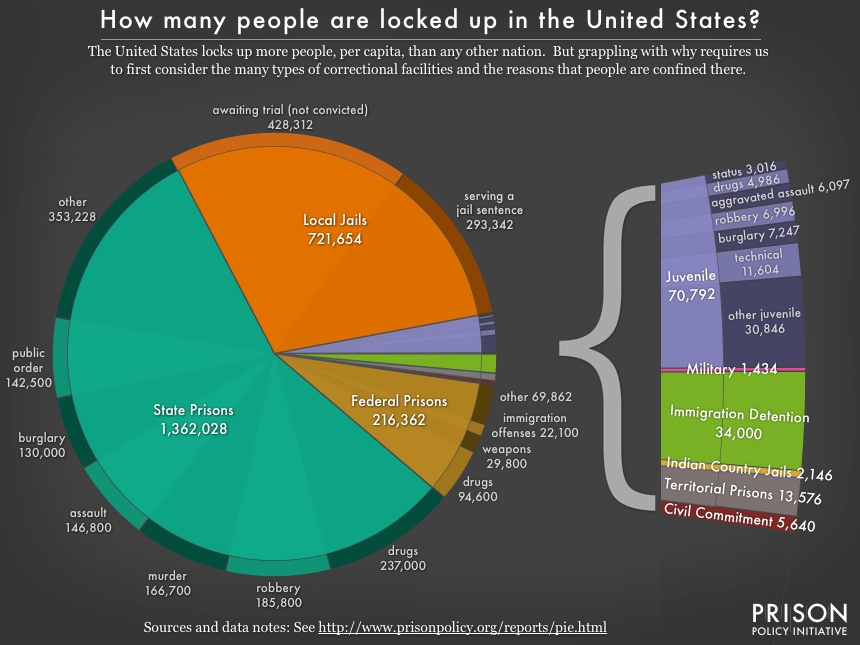
PPI has used data from the more recent 2010 U.S. Census counts to measure each state’s incarceration rates by race and ethnicity. Most (57%) people incarcerated in the United States have been convicted of violating state law and are imprisoned in a state prison. Monitoring trends at the state-level is imperative.

It’s exciting to see what discussions are beginning around the state profiles on incarceration, and how people and organizations are grappling with its’ implications. We are just beginning to see how and what these profiles can be used for to improve the current standards for mass incarceration.

Sophia Robohn is supported by the Civil Liberties and Public Policy Program.


Legislators listen up, we want fair elections! You can't count constituents in your house of corrections!

by Leah Sakala, June 12, 2014

I have the good fortune to be a bike commuter for most of the year, which gives me some good bike path thinking time every morning. A couple of years ago, I was riding along and mulling over ways to explain prison gerrymandering (as you do) when the lyrics started to come to me for a new spin on the classic Yankee Doodle.

Here’s how it starts:

If there’s a prison in your district,
don’t get so elated
‘cause it’s not fair to count folks there
who are incarcerated

Your district may be padded full,
but please don’t you gloat
’cause you are violating my right
to one person, one vote

Chorus:
Legislators listen up,
we want fair elections!
You can’t count constituents
in your house of corrections

The full sing-along print-out version is here.


Senator Robert Byrd’s passion for pork was legendary, and his love for prison-flavored pork helped fuel the record breaking growth in the federal prison population.

by Peter Wagner, June 10, 2014

While preparing our report Breaking Down Mass Incarceration in the 2010 Census: State-by-State Incarceration Rates by Race/Ethnicity, we discovered something interesting: West Virginia has more federal prison cells per capita than any other state. In fact, there are more people incarcerated in federal prisons in the state than are incarcerated in state and local jails combined.

Almost one out of every 200 people in the state is locked up in a federal prison, a rate more than seven times higher than the country as a whole. Of course, this doesn’t meant that West Virginians violate federal law more than other states, but it does mean that that state has more federal prisons than anywhere else. (And given the fact that West Virginia is one of the whitest states in the country, it certainly makes a difference to the demographics reported in the census.)

So why does West Virginia have so many federal prisons? Because until 2010, the senior senator on the U.S. Senate’s appropriation’s committee was West Virginia Senator Robert Byrd. As the longest serving U.S. Senator in history — not to mention multi-term Chairman of the Senate Committee on Appropriations — Byrd was powerful, and he focused his political clout on bringing as much federal money in to West Virginia as he could.

Senator Byrd’s passion for pork was legendary and his love for prison-flavored pork helped fuel the record breaking growth in the federal prison population over the last three decades. That’s because prison is no exception to the saying “if you build it, they will come.”

Now, it would be fair to wonder if Senator Byrd wasn’t just advocating for his state to receive federal prison money that was already earmarked to be spent somewhere. Unfortunately, the historical record makes it clear that support from the longest serving U.S. Senator in history can make things happen that wouldn’t otherwise, such as the opening of brand new FCI McDowell prison despite the Bush administration’s attempts to cut it from the budget.

Source: Jake Stump, “Byrd hopes the $126 million he secured to run prisons is really secure” Charleston Daily Mail, July 12, 2007.


Supreme Court struck down Florida decision that Freddie Lee Hall was eligible for execution with an IQ score of 71, above the cutoff of disability at 70.

by Bernadette Rabuy, May 28, 2014

On Tuesday, May 27, 2014, the United States Supreme Court struck down Florida’s strict use of an I.Q. cutoff as a legitimate way to decide which mentally disabled individuals must be spared from the death penalty. In a 5-to-4 decision, the Supreme Court ruled that Florida was in violation of the Eighth Amendment’s prohibition of cruel and unusual punishment.

In a 2002 Supreme Court case, Atkins v. Virginia, the Supreme Court gave states general guidelines for determining intellectual disability: low I.Q. scores, a lack of fundamental social and practical skills, and the presence of both conditions before age 18. Furthermore, while the Supreme Court left the specific qualifications to the states, it did assert that I.Q. scores under approximately 70 typically indicate disability.

On Tuesday, the Supreme Court further curbed the use of the death penalty. While in a 2012 decision the Florida Supreme Court ruled that Mr. Freddie Lee Hall was eligible to be executed since he had been measured with I.Q. scores of 71, 73, and 80, on Tuesday Justice Kennedy disagreed with the Florida Supreme Court arguing that intellectual disability should not be boiled down to a rigid number and should be understood as a more complex condition. As Hofstra law professor Eric M. Freedman states, “death row inmates commonly suffer from multidimensional mental problems.” This ruling will affect other states with similar cutoffs, such as Kentucky, Virginia, and Alabama.

Tuesday’s Supreme Court decision is reflective of recent discussions to further limit the use of the death penalty, which Justice Kennedy called the “gravest sentence our society may impose.” A recent study by Samuel Gross, a law professor at the University of Michigan Law School, found that more than 4% of all defendants who have been sentenced to death are likely innocent. Gross explains that while the number of innocent people who have been executed is fairly low, it is more common for innocent defendants to be sentenced to prison for life and be forgotten. This issue is exacerbated by the fact that prisoners who are awaiting execution on death row receive more intense scrutiny than prisoners whose sentences are reduced to life in prison. As there is further examination of the death penalty, it is important to additionally examine those serving life sentences, especially since one of every nine state prisoners is serving a life sentence.

Even though Justice Kennedy wrote that Mr. Freddie Lee Hall may or may not be intellectually disabled, Mr. Hall will have the opportunity to present evidence of his intellectual disability and receive a new assessment by the lower courts. Careful examination of the death penalty and life in prison are essential in order to maintain, what Justice Kennedy called, “our nation’s commitment to dignity.”


316 graphs of state-by-state data on racial disparities and prison growth

by Peter Wagner and Leah Sakala, May 28, 2014

Today, the Prison Policy Initiative released two new briefings and a brand new way to access useful data about incarceration in your state.

We released:

Also today, we launched 50 state profiles (and a national one) giving you one-click access both to the findings of these two new briefings and to the highlights of all of our work over the last 13 years on each state:

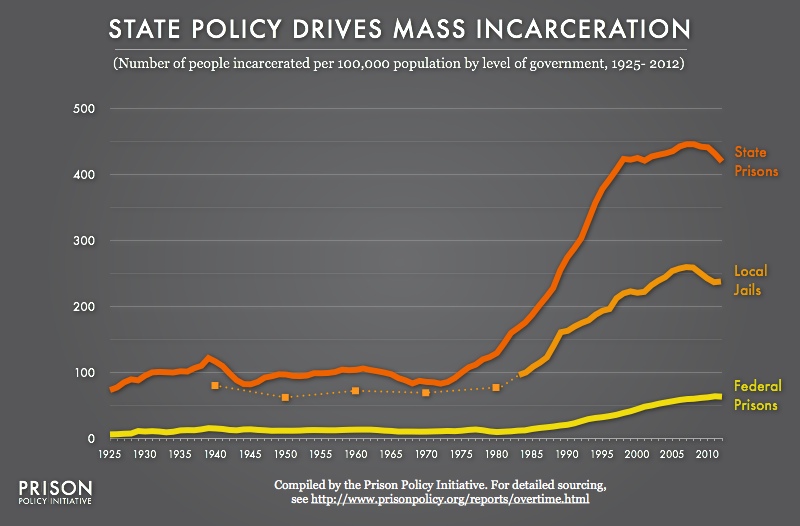
All told, we produced 316 new graphs for you to use, including these two never-seen-before graphs from the U.S. profile page:

graph showing the incarceration rates per 100,000 for (separately) United States state prisons, federal prisons and local jails from 1925 through 2012, showing that the state rate is the most important part

2010 graph showing incarceration rates per 100,000 people of various racial and ethnic groups in the United States

As we explain on our national profile page,

With over two million people behind bars at any given time, the United States has the highest incarceration rate of any country in the world.

We spend about $82.4 billion every year — not to mention the significant social cost — to lock up nearly 1% of our adult population. To be able to evaluate this policy choice, our communities must have access to reliable and up-to-date information about the trajectory and scope of our nation's experiment with mass incarceration. With this page, and the accompanying 50 State Incarceration Profile series, we hope bring some of the most important and under-discussed national facts into the public discourse.


Data show that the U.S’s incarceration tab in 2010 came out to a whopping $82.4 billion. Which is actually a serious underestimate.

by Leah Sakala, May 23, 2014

While working on an upcoming report, I set out to find the answer to a relatively straightforward question: What is the direct fiscal cost of incarceration in the United States?

The answer, it turns out, was not readily available. So I started to pull some sources. Here’s what I found for correctional expenses in 2010:

This means that the U.S.’s incarceration tab in 2010 came out to a whopping $82.4 billion.

That’s a lot of money, but it’s also a significant underestimate for two important reasons:

  1. This figure does not include expenses related to law enforcement, courts, or other pieces of the mass incarceration pie, such as the immigration detention system.
  2. This figure also does not include the huge and unquantifiable social price of overcriminalization, which falls on the shoulders of families, communities, and future generations.

Governor extends ban on draconian restraints to all state and local correctional facilities.

by Joe Mirkin, May 21, 2014

Thanks for stopping by this morning and guest-blogging, Joe! -PPI

Last week, Governor Deval Patrick signed an anti-shackling bill into law, making Massachusetts the 21st state to abolish the harmful and brutal practice of restraining incarcerated women who are pregnant, in labor, or in the post partum period.

(Read the Governor’s press release here)

The bill, S.2063, “An Act to Prevent Shackling and Promote Safe Pregnancies for Female Inmates, “also takes great strides towards establishing a “minimum level of care that must be afforded to pregnant inmates in county correctional facilities.”

While previous anti-shackling rules only applied to state prisons, the new law covers all corrections facilities in Massachusetts.

We strongly agree with Marianne Bullock, of the Prison Birth Project, when she said, “The next step is ensuring that this law is enforced.” We will continue, alongside fellow members of the Massachusetts Anti-Shackling Coalition, to advocate against any continuation of the practice following the passage of this law.

Our thanks and congratulations go out to all coalition members!

Members of the Massachusetts Anti-Shackling Coalition Include:

ACLU of Massachusetts, American Friends Service Committee of Western MA, Black and Pink, Boston Area Rape Crisis Center, Boston Feminists for Liberation, Casa Myrna, Civil Liberties and Public Policy, Coalition for Effective Public Safety, Dismas House—Worcester, Families for Justice as Healing, Harvard Prison Legal Assistance Project, Health Care for All, Health Law Advocates, Hollaback! Boston, Jane Doe Inc—the MA Coalition Against Sexual Assault and Domestic Violence, Jewish Alliance on Law and Social Action, JRI Health, The Law Offices of Howard Friedman, The Massachusetts Chapter of the National Organization for Women, Mount Holyoke Students Against Mass Incarceration, NARAL Pro-Choice Massachusetts, National Lawyers Guild, Massachusetts Chapter, Out Now—Springfield, Planned Parenthood League of Massachusetts, Pretrial Working Group, Prison Birth Project, Prisoners’ Assistance Project at NUSL, Prisoners’ Legal Services, Prison Policy Initiative, Real Cost of Prisons Project, Religious Coalition for Reproductive Choice, Stern, Shapiro, Weissberg and Garin, LLP, And Still We Rise, Unitarian Universalist Urban Ministry, The Women’s Bar Association of Massachusetts, Worcester Homeless Action Committee.


This Mother's day, hundreds of thousands of kids won't be able to call their mothers, and if Mom calls them, those kids are going to have a hard time paying for the call if she calls them.

by Peter Wagner, May 9, 2014

This Mother’s day, hundreds of thousands of kids won’t be able to call their mothers, and if Mom calls them, those kids are going to have a hard time paying for the call if she calls them. Incarcerated mothers — and most incarcerated women are parents of children — can’t receive phone calls but instead need to do the calling.

Who calls who wouldn’t be important if incarcerated moms could choose between an unlimited long distance plan and free Skype like most people do. Instead, incarcerated mothers have to use the monopoly vendor selected by their prison or jail; and the prison or jail generally selects the company that offers the highest kickback commission from the call.

You can see where this is going. The calls are expensive. The “good” news is that the Federal Communications Commission recently capped the maximum rate that can be charged for an interstate call at 21 or 25cents a minute. (Yes, people in prison live in a world where they might be lucky to make 25cents an hour from their job in the prison and where they celebrate the federal government lowering the cost of a call from $1/minute to 25cents.) But about 80% of kids with incarcerated parents won’t benefit from those new price caps because most calls home from prison are in-state calls not subject to the new price caps.

We need to work together to ensure that this is the last Mothers Day where families need to choose between putting food on the table and telling Mom how much she is missed and loved.


Sourcing: The Bureau of Justice Statistics report Parents in Prison and Their Minor Children is a goldmine of information about incarcerated parents and their minor children in state and federal prison, including detail about frequency of visits and other contact, that most they lived together with their kids when they were arrested, etc. Regarding the use of “hundreds of thousands” in this post, the BJS report says that in 2007, there were 131,000 minor children who had a mother in state prison, 16,400 who had a mother in state prison. Not included in that study were jails, which are an important but often overlooked 30% of the mass incarceration pie.


Stay Informed


Get the latest updates:


Share on 𝕏 Donate