Phones archives

We are thrilled to see the ACA support the common sense idea that emerging technologies should supplement, not replace, in person visits.

by Lucius Couloute, April 24, 2017

ACA policy on family-friendly communication and visitationAs we mentioned in our January 2015 report, in four conferences going back to 2001, our nation’s leading professional organization for correctional officials, the American Correctional Association, has consistently declared that “visitation is important” and “reaffirmed its promotion of family-friendly communication policies between offenders and their families.”

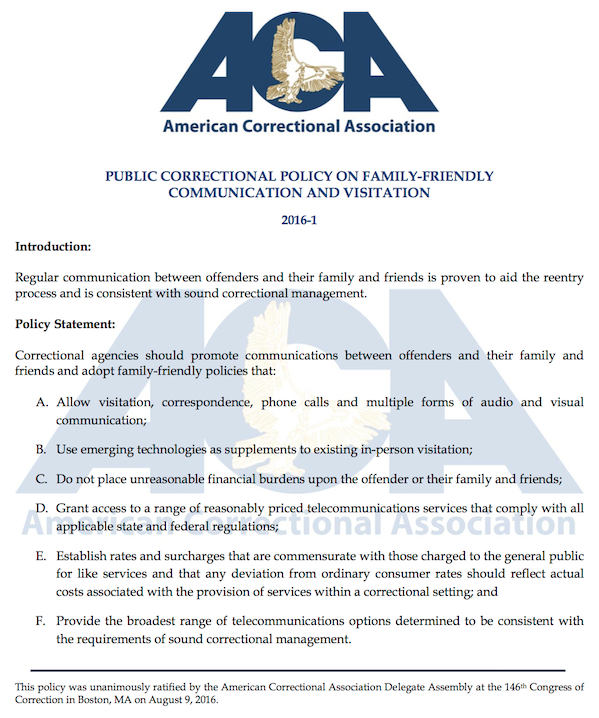
Last August, the American Correctional Association went further by explicitly declaring that emerging technologies (like video visitation) should only be used to supplement existing in-person visitation.

The ACA isn’t the only national association to take a stand; the American Bar Association’s standards state that video visitation should not replace in-person visitation.

These resolutions are important because they tell the hundreds of jails that have replaced in-person visits with video visitation that these jails are violating correctional best practices.

Since jails incarcerate people who tend to be extremely poor, video visitation can come at a great cost to their families. At up to $1.50 per minute, a single 15-minute video visit can be the difference between buying a day’s worth of food, or forgoing groceries to speak with a loved one. The American Correctional Association understands this economic reality, urging correctional facilities to “not place unreasonable financial burdens upon the offender or their family and friends.”

As a supplement to in-person visits, video visitation can help connect families who are far apart. We are thrilled to see the ACA include in their Public Correctional Policies the common sense idea that emerging technologies should supplement – not replace – in person visits.

For more information on this issue and to see country wide press coverage, see our report and organizing on the for-profit video visitation industry in prisons and jails.


Are providers of prison communication services allowing unrestricted access to the personal computers and conversations of incarcerated people and their loved ones?

by Stephen Raher, April 24, 2017

The apparent suicide of former NFL player Aaron Hernandez has received much media attention, due to Mr. Hernandez’s celebrity status. While many news reports noted that Mr. Hernandez was recently acquitted of additional murder charges, I wanted to highlight one of his experiences while awaiting trial: a civil lawsuit against prison telecom company Securus.

What happened?

While he was awaiting trial, Hernandez was held in the Suffolk County Jail in Massachusetts. The county has chosen Securus as the exclusive provider of telecom services for people incarcerated in the jail. According to a document we received, Securus has determined that an unauthorized person (or people) accessed recordings of Mr. Hernandez’s phone calls. Securus later informed the federal court that the recorded calls were between Hernandez and his fiancée.

Mr. Hernandez sued Securus in Massachusetts state court, alleging invasion of privacy and other related claims. Securus tried to move the case to federal court, but in March 2017, the U.S. District Court for Massachusetts concluded that the lawsuit did not implicate federal law, and sent it back to state court, where it is still pending.

What does this mean for incarcerated people and the loved ones they talk to?

Securus’s self-serving “Integrity Pledge (link no longer available)” claims that the company understands and honors “confidentiality of calls.” But as with so much corporate PR, when something actually goes wrong, Securus’s commitment to stated principles is nowhere to be found. In response to Mr. Hernandez’s lawsuit, Securus argued that Hernandez couldn’t sue for unauthorized access to call recordings, because “inmates have no expectation of privacy in their communications” and thus Hernandez “suffered no cognizable privacy injury.”

Notably, Hernandez was not suing because jail officials listened to his calls, but rather because he believed that Securus didn’t take adequate steps to prevent a hacker from breaking into the database of recordings and listening to private conversations. Most people realize that law enforcement can listen to non-privileged jail phone calls (Securus has also been accused of illegally taping privileged attorney-client phone calls, but this did not appear to have happened in Hernandez’s case); however, this should not mean that private phone calls can be shared with anyone in the world. Nonetheless, this is basically what Securus is arguing when it says that Hernandez doesn’t even have a right to go to court.

What additional concerns does this raise for families and friends of incarcerated people?

The same privacy concerns discussed above also apply to family and friends who call or video-chat with incarcerated people. But folks on the outside have another potential source of worry: they are often granting Securus access to their personal computers.

In the case of video visitation, Securus requires users to install a Java applet that—according to Securus—allows the transmission of audio and video. When users install the applet, they receive a warning that the applet “run[s] with unrestricted access which may put your computer and personal information at risk.” Screenshot of Securus unrestricted access applet This warning suggests that Securus’s applet can potentially access unrelated information on a customer’s computer, like photos, emails, or other private files. This, in turn, raises several concerns, given the terms and conditions that customers must agree to.
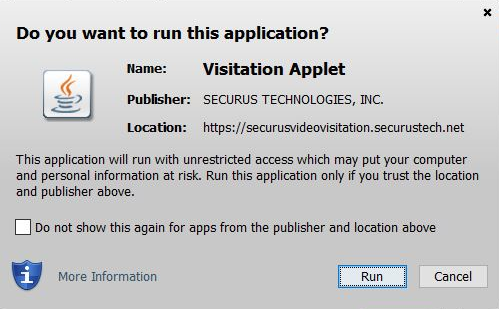
First, Securus’s privacy policy states that customers agree that Securus can “receive[] and store[] certain information whenever [the customer uses video visitation].” But “certain information” is never defined. Are customers unwittingly granting Securus permission to snoop through their files or eavesdrop through their computer’s microphone? Probably not, but Securus’s confusingly-written contract doesn’t provide any assurances to the contrary.

Of greater concern is Secrurus’s language about monitoring by law enforcement. Securus forces its customers to agree to the following language:

Securus assumes no responsibility for the activities, omissions or other conduct of any member of Law Enforcement (a “Law Enforcement Official”). Relative to [video visitation], Securus acts solely as a portal for the online distribution and publication of electronically distributed information and has no obligation to screen communications or information in advance and is not responsible for screening or monitoring electronic communications sent via this Service.

If the Java applet does create a backdoor into a user’s computer (either intentionally or accidentally), then law enforcement could exploit this backdoor (either on their own or at Securus’s invitation), and access private information on a user’s computer. In such a scenario, Securus has set itself up to disclaim any liability—an argument that is foreshadowed in the Hernandez lawsuit.

Securus is able to charge high prices because it knows it can exploit the desire of families who want to maintain contact with their loved ones. Adding insult to injury, Securus now argues that its customers have no privacy rights whatsoever. And making matters even worse, Securus’s terms of service don’t clearly tell customers what information they are surrendering.

While Aaron Hernandez had the resources to fight back, most incarcerated people do not. This situation illustrates an increasingly obvious fact: as prisons adopt new technologies (like video visitation, electronic fund transfers, and electronic messaging), incarcerated people and their families will be unfairly exploited unless lawmakers get serious about extending consumer protections inside the prison walls.

Some legislators are beginning to take notice of the abusive video visitation industry. Policymakers across the country should consider adopting legislation so that incarcerated people and their families are not prevented from face-to-face contact during difficult times.

by Lucius Couloute, April 10, 2017

As our research has shown, local jails are increasingly replacing in-person visits with expensive and poorly implemented video visitation systems.

Fortunately, some policymakers are taking notice. Illinois State Rep. Carol Ammons introduced a bill earlier this year that would protect in-person visitation from being eliminated in Illinois correctional facilities and limit the cost of video visits. There is also active legislation in New Jersey that would guarantee face-to-face family visits for incarcerated individuals, cap video costs at 11 cents a minute, and ban fees on professional video visits from lawyers and clergy.

Policymakers across the country should consider adopting similar legislation so that incarcerated people and their families are not prevented from in-person contact during difficult times. Preserving face-to-face visitation is not just humane, it’s good policy because contact between incarcerated people and their loved ones is proven to reduce the likelihood that an individual will re-offend after release.

For more information on this issue and efforts to protect in-person visitation, see our report on the video visitation industry.


We explain what's next and what the families can expect on telephone justice.

by Peter Wagner, February 8, 2017

On Monday, arguments were heard in a federal court case challenging the Federal Communications Commission’s regulations of the prison and jail telephone industry. A decision is not expected for several months, but there are a few updates to share nevertheless.

Centurylink, Global Tel*Link, Pay Tel, Securus Technologies, and Telmate sued the FCC when it started regulating the industry. Shortly thereafter, the Prison Policy Initiative joined with the D.C. Prisoners’ Legal Services Project, Citizens United for Rehabilitation of Errants (CURE), The Campaign for Prison Phone Justice, and the Office of Communication, Inc. of the United Church of Christ as intervenors in support of the government respondents in the case, and we were all represented by the Institute for Public Representation at the Georgetown University Law Center. By joining the case, we could help the FCC defend its orders, and ensure that the unique interests of the families and other stakeholders were represented in the case. The recent presidential election made our 2013 decision to intervene especially important.

The presidential election reshuffled the seats at the FCC. Ajit Pai, a commissioner since 2012 was made Chairman, and even though Pai had previously condemned the market failure caused by the corrupt commission system, he ultimately voted against the FCC’s regulations of the industry. And on January 31, the FCC told the Court that it was not going to defend two aspects of the regulations. Even as the FCC refused to support its own regulations, our attorney, Andrew Schwartzman, was able to defend the FCC’s work before the Court. We’re glad we intervened.

We don’t know what the Court is going to decide, and we don’t yet know how or whether Chairman Pai wants the FCC to address what he saw as “market failure” in the prison and jail telephone market.

All of this will become clearer over the next few months, but that leaves us with the immediate question of what families with loved ones behind bars can expect to pay. That too is complicated, in part because the Court stayed part of the FCC’s regulations.

Some states like Alabama have stricter regulations, and some prisons and jails have negotiated better deals for the families, but under the currently-enforceable federal rules:

  • For both prisons and jails, inter-state calls will continue to be capped at a maximum of $0.21-$0.25/minute for debit/prepaid or collect, respectively. (These are the rate caps that went into effect in February 2014. For now, in-state calls are not subject to rate caps.)

In addition, the abusive hidden fees for both inter-state and in-state calls, which our report Please Deposit All of Your Money: Kickbacks, Rates, and Hidden Fees in the Jail Phone Industry found can easily double the price of a call, are now capped at:

  • Payment by phone or website: $3 (previously up to $10)
  • Payment via live operator: $5.95 (previously up to $10)
  • Paper bills: $2 (previously up to $3.49)
  • Markups and hidden fees embedded within Western Union and MoneyGram payments: $0 (previously up to $6.95)
  • Markups and hidden profits on mandatory taxes and regulatory fees: $0 (We’ve seen these markups and hidden profits on “mandatory” taxes be 25% of the cost of the call)
  • All other ancillary fees: $0. (There are many of these charges. Some of the most egregious ones are $10 fees for refunds, $2.50/month for “network infrastructure” and a 4% charge for “validation”.)

Later, if we are successful in Court and nothing else happens:

  • In-state calls will be capped at $0.21-$0.25/minute, just like interstate calls. (This is particularly important because 92% of calls from prisons and jails are in-state, and because in the absence of regulation, jails are increasing the cost of these calls to up to an exploitative $1.50 a minute.
  • The companies will be prohibited from defying the FCC’s rate caps by steering families to abusive “single call” products like Text2Connect™ and PayNow™ that charge $9.99-$14.99 for a single call.

Stay tuned.


From state and federal legislation to the press, support for in-person visits continues to grow.

by Bernadette Rabuy, February 1, 2017

In a January 2015 report, we discovered that 74% of jails that adopt video visitation go on to ban in-person visits. Fortunately, the movement to protect in-person visits from video technology has continued to grow. Here are some recent developments we wanted to share:

  • New Jersey legislation, A4389, that would protect in-person jail visits and require that video visits cost no more than $0.11/minute unanimously passed the Assembly Law and Public Safety Committee.
  • An editorial from Maine’s Bangor Daily News called on Maine to follow Texas’ lead and ensure that jails maintain in-person visits, for the benefit of prisoners and their families, and, ultimately, the state.
  • Fifty-two organizations nationwide signed on to support the Video Visitation in Prisons Act introduced by Senator Tammy Duckworth. The Act would require the Federal Communications Commission to regulate video visits. It would also require that the Bureau of Prisons continue to provide in-person visits and only use video technology as a supplement to in-person visitation.

    Additionally, over 40,000 individuals have signed a Care2 petition in support of Senator Duckworth’s Video Visitation in Prisons Act. You can still sign.


The first ever national survey of in-state jail phone rates finds some jails charge more than $1.50 a minute.

by Aleks Kajstura, January 19, 2017

Two recent submissions to the FCC shed new light on the high cost of in-state phone calls from jails. While the campaign to make phone calls from prison and jail more affordable for family and friends of incarcerated people has made significant progress, the new filings underscore how private companies continue to avoid regulation while charging unconscionable rates.

These submissions present new research which reveals that some in-state calls cost over $1.50 a minute, and finds pricing structures that “bear a remarkable similarity” to practices prohibited by the FCC.

In order to “highlight the current ICS [Inmate Calling Service] landscape” for the FCC, Lee Petro, counsel for the Wright Petitioners, and the Prison Policy Initiative (thanks to members of our Young Professionals Network) conducted a survey of jails served by the major ICS providers.

The most significant discovery made from reviewing the current pricing policies of the ICS providers was that several ICS providers have imposed a rate structure for intrastate ICS calls that bear a remarkable similarity to the now-prohibited “connection fee” which was prohibited in the 2015 Second Report and Order, and memorialized in Section 64.6080 of the Commission’s rules.

These pricing schemes have resulted in 15 minute calls that would cost $24.95 from the Arkansas County Jail via Securus and $17.77 from the Douglas County jail in Oregon via Global Tel*Link.

You can find the summary of the Comments submission findings in the Ex-Parte submission, and the rates for all of the jails surveyed in exhibits B and C of the Comments submission (starting on page 82), and exhibits A and D in an updated filing reflecting Legacy’s correction of their advertised rates.


NPR covers video visitation, and reform legislation is introduced in Congress.

by Peter Wagner, December 8, 2016

It’s been a big week for the movement for telephone justice:


For the first time since 2013, in-person visits will be allowed at Travis County jails.

by Alison Walsh, April 19, 2016

Visits in Travis County, Texas, took on a special significance today. This morning marked the end of the county’s video-only visitation policy and the first time since 2013 that people incarcerated in the county’s jails were able to see their loved ones through a plexiglass window instead of a computer screen.

In 2013, Travis County phased out its in-person visitation program and adopted a video-only visitation policy. Jail administrators claimed that video was more efficient and conducive to more frequent visitation. Families reported a different experience, and the current psychological research confirms that video and in-person communication are far from equal.

The reversal in Travis County sets a new precedent. While almost three-fourths of the jails that adopt video visitation also ban in-person visits, the Travis County jails are now an example of how the technology can supplement in-person visits and improve communication options for families.

Congratulations to Grassroots Leadership, and to the formerly incarcerated people and their families whose advocacy brought about this change!


Travis County, Texas' experience shows: video visitation often fails to meet expectations.

by Emily Widra, April 18, 2016

Last week we wrote about the psychological differences between in-person and video communication. This week, we decided to look into how incarcerated people and their families feel about using video visitation and how this compares to the expectations that sheriffs have when they adopt video visitation.

In 2009, the Travis County Sheriff’s Office in Texas made the transition from 100% face-to-face visitation to 50% face-to-face and 50% video visitation. In 2013, the Sheriff’s Office went further, eliminating in-person visitation in favor of 100% video visitation.

What arguments do sheriff’s offices make to support the decision to ban in-person visitation in favor of video-only visitation? Some claim video visitation is more efficient, allows for more frequent visitation, and can reduce the introduction of contraband into correctional facilities.

Claim: Video visitation is more efficient.
Travis County’s experience: Travis County’s experience shows that visitation and in-person visitation can be used together to allow for increased efficiency and a greater frequency of visits. For example, the average wait time for a face-to-face visit before the Travis County Sheriff’s Office offered video visitation was 1.5-3 hours. When the jail offered both video and face-to-face visitation, the average wait time was reduced by half. With video visitation as the only option, appointments did drastically shorten wait time, but the wait can still be up to a full hour when an appointment is not scheduled in advance. While pre-scheduling visitation can be beneficial for some families, we’ve spoken to many who find coordinating issues like transportation to the jail, childcare, and employment ahead of time to be difficult.

Claim: Video visitation allows for more frequent visitation.
Travis County’s experience: The Sheriff’s Office found that the average number of visits per year was highest when they offered both video and face-to-face visitation, leading to about 1,429 more visits per month than when the Sheriff’s Office only offered in-person visits. The number of visits dropped dramatically when the Sheriff’s Office went to video-only visitation.

Claim: Video visitation can reduce the introduction of contraband into correctional facilities.
Travis County’s experience: Because many in-person jail visits are conducted through glass, there is no reason to think that video would lead to a greater reduction in contraband than a through-the-glass visit. In fact, according to a report by Grassroots Leadership and the Texas Criminal Justice Coalition, disciplinary cases in Travis County jails for possession of contraband increased an overall 54% following the elimination of all in-person visitation.

Claim: Incarcerated people and their families will love video visitation.
Travis County’s experience: Two years after changing to video-only visitation, the Travis County Sherriff’s Office surveyed visitors about their experience with video visitation. A majority of the respondents had experienced both in-person and video visitation at the jail and 43% had never had face-to-face visitation at the jail.

While the majority rated their experience with video visitation as positive, almost all (91%) reported they would prefer face-to-face visitation.

Visitors prefer face-to-face visitation, even when that requires the visitor and incarcerated person to be separated by glass. As we reported last week, the reasons for this preference are numerous: video communication reduces the natural flow of conversation, slows the process of establishing trust, prohibits the intimacy and social connection that come with in-person visits, and leads to shorter conversations and reduced interactivity. Another reason for this preference might come from the fact that over 90% of video visits in Travis County took place at the jail and not from a home computer, making video far less convenient than one might think. It looks like visitors prefer face-to-face even if it means waiting longer to visit.

So taking all of these factors into account, what did the Travis County Sheriff’s Office decide to do?

In 2015, the sheriff’s office announced it would move back in the right direction by reinstating in-person visitation and only offering video visitation as a supplemental option. We hope that other county sheriff’s offices will follow suit or will, at the very least, start surveying incarcerated people and their visitors about their experience with video visitation.

For the complete survey data from Travis County, see: https://traviscountytx.iqm2.com/Citizens/FileOpen.aspx?Type=1&ID=1454&Inline=True.


The federal courts have issued a second stay of the FCC's October 2015 order. Families should expect caps and bans on ancillary fees.

by Bernadette Rabuy, March 24, 2016

Yesterday, March 23, 2016, the federal courts issued a second stay of the Federal Communications Commission’s historic October 2015 order that would have expanded regulations of the prison and jail telephone industry to in-state calls and ancillary fees.

It’s a little complicated because on March 16, the FCC issued a public notice reminding the phone companies that the interim rate caps of $0.21/minute (debit/prepaid) and $0.25/minute (collect) should apply to in-state calls. Just as expected, the companies went running to the courts in response. The bad news is that, for now, the courts have sided with these billion-dollar interests that have been price gouging families for far too long. The good news is that families will benefit from the bans and caps on ancillary fees, which can double the cost of a call.

Barring new court developments, here is what families of incarcerated people can expect to be charged:

For prisons, in effect now:

Inter-state calls will continue to be capped at a maximum of $0.21-$0.25/minute for debit/prepaid or collect, respectively. These are the rate caps that went into effect in February 2014. For now, in-state calls are not subject to rate caps.

The abusive hidden fees that our report Please Deposit All of Your Money: Kickbacks, Rates, and Hidden Fees in the Jail Phone Industry found can easily double the price of a call are now capped at:

  • Payment by phone or website: $3 (previously up to $10)
  • Payment via live operator: $5.95 (previously up to $10)
  • Paper bills: $2 (previously up to $3.49)
  • Markups and hidden fees embedded within Western Union and MoneyGram payments: $0 (previously up to $6.95)
  • Markups and hidden profits on mandatory taxes and regulatory fees: $0 (We’ve seen these markups and hidden profits on “mandatory” taxes be 25% of the cost of the call)
  • All other ancillary fees: $0. (There are many of these charges. Some of the most egregious ones are $10 fees for refunds, $2.50/month for “network infrastructure” and a 4% charge for “validation”.)

For jails, starting June 20, 2016:

Inter-state calls will continue to be capped at a maximum of $0.21-$0.25/minute, depending on whether the call is debit or collect. These are the rate caps that went into effect in February 2014. For now, in-state calls are not subject to rate caps.

The caps on the abusive fees discussed above will go into effect for calls from jails on June 20th.

After the court’s partial stay on the FCC order is lifted

Assuming that the federal court eventually sides with the FCC and allows the October order to go fully into effect, families can expect to see the following results at a later date:

  • The following rate caps will apply to in-state calls:
    • In prisons, the cost of a call will drop to $0.11/minute.
    • In jails, the cost of a debit/prepaid call will fall to $0.14/minute to $0.22/minute, depending on the size of the jail. (Traditional collect calls will initially be higher and then, over a two-year period, fall to the $0.14-$0.22/minute level.)
  • For both prisons and jails, the companies will be prohibited from defying the FCC’s rate caps by steering families to abusive “single call” products like Text2Connect™ and PayNow™ that charge $9.99-$14.99 for a single call.

The court has not set a schedule for the case yet, so we do not know when the partial stay might be lifted.

International calling and advanced communication services

The FCC also sought comments on regulating international calling and advanced communications services like video visitation and email, so the FCC is likely considering regulations of those services as well. The comment period closed in January, and we do not know when the FCC will rule on those issues.

Update March 30, 2016: The FCC has clarified what rules are in effect.


Stay Informed


Get the latest updates:


Share on 𝕏 Donate