Sarah advocates tirelessly to improve our criminal justice system, including working on projects to end prison gerrymandering and remove barriers to participation in our democratic process.
by Leah Sakala,
February 5, 2014

The Minnesota Women’s Press has published a wonderful profile of Sarah Walker, Prison Policy Initiative board member and founder of the Minnesota Second Chance Coalition.
Sarah tirelessly advocates to improve our criminal justice system, and her work includes projects to end prison gerrymandering, remove barriers to participation in our democratic process, promote gender-responsive justice policy, and overcome harmful racial disparities.
Congratulations, Sarah!
We asked The New York Times consumer protection columnist the Haggler to investigate the broken prison phone industry. He did!
by Leah Sakala,
February 3, 2014
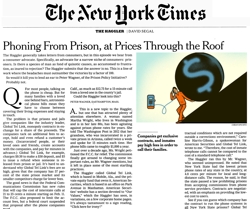
We asked The New York Times consumer protection columnist David Segel (AKA “the Haggler”) to look into the outrageous charges that families are forced to pay to speak on the phone with incarcerated loved ones.
And he did! Peter’s letter and the Haggler’s investigation were printed in yesterday’s paper.
Jennifer Sellitti, Deputy Public Defender in Essex County, NJ, shares her thoughts on her work and why she joined our board.
by Leah Sakala,
February 3, 2014

We are thrilled to begin a blog series introducing several accomplished new members of the Prison Policy Initiative board! We spoke with each of them about their important work and thoughts on the Prison Policy Initiative.
First up, Jennifer Sellitti, who is Assistant Deputy Public Defender in Essex County, New Jersey.
Why did you decide to join the PPI board?
Jennifer Sellitti: Although I currently work as a criminal defense attorney, I began my career in prisoners’ rights. I guess you could say that the mission of prison reform has been and always will be in my professional blood. It is unacceptable to me that what passes for justice in this country is a broken, unrelenting, and soulless system of mass incarceration. I am honored to be a part of an organization that not only brings attention to some of the most pressing issues in prison reform but also leads the way in proposing groundbreaking solutions to the American prison crisis.
What does your work focus on? And what’s the connection between that work and PPI?
JS: As an assistant deputy public defender for the State of NJ, my work focuses on the criminal defense of indigent people accused of felonies in the NJ Superior Court. In my experience, busy criminal defense attorneys often forget that our clients live with the repercussions of their cases long after the case is resolved and the file is closed. Whether our clients go to prison, spend time on probation, or go back into their communities, their lives will be forever impacted by the choices their attorneys help them make. Through my work at PPI, I hope to spread the message to my colleagues in the criminal defense bar that we should be just as concerned about broader legal issues as we are about individual cases. These issues include prison conditions, attorney and family access, sentence enhancements, solitary confinement, provision of rehabilitative programs and other concerns that directly impact both the quality of life and the futures of our clients and their families.
What do you think is most unique about the Prison Policy Initiative and the projects it takes on?
JS:This is not your parents’ prison reform. By that I mean what makes PPI unique is that, unlike other prisoners’ rights organizations, it does not try to tackle every issue in criminal justice reform at the same time. It takes a more tailored, surgical approach that maximizes resources and organizational efficiency. By focusing on key areas – such as prison gerrymandering, high rates of prison and jail telephone calls, and sentence enhancement zones – PPI can make a tremendous impact and see results in a shorter amount of time.
What’s something that you wish more people knew about the Prison Policy Initiative?
JS: PPI Executive Director Peter Wagner and I began our careers together as student interns at the same prisoners’ rights organization. I have many fond memories of our talks, most of which took place in prison waiting rooms, about our plans to take on the justice system in our own distinct ways. Peter was passionate about bringing attention to “prison gerrymandering,” his discovery that the size of the prison population was combining with an outdated Census Bureau rule to undermine electoral fairness. When we reconnected recently, I was amazed to see how Peter’s idea has transformed PPI from a law student’s dream into one of the nation’s leading criminal justice policy organizations. What did not surprise me is that Peter still has the same passion, energy and enthusiasm for the work that he did all those years ago and that same zeal is now reflected in his talented staff and my fellow board members.
We submitted additional comments to the FCC confirming more kickbacks, and urging the FCC to keep protections in place for people in jail.
by Aleks Kajstura,
January 15, 2014
The prison and jail phone industry has been busy recently, urging the Federal Communications Commission to roll back regulations and allow companies to charge exorbitant rates and fees for calls. Meanwhile, we’ve submitted a few comments of our own, highlighting bloated payment fees and showing that phone services in jails require regulation just like in the prisons.
Although we, and the FCC, have suspected that phone companies take a cut of the fees charged by third party payment services such as Western Union, we were finally able to confirm the practice. On Monday we submitted a comment that documents the kickbacks from Western Union.
The FCC also sought additional information on the differences between jails and prisons, and whether the new phone regulations should protect people from unconscionable prices no matter where they, or their family members, are incarcerated. We demonstrated the industry’s inability to articulate a good reason to roll back regulations of jail phone services, and we urged the FCC to continue its protection for people confined in jails.
We also signed on to
-->
Show your support for our work with some PPI gear.
by Leah Sakala,
January 15, 2014
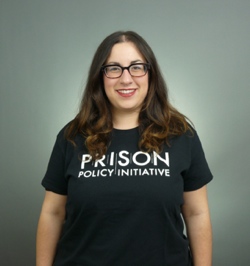
Looking for a new way to proudly show your support for our work to end mass incarceration?
You can now sport a snazzy new Prison Policy Initiative t-shirt (like Elena, at right), spread the word with a bumper sticker about ending prison gerrymandering, or stick a PPI pin on your backpack or magnet on your fridge.
Place your order today!
Court orders stay on some of the FCC's new prison phone regulations, but caps on call rates still go into effect on February 11th.
by Aleks Kajstura,
January 14, 2014
Recently, prison phone companies took the FCC to court for the right to charge the families of incarcerated people exorbitant rates for talking to their loved ones in prison. (Securus Technologies v. FCC and United States of America (D.C. Cir. Docket No. 13-1280)). Yesterday, the U.S. Court of Appeals granted a partial stay of the FCC’s new prison phone regulations, but allowed the new rate caps to take effect on February 11.
Communications Daily reports that the Court
kept in place the interim rate cap of 21 cents per minute for debit and prepaid calls, and 25 cents a minute for collect calls. It put on hold three other sections of the FCC’s rules: the requirement that rates and ancillary services be “cost-based”; low safe-harbor rates that presume charges are reasonable; and the annual reporting requirement.
The article quotes Peter Wagner’s analysis of the order:
It is important that the court left intact the most important and immediate of the FCC’s reforms… [b]ut I’m disappointed that the court stayed three sections of the FCC’s order, including the section that reined in the fees….Those fees can double the price of a call…. With new fairer rates, Global Tel*Link will make far more from deposit fees than from multiple 15-minute calls.
Several FCC commissioners were also disappointed in the ruling, but optimistic. Chairman Tom Wheeler, Commissioner Mignon Clyburn, and Commissioner Jessica Rosenworcel issued a joint statement highlighting how even having the partial regulation remain in effect is still a significant stride toward more reasonable phone bills:
We are pleased that millions of families will finally see relief from outrageous rates for inmate calling services when the interim rate caps… go into effect in February 2014. These families have been forced to pay exorbitant rates for far too long. Although we are disappointed that the court granted a partial stay on other aspects of the Inmate Calling Services Order, we look forward to a hearing on the merits soon, and to adopting further reforms quickly.
We are among the organizations intervening in the lawsuit, stay tuned for updates!
Lots of local folks are doing great work to end mass incarceration, and we'd like to create a space where we can connect with each other and strengthen our work.
by Leah Sakala,
January 9, 2014
We are co-organizing, with the Prison Birth Project, a meet and greet event for criminal justice-focused organizations and advocates in Western Massachusetts. Lots of local folks are doing great work to end mass incarceration, and we’d like to create a space where we can connect with each other and strengthen our work.
When: Tuesday, February 11th 2014 from 6-7:30 PM
Where: Peace Development Fund Office, 44 N. Prospect St. Amherst, MA
What: Pizza, conversation, and one-minute introductions from each organization
If you plan to attend, please RSVP so that we can order pizza, arrange childcare, print name tags and make a participant list that we can share with the other attendees.
We’d like to build as many connections as possible, so please forward this information and the RSVP link to any Pioneer Valley advocates who might be interested.
Let us know if you have any questions, and we hope to see you there!
"…the Prison Policy Initiative, a Massachusetts research group, urged similar rules for video visitation, email, voice mail and other systems."
by Leah Sakala,
January 7, 2014
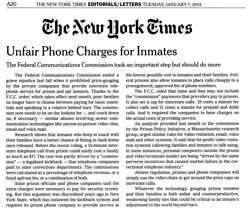
Today the New York Times issued a strong editorial praising the Federal Communications Commission for acting to regulate inter-state prison phone call charges, and proclaiming:
The commission now needs to be on the lookout for — and crack down on, if necessary — similar abuses involving newer communication technologies like person-to-person video chat, email and voice mail.
The editorial cites our recent submission to the FCC detailing why it should keep an eye on the prison and jail video communication and email markets:
An analysis provided last month to the commission by the Prison Policy Initiative, a Massachusetts research group, urged similar rules for video visitation, email, voice mail and other systems. It said that for-profit video visitation systems (allowing families and inmates to talk using, in some instances, personal computers outside the prison and video terminals inside) are being “driven by the same perverse incentives that caused market failure in the correctional telephone industry.”
Absent regulation, prisons and phone companies will simply use the video chats to get around the price caps on interstate calls.
Whatever the technology, gouging prison inmates and their families is both unfair and counterproductive, weakening family ties that could be critical to an inmate’s adjustment to the world beyond bars.
If you’d like to weigh in, too, please do so on the FCC’s website before the current comment period closes on Monday, January 13.
Leah spoke with the Valley Advocate about PPI's testimony in support of S 1171.
by Leah Sakala,
January 3, 2014
I spoke with the Valley Advocate for a new article on a bill to ban the routine use of physical restraints on incarcerated pregnant women after the first trimester, including during labor and delivery.
The bill was up for a hearing earlier this month, and we submitted written testimony urging the legislature add Massachusetts to the growing list of states that have rejected this inhumane and dangerous practice.
We’ll be reporting back with updates, so stay tuned!
Our local paper awarded the Prison Policy Initiative a “halo” this year for our work to improve justice policy.
by Leah Sakala,
December 31, 2013
We’re excited to share that the Valley Advocate, our local paper, awarded the Prison Policy Initiative a “halo” this year for our work to improve justice policy:
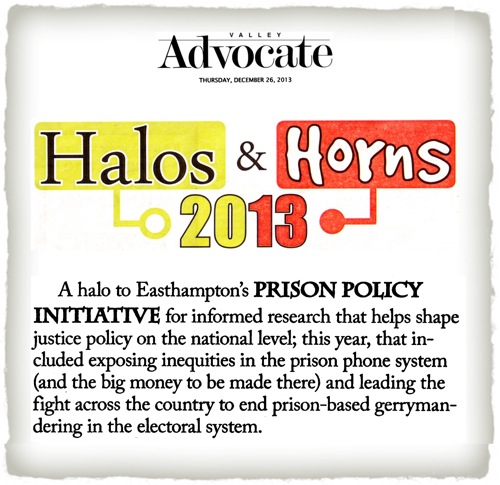
Over the years the Valley Advocate has provided great coverage of our work to expose the broader harm caused by mass incarceration (such as prison gerrymandering and sentencing enhancement zones). We’re honored!


