Increasing the number of ways that families can stay in touch is a good thing. But allowing companies to exploit families and undercut the FCC's efforts to bring fairness to this industry is not.
by Leah Sakala,
December 23, 2013
When the Federal Communications Commission approved its first regulation of the prison phone industry in August, the Commissioners put out a call for additional information on the rise of alternate forms of electronic communication in prisons and jails.
We just submitted a comment to the FCC detailing some of our disturbing findings about the burgeoning prison and jail video communications market, and urging the FCC to keep tabs on non-phone forms of communication in future rulings.
Here’s a summary of what we found (but check out the whole submission for examples and footnotes):
- Some jails are using video visitation, which is often fee-based, to replace, rather than supplement, free in person visits.
- Like the prison and jail phone industry, the video communication industry is rife with technical malfunctions and usability issues that need to be addressed.
- In many cases, video communication customers are subject to hefty fees and high rates, and a portion of the proceeds goes to site commissions. (Sound familiar?)
- FCC failure to regulate prison and jail video communication charges will leave this industry with a ready method to instantly circumvent FCC phone charge regulation simply by replacing facilities’ current telephones with video phones and labeling the verbal communications that take place as “video calls”. This would, of course, defeat the FCC’s mission to relieve families from having to pay astronomical phone bills.
We also noted that more and more correctional facilities are adopting email service, which has the similar potential to replace other critical forms of communication and carries similar risks of financial commission-fueled consumer abuse.
As our submission demonstrates, video visitation is here to stay. Increasing the number of ways that families can stay in touch is a good thing. But allowing companies to exploit families and undercut the FCC’s efforts to bring fairiness to this industry is not.
Stanford Law School professor and long time PPI Advisory Board member Pam Karlan will be moving on to defend voting rights in the Department of Justice.
by Peter Wagner,
December 23, 2013
After a rough year for voting rights in the U.S., things are looking up:
I’m thrilled to share that Stanford Law School professor and long-time PPI Advisory Board member Pam Karlan will be moving on to join the Department of Justice. She has been appointed to be the deputy assistant attorney general for voting rights in the Department of Justice’s Civil Rights Division.
Congratulations, Professor Karlan!
People all over the country want to ensure that ALL families can afford to stay in touch with incarcerated loved ones.
by Leah Sakala,
December 16, 2013
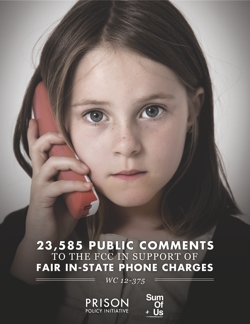
On Friday we submitted a petition, together with the corporate accountability organization SumOfUs, signed by 23,585 people calling on the Federal Communications Commission to regulate the expensive charges families pay for instate calls from a loved one in prison or jail.
When the FCC ruled in August to regulate the most expensive inter-state phone charges, the Commissioners asked for comments on whether they should extend their regulation to also rein in instate prison and jail phone charges. As we told the FCC in our cover letter, the support for instate regulation is broad:
1,489 of the comments contain unique statements written by individual signers. We have enlarged and highlighted these unique comments to demonstrate the depth of public support for regulating in-state calls from prisons and jails. These comments contain firsthand accounts from mothers, fathers, spouses, stepparents, godparents, aunts, and children of incarcerated people discussing how the unregulated prison and jail telephone industry strains family ties and presents them with an enormous financial burden. We also received comments from correctional facility employees, police officers, probation officers, teachers, ministers, lawyers, child psychiatrists, and social workers explaining how high phone charges break up families, thus increasing the odds that incarcerated people will commit a new offense in the future and return to prison.
And as our map shows, people all over the country want to ensure that ALL families can afford to stay in touch:
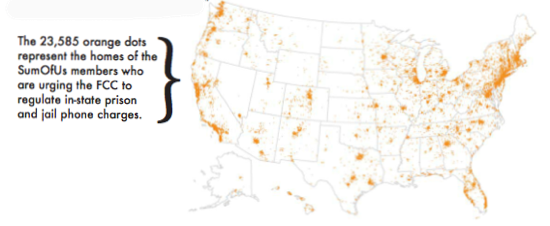
The FCC’s initial public comment period on instate prison and jail phone charge regulation is open through this Friday. You can weigh in, too, by submitting comments to the FCC’s docket.
We submitted testimony in support of S.1171, a bill that would ban the routine use of physical restraints on incarcerated pregnant women in Massachusetts.
by Leah Sakala,
December 12, 2013
The list of states that reject the dangerous and inhumane practice of shackling incarcerated women in labor and delivery is growing. But Massachusetts isn’t on it. Yet.
A bill has been introduced in the Massachusetts Legislature to ban the routine use of physical restraints on incarcerated pregnant women after the first trimester, including during labor and delivery. The bill also establishes common-sense basic standards for the prenatal, childbirth, and postpartum care afforded to incarcerated women in Massachusetts.
This bill is up for a hearing before the Joint Committee on Public Safety and Homeland Security this morning, and we submitted written testimony:
This bill presents Massachusetts with the opportunity to ban the dangerous, inhumane, and degrading practice of shackling incarcerated women who give birth while in correctional custody. Current Massachusetts policy fails to protect incarcerated women from being subject to such harmful and degrading restraints. S.1171 is consistent with the national trend to abolish the practice of shackling incarcerated pregnant women: 18 other states and the Federal Bureau of Prisons have already prohibited the routine use of shackles on incarcerated women who are giving birth, and it is time for Massachusetts to follow suit.
Using physical restraints during labor and childbirth is unsafe for the mother and her infant. For example, the practice prevents healthy, natural labor movement, increases the chances that a laboring woman will fall, impedes medical providers’ ability to provide care during labor and childbirth, delays emergency care when necessary, and obstructs maternal-infant bonding. The practice of shackling incarcerated pregnant women has been widely condemned by the medical community including the American Medical Association, the American Public Health Association, and the American College of Obstetricians and Gynecologists.
Furthermore, the routine use of physical restraints during labor and delivery serves no legitimate public safety purpose. An August 2013 report found that “[a]mong states that have restricted the shackling of pregnant women, none have reported any subsequent instances of women in labor escaping or causing harm to themselves, the public, security guards, or medical staff.”
The Committee should act quickly to pass the bill so that incarcerated women in Massachusetts are permitted to give birth safely and with dignity.
Your gift will go twice as far, and maybe even further!
by Leah Sakala,
December 9, 2013

This year we're thrilled to participate in Valley Gives, a 24-hour celebration of generosity in the Massachusetts Pioneer Valley on December 12th.
Please consider supporting our work this Thursday on 12/12/13, when your gift will be doubled by a matching grant and could be selected to win a prize that would make it go even further.
Schedule your gift today!
Mandela was an inspiration to people fighting for freedom around the world, and one of the main inspirations for my own prison activism.
by Peter Wagner,
December 5, 2013
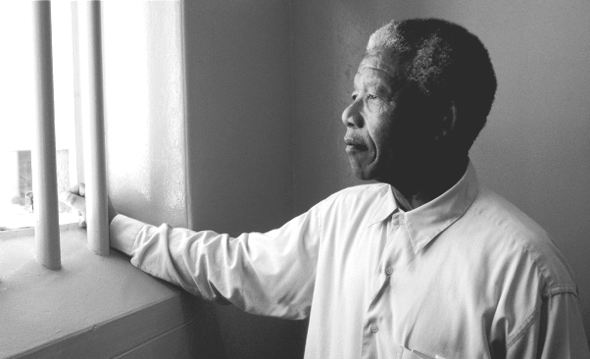
Nelson Mandela (1918-2013) was a South African freedom fighter and one of the longest held political prisoners in the world. He led the fight to abolish Apartheid and was elected President in the first multi-racial election in 1994. This photo was taken that same year when he revisited his prison cell at the infamous Robben Island (Photo: Getty Images).
Nelson Mandela has died at the age of 95. He was recently hospitalized battling a recurring lung infection no doubt related to the tuberculosis he contracted in a dank prison cell decades before. He was an anti-Apartheid freedom fighter, one of the longest-held political prisoners in the world, and the first Black South African to be elected President of that country. Mandela was an inspiration to people fighting for freedom around the world, and one of the main inspirations for my own prison activism.
In high school in the late 1980s, I was a peace and anti-apartheid activist. Although South Africa’s history is largely forgotten here in the U.S., in the late 1940s the white minority government of South Africa put in place a political system of strict racial segregation and oppression called Apartheid. Opposition parties and dissent were banned. The majority-Black population of South African resisted through the African National Congress and other organizations. In August of 1962, a tip from the CIA led to Nelson Mandela’s arrest. He was tried, convicted and sentenced to life in prison for his activities as a leader of the African National Congress.
The international community responded to the totalitarian racism of Apartheid by nearly unanimously shunning South Africa for decades. I came of political age in the mid 1980s, when the divestment movement was continuing to pick up steam despite the strong opposition of President Ronald Reagan, and an international campaign demanding the release of Nelson Mandela was underway. At that time, South African teams that did not allow Blacks to participate where excluded from most international competitions, including the Olympics. Celebrities responded to pressure from fans to boycott South Africa. Governments and shareholders urged companies to refuse to do business with the South African regime.
To jump forward in the story, by the late 1980s the internal resistance and international pressure finally forced the white-minority South African government to negotiate. On February 2, 1990, after 27 years in prison, Nelson Mandela was freed unconditionally, and the banned political parties were legalized. After further negotiations to reestablish a democratic government, Nelson Mandela was elected president in the first multi-racial election in South Africa’s history.
Apartheid was ending as I was preparing to graduate from high school. Nelson Mandela went on a brief global tour to organize support for continuing the international pressure on South Africa to continue reforms. I saw Mandela speak in Boston at the Hatchshell about the need to retain “sanctions until democracy”.

Nelson Mandela addresses the crowd at the Boston Hatch Shell, June 23, 1990 (Photo: Paul W. Locke).
A few months later, when I was in college, I came to the frightening realization that there was something quite like Apartheid in this country: the prison system.
I was shocked to learn that the U.S. locks up African-Americans at a rate 6 times higher than Whites, and in fact locks up a higher portion of its Black population than South Africa ever did. I came to see that criminal justice reform is integral to the struggle for racial justice here in the United States.
Nelson Mandela was a leader of his people before prison, for 27 years within prison, and then as president of his country. And in his autobiography he set forth a challenge to other world leaders to consider their own prison practices:
“It is said that no one truly knows a nation until one has been inside its jails. A nation should not be judged by how it treats its highest citizens, but its lowest ones.”
It is time for the United States to take up Mandela’s challenge.
We're partnering with SumOfUs to collect petitions supporting the FCC's next steps in regulating the prison phone industry.
by Aleks Kajstura,
December 4, 2013
We’re partnering with SumOfUs to help you take advantage of the Federal Communications Commission’s call for comments on its proposal to extend its new prison phone regulation to in-state calls.

Last year SumOfUs members submitted 36,690 petitions, which were cited in the FCC’s recent historic ruling capping the price of interstate calls, so their help — and yours will make a great difference for families who need to make in-state calls, which still remain unregulated!
Sign the petition today and please share with your networks so that the FCC hears us loud and clear by its December 13th deadline!
From ending prison gerrymandering to protecting families from exploitative prison phone companies, 2013 has been a watershed year for the Prison Policy Initiative.
by Peter Wagner,
November 27, 2013
As we head into Thanksgiving weekend with family and friends, here at the Prison Policy Initiative we’re taking this opportunity to celebrate how much we’ve achieved in the past year and express our enormous gratitude to our colleagues and supporters who make it all possible. As our new annual report shows, this year we’ve accomplished more than ever on a growing number of campaigns. Here are some highlights:
- Our work to end prison gerrymandering sparked legislation in eight states and passed in two, more than 200 local governments have solved the problem on their own, and the issue got news coverage in hundreds of articles and editorials including a New York Times editorial. And the Census Bureau, which encourages states to engage in prison gerrymandering by counting incarcerated people at correctional facilities, is finally signaling that it is open to changing the practice.
- This year we took on the exploitative prison phone industry, releasing two reports and a video, and co-coordinating a petition that changed the pace of the movement for fair phone charges for the families of incarcerated people. In August, after ten years of inaction, the Federal Communications Commission finally voted to regulate the industry so that families will no longer have to pay $1/minute to stay in touch with incarcerated loved ones.
- We also stepped up to the plate to bring an end to the latest harmful fad in local jails: banning letters from home. Our groundbreaking report on why banning families from writing to loved ones in jail is harmful and counterproductive was called “required reading” by the National Institute of Corrections, and helped a grassroots campaign in Santa Clara California halt the local sheriff’s letter ban proposal.
- Our work to reduce the harm of over-broad geography-based sentencing policies helped win some important victories this year, including a legal victory for improved sentencing practice in Massachusetts, and overturning a counterproductive banishment ordinance in a Colorado city.
- Our Research Clearinghouse of empirical criminal justice research is larger than ever, and our Legal resource list for incarcerated people continues to offer up-to-date information to those who need it.
As you can see, we’ve been busier than ever this year to expose and ameliorate the broader harm of mass incarceration. But none of this would be possible without the support of a core group of individual donors and a handful of committed foundations. Can you make a tax-deductible donation to support our work so that we can take full advantage of this incredible momentum in 2014? Every gift we receive before the end of the year will be matched by a generous group of donors, so your gift will go twice as far.
And finally, please stay in touch with us this year! You can drop us a line at any time, we’ve added two new e-newsletters you can use to keep track of what we’re up to (sign up for one or all at at http://www.prisonpolicy.org), and you can follow us on Facebook and Twitter as well.
Thank you for your partnership in this movement!
The FCC denies prison phone companies’ petitions to delay implementing fair rates, reiterating the need for regulation.
by Aleks Kajstura,
November 26, 2013
Before the FCC’s new regulations lowering the price of calls home from prison even hit the Federal Register, the two largest prison phone companies (Securus and GTL) filed petitions to delay implementation of the new rules while they fight the regulations in court.
But the FCC isn’t backing down. The FCC denied the companies’ petitions, reiterating the need for regulation. Here are the highlights:
As the Commission stated in the Inmate Calling Report and Order and FNPRM, current interstate ICS rates are, in most cases, greatly above costs, and as such, “place an unreasonable burden on some of the most economically disadvantaged people in our nation.” The Commission noted that excessively high ICS rates “discourage communication between inmates and their families and larger support networks.” (¶ 48)
Section 201 of the Communications Act of 1934, as amended (Act) requires that all carriers’ interstate rates be just and reasonable. To be just and reasonable, rates must be related to the cost of providing service. Section 276 additionally requires that payphone rates be fair. Yet for many years, interstate ICS rates have been unreasonably high, unfair, and far in excess of the cost of providing service. Excessive rates have been driven largely by substantial commission payments ICS providers have agreed to make to prison authorities. The Commission relies in the first instance on competition when it can do so to ensure just and reasonable rates. In the Inmate Calling Report and Order and FNPRM the Commission found that “competition for ICS contracts may actually tend to increase the rate levels in ICS contract bids where site commission size is a factor in evaluating bids.” As such, the Commission found that the market forces in the interstate ICS market actually fail to constrain ICS rates. In fact, because the benefits of any “competition” in the ICS market ran to the facility rather than the inmate or their family (i.e., the party who actually paid for the service), rates in many cases were being driven higher. (¶ 3)
The Order also makes clear that regulating ancillary fees “was a necessary aspect of our cost-based reforms, as otherwise providers could simply increase their ancillary charges to offset lower rates subject to our caps.” (¶ 15)
Securus argues that it will suffer significant lost revenues under the new ICS rate regime. The new rules may reduce Securus’ revenue compared to pre-reform levels. But, to the extent that is true, it is because its current revenues are the product of unlawfully high rates. (¶ 35, emphasis added)
And on a technical note, the FCC points out Securus’ hypocrisy:
While Securus faults the Order for ignoring record evidence that the cost of serving some of its facilities is higher than the interim rate caps, Securus’ own cost study underscores the fact that averaged pricing is commonplace among ICS providers, as it is among communications providers generally. The Siwek Report shows that the rates Securus charges for the highest cost institutions fail to recover its self-identified costs of serving those institutions. It indicates that the average cost for “Low 10” group of institutions it serves is $1.71 per minute but that on average Securus charges only $1.10 per minute for calls from these same institutions. Securus does not contend that it is not profitable as a whole or that because its current rates do not cover the cost of serving its Low 10 facilities, it will be obliged to cease serving these locations. (¶ 27)
Neelum Arya, Research Director at the David J. Epstein Program in Public Interest Law and Policy at UCLA School of Law, shares her work and why she joined PPI's board.
by Leah Sakala,
November 21, 2013
Neelum Arya is Research Director of the David J. Epstein Program in Public Interest Law and Policy at UCLA School of Law. Prior to joining UCLA she was the Research and Policy Director for the Campaign for Youth Justice, a national nonprofit devoted to removing youth from the adult criminal justice system. She has published extensively about the dangers of incarceration for youth focusing on the impact on families and communities of color. For her work she was named a Harvard Wasserstein Public Interest Fellow in 2011. Neelum joined the PPI board in 2012.

Why did you join the Prison Policy Initiative board?
Neelum Arya: I have admired PPI for a long time, starting with their work on prison gerrymandering. I joined the Board to help PPI expand their reach to new constituencies. If you are active in the justice-reform movement you are aware of PPI and rely on their work. I joined the Board to help bring more people into the movement.
What’s unique about PPI?
NA: PPI is a nimble organization that always seems to be on the cutting edge of identifying ways that we are harmed by mass incarceration. They produce amazing reports with critical information and graphics, and then get the word out through traditional media and social media. Plus they are fast, fast, fast.
What’s something that most people don’t know about PPI?
NA: Most people probably don’t know that PPI is a small nonprofit based in Western Massachusetts. Given the amount of work that PPI produces, I think most people think PPI is a much bigger organization based in New York or DC.


