Shorts archives

"...locking up unprecedented numbers of citizens over the last forty years has itself made the prison system highly resistant to reform through the democratic process."

by Leah Sakala, October 7, 2013

Chances are, your high school U.S. History class didn’t quite tell you the whole story about how the criminal justice system has cast its shadow on U.S. democracy for centuries. Here’s a chance to get the record straight.

Heather Ann Thompson, historian and Prison Policy Initiative board member, just published a must-read new article in The Atlantic, “How Prisons Have Changed America’s Electoral Politics.”

As Heather writes,

…locking up unprecedented numbers of citizens over the last forty years has itself made the prison system highly resistant to reform through the democratic process. To an extent that few Americans have yet appreciated, record rates of incarceration have, in fact, undermined our American democracy, both by impacting who gets to vote and how votes are counted.

Of course, one of the ways mass incarceration distorts democracy is via prison gerrymandering. Heather explains:

Today, just as it did more than a hundred years earlier, the way the Census calculates resident population also plays a subtle but significant role. As ex-Confederates knew well, prisoners would be counted as residents of a given county, even if they could not themselves vote: High numbers of prisoners could easily translate to greater political power for those who put them behind bars.

The full article is absolutely worth a read. We, the people, deserve to know the whole story.


Peter Wagner and Jake Mitchell talk about their software to make prison phone justice documents on the FCC website accessible to the larger movement.

by Leah Sakala, June 28, 2013

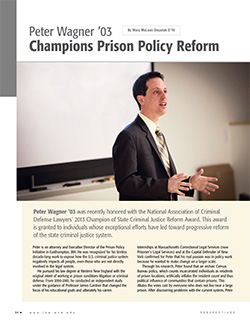
Our Executive Director, Peter Wagner, was featured in a Northampton Community TV segment about the Western Mass Hackathon’s Unlocking Prison Phone Data project, along with team member Jake Mitchell:

The project’s website will be launched shortly. Stay tuned!


Prison Policy Initiative's newest phone report is on the NIC homepage.

by Leah Sakala, June 24, 2013

We’re very excited to see that the National Institute of Corrections homepage is featuring our newest prison phone industry report:

NIC website screenshot


Our letter explains why the Harrison County, Mississippi Sheriff's Department should cancel plans to implement dramatic mail restrictions.

by Leah Sakala, June 13, 2013

The Mississippi Sun Herald printed my letter to the editor about why the Harrison County Sheriff’s Department’s plan to ban all non-legal letter correspondence to or from the jail is a bad idea:

Starting Monday, the Harrison County Sheriff’s Department plans to prohibit all non-legal mail except postcards. Such a policy would both decrease public safety and place an enormous burden on the families of incarcerated people. Also, as the courts have ruled, other jails have found that banning letters to and from home doesn’t actually cut costs.

My Prison Policy Initiative report, “Return to Sender: Postcard-only Policies in Jail,” finds postcard-only policies jeopardize critical social ties to families and friends, hindering re-entry and increasing the chances that people will commit more crime in the future. These policies also stifle important family communication and raise the price kids and other family members must pay to stay in touch.

If the sheriff’s department wants to increase public safety, it should immediately cancel the proposed postcard-only mail policy. The friends and loved ones of incarcerated people need to be allowed to maintain the connections that keep communities safe and families intact.

Check out our page on postcard-only policies in jails for more information on this harmful trend, and to learn how people around the country are fighting for the right to write letters.


by Peter Wagner, April 27, 2007

Gabriel Sayegh of the Drug Policy Alliance cites our research in an op-ed in yesterday’s Albany Times Union: Spitzer must lead drug law reform


David Feige's new chronicles one day in the life of a public defender in the South Bronx.

by Peter Wagner, June 19, 2006

book cover for indefensible

David Feige’s great new book, Indefensible : One Lawyer’s Journey into the Inferno of American Justice came out two weeks ago. Written by the former trial chief of the Bronx Defenders, Indefensible chronicles one day in the life of a public defender in the South Bronx. It’s a fast, exciting and very important book.

Read the book and David’s blog today.


The European Court rules that the disenfranchisement of 48,000 convicts in British jails violates the European convention on human rights.

by Peter Wagner, October 6, 2005

UK prisoners should get vote, European court rules

Simon Jeffery

Thursday October 6, 2005

“Laws setting out who can and cannot take part in elections are to be rewritten after the European court of human rights today ruled in favour of giving British prisoners the right to vote.

“Ruling in the case of a former prisoner against the United Kingdom, the Strasbourg court said the disenfranchisement of 48,000 convicts in British jails violated the European convention on human rights.

“It said that with the exception of the right to liberty, lawfully detained prisoners continued to enjoy all the rights guaranteed in the convention – including political rights and freedom from inhumane and degrading punishment.” ….

See the full story on the Guardian website.

Thank you to Rick Lines at the Irish Penal Reform Trust for the heads up about this exciting news.


As Hurricane Katrina began pounding New Orleans, the sheriff's department abandoned hundreds of inmates imprisoned in the city's jail.

by Peter Wagner, September 23, 2005

Officers Deserted a Jail Building, Leaving Inmates Locked in Cells

(New York, September 22, 2005)–

As Hurricane Katrina began pounding New Orleans, the sheriff’s department abandoned hundreds of inmates imprisoned in the city’s jail, Human Rights Watch said today.

Inmates in Templeman III, one of several buildings in the Orleans Parish Prison compound, reported that as of Monday, August 29, there were no correctional officers in the building, which held more than 600 inmates. These inmates, including some who were locked in ground-floor cells, were not evacuated until Thursday, September 1, four days after flood waters in the jail had reached chest-level.

“Of all the nightmares during Hurricane Katrina, this must be one of the worst,” said Corinne Carey, researcher from Human Rights Watch. “Prisoners were abandoned in their cells without food or water for days as floodwaters rose toward the ceiling.”

Read the rest from Human Rights Watch.


The Supreme Court today declared the juvenile death penalty to be unconstitutional.

by Peter Wagner, March 1, 2005

The Supreme Court today declared the juvenile death penalty to be unconstitutional. See the article on Civilrights.org.

With great pleasure, we’ve removed our map of counties that execute juveniles from the front page of this site.


Kevin Pyle and Craig Gilmore explore how mass incarceration alters both rural and urban communities.

by Peter Wagner, February 10, 2005

The Real Cost of Prisons Project, which does innovative popular education workshops on criminal justice issues, has completed the first of the comic books based on one of their workshops. comic book coverPrison Town: Paying the Price by Kevin Pyle and Craig Gilmore tells one story of the way in which the financing and siting of prisons and jails impact the people and economies of rural communities where prisons are built. It tells a parallel story of the damage done to people in urban communities by mass incarceration. Included is a two page “map” of How Prison Are Paid For (and who really pays?) as well as alternatives to the current system. It’s available on the web now in PDF and will be out in print in March 2005.

Other comic books being prepared for release later this spring are Prisoners of the War on Drugs and Prisoners of a Hard Life: Women and Children. Organizations can order up to 300 copies of each comic book for use in their own organizing, community education and outreach work for free, merely by explaining how they would use the books. See the instructions on the Real Cost of Prisons comics page.


Stay Informed


Get the latest updates:


Share on 𝕏 Donate