Shorts archives

Think Progress covers the push for the APA to recognize that pharmacists have a moral imperative to refuse to participate in the state-sanctioned administration of death.

by Leah Sakala, April 14, 2014

Our friend and colleague Kelsey Kauffman is urging the American Pharmacist Association to join virtually all other leading medical associations in declaring that the Hippocratic Oath bars medical professionals from participating in executions. As Tara Culp-Ressler reported in Think Progress:

States are turning to so-called “compounding pharmacies” — facilities that are outside of the regulatory scope of the Food and Drug Administration — to get the ingredients they need for untested cocktails like the one that killed McGuire. Compounding pharmacies, which repackage drugs to keep down the cost of filling prescriptions, are already controversial from a public health perspective. For instance, in 2012, a compounding pharmacy was identified as the source of a deadly meningitis outbreak that killed 36 people. Since then, Congress has worked to crack down on these unregulated facilities, although some public health advocates don’t believe the recent legislative push goes far enough.

Some compounding pharmacies have agreed to manufacture the drugs that states need to kill people, but state officials won’t always reveal the details. States like Oklahoma and Missouri claim that publicizing where they’re getting their lethal drugs will result in too much public pressure on the compounding pharmacies to stop producing them. So the methods they’re using for executions are increasingly kept secret, and it’s not entirely clear whether they’re violating the Constitution’s prohibition against “cruel and unusual punishment.”

Kauffman hopes that, if the American Pharmacist Association adopts a new policy position that forbids pharmacists from assisting in executions, this will all become moot because the employees at compounding facilities won’t be able to continue supplying these drugs. And, after attending APhA’s annual meeting at the end of last month, Kauffman believes senior officials in the pharmaceutical industry are receptive.

“I look at the American Pharmacist Association as a partner in this process, and when it comes to almost all of the pharmacists I spoke to, I see them as future allies,” she said, pointing out that medical professionals don’t have to be personally opposed to the death penalty to agree that it’s against their code of ethics to participate in them.

Kelsey is working with corporate accountability organization SumOfUs on a petition collecting 50,000 signatures to urge the American Pharmacists Association to ban its members “from participating in executions in any way.” Please sign if you haven’t already!


John Green responds to Hank's video about Mass Incarceration with his own insightful comments on racial disparities and why the U.S. has the world's highest incarceration rate.

by Peter Wagner, April 11, 2014

The other half of the Vlog Brothers, John Green, responds to his brother Hank’s amazing animated video about Mass Incarceration in the U.S. with his own insightful comments on racial disparities in prison and the one of the key reasons why the U.S. has the highest incarceration rate in the world: because sentences in this country are so much longer than for the same offense in other countries.

The best part is from 0:47 to 1:35:

I was also thrilled to see that one of John’s sources was this excellent article in The Economist America’s prison population: Who, what, where and why which was based on our briefing Mass Incarceration: The Whole Pie.


Conn. Judicial Committee hears testimony in favor of sentencing enhancement zone reform.

by Aleks Kajstura, March 13, 2014

Aleks testifies in CT for sentencing enhancement zone policy reform

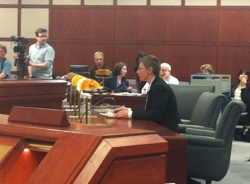
Yesterday, I testified before Connecticut’s Judiciary Committee in support of reforming Connecticut’s sentencing enhancement laws (my testimony starts at 3:34:03).

Connecticut’s 1,500-foot sentencing enhancement zones, meant to protect children from drug activity, are some of the largest in the country. I described how the law’s sheer expanse means it fails to actually set apart protected areas and that it arbitrarily increases penalties for urban residents. As Senator Holder-Winfield concisely explains, Senate Bill 259 would decrease that size to a more effective 200 feet.

For more details, check out the video above and my written testimony (with maps).

And check back in soon, I’m releasing a report examining Connecticut’s sentencing enhancement zones on the 28th.


The Prison Policy Initiative is thrilled to be chosen as one of three CharitySub organizations addressing this month’s “prison epidemic” theme.

by Peter Wagner, March 3, 2014

banner from CharitySub showing what a $5 gift to the Prison Policy Initiative will doThe Prison Policy Initiative is thrilled to be chosen as one of three CharitySub organizations addressing this month’s “prison epidemic” theme.

CharitySub is an innovative new approach to online giving. CharitySub members pledge $5 a month, and each month CharitySub picks a new cause and identifies three non-profits making a difference on that cause. Each month, CharitySub members get to pick which of the three organizations receives their $5.

You can join today to support this month’s organizations and learn about other organizations doing great work in the future.


Peter Wagner will discuss the hidden costs of mass incarceration on 2/10.

by Leah Sakala, February 6, 2014

Peter Wagner

Western New England University has released a press release detailing Peter’s upcoming Clason Speaker Series talk, “Overdosing on prisons: Tackling the side effects of the United States’ globally unprecedented use of the prison” this Monday, February 10th:

Wagner will discuss the hidden costs of mass incarceration for our democracy, our economy, and public safety. A 2003 graduate of the Western New England University School of Law, Wagner co-founded the Prison Policy Initiative in 2001, building an independent study project into a national movement against prison gerrymandering. His efforts have led to new legislation in four states including Maryland, where the law he helped write was affirmed by the United States Supreme Court. Wagner’s work has been featured in hundreds of newspapers nationwide, winning editorial endorsements for criminal justice reform from such publications as The New York Times> and the Boston Globe.

This lecture is free and open to the public. Hope to see you there!


Sarah advocates tirelessly to improve our criminal justice system, including working on projects to end prison gerrymandering and remove barriers to participation in our democratic process.

by Leah Sakala, February 5, 2014

Sarah Walker

The Minnesota Women’s Press has published a wonderful profile of Sarah Walker, Prison Policy Initiative board member and founder of the Minnesota Second Chance Coalition.

Sarah tirelessly advocates to improve our criminal justice system, and her work includes projects to end prison gerrymandering, remove barriers to participation in our democratic process, promote gender-responsive justice policy, and overcome harmful racial disparities.

Congratulations, Sarah!


Leah spoke with the Valley Advocate about PPI's testimony in support of S 1171.

by Leah Sakala, January 3, 2014

I spoke with the Valley Advocate for a new article on a bill to ban the routine use of physical restraints on incarcerated pregnant women after the first trimester, including during labor and delivery.

The bill was up for a hearing earlier this month, and we submitted written testimony urging the legislature add Massachusetts to the growing list of states that have rejected this inhumane and dangerous practice.

We’ll be reporting back with updates, so stay tuned!


We're partnering with SumOfUs to collect petitions supporting the FCC's next steps in regulating the prison phone industry.

by Aleks Kajstura, December 4, 2013

We’re partnering with SumOfUs to help you take advantage of the Federal Communications Commission’s call for comments on its proposal to extend its new prison phone regulation to in-state calls.

Last year SumOfUs members submitted 36,690 petitions, which were cited in the FCC’s recent historic ruling capping the price of interstate calls, so their help — and yours will make a great difference for families who need to make in-state calls, which still remain unregulated!

Sign the petition today and please share with your networks so that the FCC hears us loud and clear by its December 13th deadline!


"Peter Wagner ’03 was recently honored with the National Association of Criminal Defense Lawyers’ 2013 Champion of State Criminal Justice Reform Award."

by Leah Sakala, November 8, 2013

Perspectives article featuring Peter Wagner

The newest issue of the Western New England College of Law alumni magazine Perspectives includes a nice profile of Peter Wagner (class of 2003):

Peter Wagner ’03 was recently honored with the National Association of Criminal Defense Lawyers’ 2013 Champion of State Criminal Justice Reform Award. This award is granted to individuals whose exceptional efforts have led toward progressive reform of the state criminal justice system.

Peter is an attorney and Executive Director of the Prison Policy Initiative in Easthampton, MA. He was recognized for his tireless decade-long work to expose how the U.S. criminal justice system negatively impacts all people, even those who are not directly involved in the legal system.


by Peter Wagner, October 19, 2013

When Charles Dickens came to the United States, he wanted to see two things: Niagara Falls and Eastern State Penitentiary. He expected to be impressed with this radical new type of prison with a solitary confinement system. Instead, he was horrified. PPI’s Leah Sakala made this graphic to commemorate this anniversary:

graphic about charles dickens and solitary confinement


Stay Informed


Get the latest updates:


Share on 𝕏 Donate