Uncategorized archives

As 2015 winds to a close, the Prison Policy Initiative wanted to recognize eight investigative news stories that brought public attention to key issues in criminal justice reform.

by Peter Wagner and Bernadette Rabuy, December 28, 2015

As 2015 winds to a close, the Prison Policy Initiative wanted to recognize eight investigative news stories that brought public attention to key issues in criminal justice reform. In no particular order:

  • Hundreds of South Carolina Inmates Sent to Solitary Confinement Over Facebook
    by Dave Maass
    Electronic Frontier Foundation
    An exposé finding that in some states incarcerated people are sent to solitary confinement for years for having Facebook accounts, even if family members on the outside are the ones accessing the accounts. In response to the original exposé, Facebook has taken steps to reform its policy of taking down incarcerated people’s Facebook accounts for state Departments of Corrections.
  • Prison Born
    by Sarah Yager
    The Atlantic
    Shining light on the rarely talked about experience of women in prison, this article focuses on the 1 in 25 women who are pregnant behind bars.
  • Probation May Sound Light, but Punishments Can Land Hard
    by Shaila Dewan
    The New York Times
    Probation can sound infinitely better than a jail sentence, but this article describes how too often probation sets people up to fail.
  • Chain Gang 2.0: If You Can’t Afford This GPS Ankle Bracelet, You Get Thrown in Jail
    by Eric Markowitz
    International Business Times
    Electronic monitoring is often seen as an “alternative to incarceration,” but Markowitz’s special report finds that for-profit GPS tracking ends up being a perfect recipe for sending people back to jail.
  • Amid Backlash Against Isolating Inmates, New Mexico Moves Toward Change
    by Natasha Haverty
    NPR
    The second in a three-part series on solitary confinement in the U.S., this 6-minute story covers growing interest in curbing the use of isolation in prisons and the challenges that come with implementing reforms.
  • For Men in Prison, Child Support Becomes a Crushing Debt
    by Eli Hager
    The Marshall Project
    Is it reasonable to expect men in prison to pay child support? Is exempting incarcerated fathers fair? This Marshall Project feature finds that many incarcerated fathers are racking up hundreds of dollars in child support debt each month.
  • Should Prison Sentences Be Based on Crimes That Haven’t Been Committed Yet?
    by Anna Maria Barry-Jester, Ben Casselman and Dana Goldstein
    FiveThirtyEight
    It’s becoming increasingly common to hear talk of “risk assessments” and “evidence-based” tools in criminal justice. This story and interactive tool unpack how risk assessments work and describe what makes Pennsylvania’s plans different: it would be the first to use risk assessment in sentencing rather than, for example, at the pretrial phase.
  • An Inmate Dies, and No One is Punished
    by Michael Winerip and Michael Schwirtz
    The New York Times
    This article chronicles the brutal death of Leonard Strickland, one in a larger trend of troubling beatings by corrections officers in New York State prisons. This recent New York Times article details the steps New York State prisons are now taking to better track complaints about corrections officers.

Note: The purpose of this list is to highlight journalists who filled critical gaps in the public’s knowledge about criminal justice issues. To keep things fair, we excluded from consideration any articles that we are quoted in and articles that we consulted on in any way.


The Iowa Governor's Working Group On Justice Policy takes up our recommendations on phone justice.

by Peter Wagner, December 28, 2015

In August, I gave the keynote address at the Iowa-Nebraska NAACP’s
Iowa Summit on Justice & Disparities and a major topic was the need for prison phone justice. At that meeting, Governor Brandstad announced a Governor’s Working Group On Justice Policy to address several problems, including the need for phone justice.

In September, I testified by phone to the Working Group about steps Iowa could take.

In November, Governor Brandstad announced the Working Group’s recommendations (summary | details ) which he wanted introduced in the next legislative session. The proposed phone reforms include:

  • Renegotiate contracts with the Iowa Communications Network and seek bids from other vendors with the goal of reducing rates paid by prison inmates and their families.
  • Transition to a per minute calculation for call costs rather than a flat fee.
  • Enable and encourage counties to partner with one another or the Department of Corrections to negotiate more favorable rates with phone vendors.

Eleven ideas for criminal justice reforms that are ripe for legislative victory.

by Bernadette Rabuy and Peter Wagner, December 21, 2015

With the 2016 legislative sessions about to start, it’s time to unveil our third annual list of under-discussed but winnable criminal justice reforms.

The list is published as a briefing with links to more information and model bills, and it was recently sent to reform-minded state legislators across the country. The reform topics we think are ripe for legislative victory are:

  • Ending prison gerrymandering
  • Lowering the cost of calls home from prison or jail
  • Repealing or reforming ineffective and harmful sentencing enhancement zones
  • Protecting in-person family visits from the video visitation industry
  • Stopping automatic driver’s license suspensions for drug offenses unrelated to driving
  • Protecting letters from home in local jails
  • Requiring racial impact statements for criminal justice bills
  • Repealing “Truth in Sentencing”
  • Creating a safety valve for mandatory minimum sentences
  • Immediately eliminating “pay only” probation and regulating privatized probation services
  • Reducing pretrial detention

Let us know what you think of this year’s list. We look forward to working together to make 2016 a year of great progress for justice reform!


U.S. locks up more than 2.3 million people in prisons, jails, and other facilities on any given day. New report provides foundation for long overdue conversation about criminal justice reform.

December 8, 2015

FOR IMMEDIATE RELEASE: December 8, 2015

Contact:
Bernadette Rabuy
brabuy [at] prisonpolicy.org

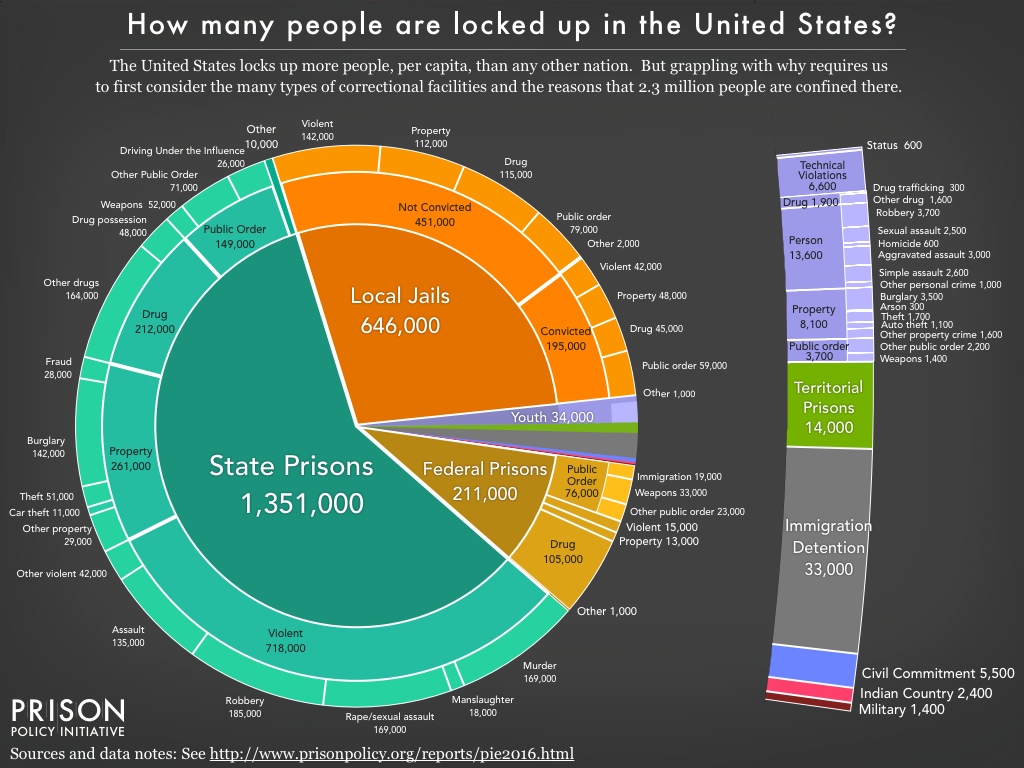
Easthampton, MA — With 2.3 million people locked up in more than 7,000 correctional facilities operated by thousands of agencies, getting the big picture is anything but easy. Today, with the publication of Mass Incarceration: The Whole Pie 2015, the Prison Policy Initiative provides the answer to how many people are locked up in the U.S., where, and why. Building upon our groundbreaking 2014 report that, for the first time, aggregated the disparate systems of confinement, this updated version contains further detail on why people are locked up:

pie chart showing the number of people locked up on a given day in the United States by facility type and the underlying offense using the newest data available in December 2015

As we discuss in our report, looking at the “whole pie” allows us to cut through the fog to answer key questions such as:

  • After state prisons, what is the next biggest slice of confinement?
  • How does the number of people that cycle through correctional facilities in a year differ from the number of people locked up on a particular day?
  • How important is it to ending mass incarceration that we reform the policies that increasingly detain people pretrial?
  • How many people nationwide are imprisoned because their most serious offense was a drug offense?
  • How does the number of people in correctional facilities compare to the even larger number of people on probation and parole?

Armed with the big picture, Mass Incarceration: The Whole Pie 2015, gives the public and policymakers the foundation to now consider the types of changes that would end the country’s reign as the number one incarcerator in the world.

The report is available at: http://www.prisonpolicy.org/reports/pie2015.html

-30-


Jail churn and pre-trial detention are even more important than a quick look at the data suggests. Here, we correct for the fact that a sizable number of people are housed in jails for other agencies.

by Peter Wagner, December 8, 2015

In August, I wrote a piece called Jails Matter. But Who is Listening? about the importance of focusing on jails, given their locus as the place where most of the people who go to prison or jail in a year are initially locked up.

In that piece, I talked about the tremendous churn of people through our jail system (11 million people a year) and about how 99% of the growth in the jail population in the last 15 years has been in the “unconvicted” or pretrial population. Only a minority of people in jails have been convicted and are serving a typically short misdemeanor sentence. Of the larger, unconvicted group, I wrote:

These people are legally considered innocent until proven otherwise in court. But if they don’t have the money to post bail, the principle that they are legally innocent is not enough to keep them from being locked up until trial.

And:

getting to the bottom of this country’s jail problem is going to depend on both reducing the number of people we send to jail each year and making it far easier for those who have been arrested to resume their lives while the judicial process proceeds.

Holding people in jail for even a few days has been demonstrated to do permanent harm, so this should be an obvious priority. If you are, at this point, fully convinced of that point, you can stop reading now. If you needed to know that more than 99% of the jail population growth is pretrial detainees, or if you are really interested in jail data calculations, keep reading.

We just connected the dots on an interesting quirk in how the data for convicted/unconvicted is calculated for jails that makes focusing on the flawed policies that send people to jails and keep them there even more important.

Jails, as we know, house people for other agencies, with the two largest groups being for Immigration and Customs Enforcement (ICE) at about 2% of their population, and also for state and federal prisons.

As the Bureau of Justice Statistics shows in Prisoners in 2014, 81,738 people were held in jails on behalf of federal or state prisons. The numbers of people held for federal authorities is small, but the number held for state authorities constitutes 6% of the total state prison population. Some states don’t do this at all, but in Kentucky, Mississippi, and Tennessee, more than a quarter of the state prison population is in local jails, and in Louisiana more than half of the state prison population is in the local jails.

So what’s important here is that there are a lot of people reported as convicted in jails who aren’t serving short misdemeanor sentences after being convicted in local courts but are serving state or federal prison sentences and just housed in local jails.

Of course, this isn’t the Bureau of Justice Statistics’s fault. They are asking a very useful question and getting useful data that answers their question. It just so happens that their data needs some adjustment to answer the slightly different question of: How important is it for local officials to focus on pretrial/unconvicted populations?

The answer: It’s very important that we get local officials to focus on the policies that impact the size of their pretrial populations because that’s the overwhelming majority of the people in jail on a given day. Excluding people confined under contract with ICE from the unconvicted population and excluding people confined under contract with state or federal prisons from the convicted population leaves us with this breakdown:

graphic showing the portion of the jails population that is convicted and unconvicted with and without including the tens of thousands of immigration detainees and state/federal prisoners who are also housed in jails


Can you make a gift today to fuel the movement to end mass incarceration?

by Peter Wagner, November 30, 2015

The Prison Policy Initiative has celebrated some huge victories recently: historic prison and jail phone industry regulation, making strides towards a national end to prison gerrymandering, and reversing bans on in-person family visitation in Oregon and Texas jails.

Here at the Prison Policy Initiative, we know that in order to keep winning victories for fairness and justice, the movement to end mass incarceration needs compelling and up-to-date information about the U.S. incarceration crisis. This year, we’ve continued to fill critical gaps in the movement’s knowledge with exciting reports that:

  • Show that each state’s rate of incarcerating women is far out of step with the rest of the world. Compared to other countries, most U.S. states lock up proportionally more women than any other country in the world.
  • Uncover the data to show that even before their incarceration, the people in prison are much poorer than Americans of similar ages, race/ethnicity and gender. This report was also the first to provide the pre-incarceration incomes of women in prison.
  • Reframe the entire debate about visitation and reentry with new data that demonstrates that incarcerating people far from home actively discourages family visits.
  • Provide critical new data to demonstrate the degree to which mass incarceration transfers people of color to predominantly white communities.
  • Demonstrate that jails, not just prisons, matter in policy discussions because 11 million people cycle through jails, and the dramatic growth in the jail population is the direct result of policies that increasingly detain people awaiting trial.

These reports were made possible by the generosity of a small group of individual donors. Can you make a gift today so we can both advance specific campaigns for justice and produce critical research?

To encourage you to give generously, some of our existing donors will match the first $19,000 that we receive in this appeal.

We thank you for standing by our side in the fight for fairer and safer communities for everyone.


How do the campaign contributions of the prison phone industry compare to those of the private prison industry?

by Peter Wagner, November 25, 2015

The Voice of OC has revealed that $85,000 in campaign contributions to two Orange County, California county supervisors by Global Tel*Link flipped the two supervisors from being opponents of charging families high phone rates into supporters.

The Voice of OC articles are a must-read (first article, second article), and they have a video showing the dramatic change in positions:

We’re thrilled to see more investigation of the phone companies using campaign contributions to purchase influence. We broke the first story of this type in August, with our exposé that found that Securus was one of the largest contributors to the sheriff’s reelection campaign in Sacramento, California. Notably, this is a county where Securus did not have the contract, but clearly wanted to be the winning bidder when the contract was next put out for bid.

How big is $85,000 in campaign contributions, exactly? To be sure, it pales in comparison to the $4 million/year in kickbacks that the contract would give to the Orange County slush fund called the “Inmate Welfare Fund”. (Despite the name, the funds can be used for almost anything, and as the Voice of OC article says, most of it is spent on staff salaries.)

On the other hand, $85,000 was apparently enough to change these two votes in this one county. And it’s a massive sum when you compare it to the outrage that was aimed at Hillary Clinton after The Intercept reported that bundlers associated with the private prison industry were supporting her presidential campaign with similar amounts of money. (ColorOfChange says that the total received by the Clinton campaign from the industry was $133,000.)

It’s stories like this that illustrate two points we’ve been making a lot lately:

  • Jails matter. Their policies might be set by 3,000 local governments, which can make them hard to follow and understand. But we need to look at jails, which are literally mass incarceration’s front door.
  • Private prisons get all the attention, but other kinds of prison profiteers like the prison phone industry and the California guard union are just as successful — if not more so — at buying the outcomes they want.

Report reveals that every US state incarcerates women at higher rate than most countries, shows growth of women's incarceration in the US over the last century.

November 18, 2015

report thumbnailEasthampton MA — How does your state compare to the international community when it comes to incarcerating women? Not very well, says a new infographic and report from the Prison Policy Initiative.

The report, “States of Women’s Incarceration: The Global Context,” shows that every American state is out of step with the rest of the world.

While there are important differences in the extent and rate at which different U.S. states incarcerate women, there are also differences between how American states, and the country as a whole, compare with most other nations in their propensity to incarcerate women.

“Our analysis shows that even states which seem to incarcerate women less than others in the U.S. are in fact incredibly punitive once that isolationist worldview is broadened,” said Aleks Kajstura, Legal Director of the Prison Policy Initiative. “Every single state incarcerates women at a rate that far exceeds international norms.”

This report is the first to directly put individual U.S. states’ rates of incarcerating women in the global context. The report draws on international statistics from the London-based Institute for Criminal Policy Research, state-level data from the U.S. Census Bureau for interstate and international incarceration comparisons, and historical data from various sources for a detailed look at the U.S.’s past record on women’s incarceration.

The Prison Policy Initiative found that nearly 30% of the world’s incarcerated women are imprisoned in the U.S. even though only 5% of the world’s women live here. Overall, with the exception of Thailand and the U.S. itself, the top 44 jurisdictions throughout the world with the highest rate of incarcerating women are individual American states.

In Illinois, the incarceration rate for women is on par with El Salvador, where abortion is illegal and women are jailed for having miscarriages. New Hampshire is on the same level as Russia, and New York with Rwanda.

“The statistics revealed by this report are simple and staggering” the report concludes. “They suggest that states cannot remain complacent about how many women they incarcerate. Women should be a mainstay of any state policy discussions on the economical and effective use of incarceration if we hope to incarcerate fewer women.”

The non-profit, non-partisan Prison Policy Initiative produces cutting edge research to expose the broader harm of mass incarceration, and then sparks advocacy campaigns to create a more just society. This report was prepared by Aleks Kajstura, Legal Director of the Prison Policy Initiative, and Russ Immarigeon, an independent researcher and editor of the two-volume set, Women and Girls in the Criminal Justice System: Policy Strategies and Program Options (Civic Research Institute, 2006, 2011).

For further information, contact Aleks Kajstura at akajstura [at] prisonpolicy.org.

Links:

– 30 –


by Aleks Kajstura, November 17, 2015

Last month James Kilgore published a new report evaluating the use of electronic monitoring as an alternative to incarceration. Drawing on an impressively wide range of sources, “Electronic Monitoring Is Not the Answer: Critical reflections on a flawed alternative” tackles the use of electronic monitoring in the context of mass incarceration and the expanding surveillance state.

The report recommends 14 guiding principles for re-framing the U.S.’s approach to electronic monitoring, concluding that:

In the present context, there is little evidence to support EM as a genuine alternative to incarceration. At the same time, EM is not going to go away, especially with the constantly expanding capacity of devices to track and gather other data. If decarceration gathers steam, EM will become an important option. Before that happens, the debate around its use and implications needs to sharpen. Any useful framing must open up a dialog around the rights of the monitored and link EM to state and corporate surveillance. Otherwise, we run the risk of hundreds of thousands of people being virtually incarcerated in their homes and of the net widening to track many more who have not even had an encounter with law enforcement.

A point by point summary and full report are available here.


Oliver illustrates the various ways that we set formerly incarcerated people up to fail and says we're all responsible

by Bernadette Rabuy, November 11, 2015

John Oliver explains another broken aspect of the criminal justice system, re-entry. Oliver illustrates the various ways that we set formerly incarcerated people up to fail, from restrictions on housing and employment to the rolling back of Pell grants. According to Oliver, because of the resounding and bipartisan support for enacting barriers to re-entry during the tough-on-crime era, we should all feel responsible for the lack of opportunity available to people trying to turn their lives around.


Stay Informed


Get the latest updates:


Share on 𝕏 Donate