Uncategorized archives

Can you make a gift today and join the Individual donors who are fueling the movement for justice reform?

by Peter Wagner, October 6, 2014

handout describing PPI's national incarceration briefing series

As we wrote in our brand new annual report, this has been an especially prolific year for the Prison Policy Initiative. For example, in addition to our ongoing campaign work, we were frustrated that major data gaps were holding back the movement for justice reform. So, we stepped up to the plate by creating our first National Incarceration Briefing Series: four ambitious reports (and 50 state incarceration profiles) that reveal the current state of the U.S. carceral crisis.

These publications — funded entirely by individual donor support — were so popular that they overwhelmed our server and sparked more media attention than we could keep track of.

We’re just getting started. We’re primed to start working on a follow up Briefing Series, on top of keeping up the momentum on our major campaigns, but we need your help. Can you take a minute today to propel the movement for justice forward by making a gift to support our work?

Your generous gift will be doubled thanks to a matching challenge sponsored by other donors. Thank you for your partnership in this movement for justice.


Center for Public Integrity releases first part of a series on web of prison bankers, private vendors, and corrections agencies profiting off families of the incarcerated.

by Bernadette Rabuy, September 30, 2014

Daniel Wagner and Eleanor Bell of the nonprofit investigative news organization, the Center for Public Integrity, have recently released “Prison bankers cash in on captive customers” and the video Time is Money, part one of a two-part series on the growing web of prison bankers, private vendors, and corrections agencies that profit off the backs of families of the incarcerated.

The Center for Public Integrity’s six-month investigation found plenty of families making necessary sacrifices in order to support and maintain contact with their incarcerated loved one. In order to send money to their incarcerated loved one, family members would sometimes be forced to forego medical care, skip utility bills, and even limit visits with their loved one. Meanwhile, corporations such as JPay, which handles deposits into incarcerated individuals’ accounts, generated well over $50 million in revenue in 2013. Vincent Townsend, president of prison phone company, Pay-Tel Communications, agrees that there’s something wrong with this, telling the Center for Public Integrity, “My industry has abused the public and I’m willing to admit that.” And beyond prison vendors’ profits, there is still the share of profits that gets returned to corrections agencies, often called commissions or kickbacks.

Stay tuned for part two, which will run this Thursday!


by Peter Wagner, September 29, 2014

We just released our 2013-2014 Prison Policy Initiative Annual Report, which I’m thrilled to say details greater progress on more fronts than ever before. A combination of new and ongoing partnerships has allowed us to win solid victories on our ongoing campaigns, step up to the plate on new issues, and also work on strengthening the reform movement by filling in some major national data gaps.

thumbnails of Prison Policy Initiative annual report for 2013-2014

Here are just a few campaign highlights:

  • We made headway towards a national solution to prison gerrymandering, joined with our allies in a lawsuit to protect the voting rights of the citizens of Cranston, RI, supported the new Massachusetts resolution urging the Census Bureau to count incarcerated people at home, and continued to build momentum in state-based campaigns around the country.
  • Our research and advocacy urging the Federal Communications Commission (FCC) to protect the families of incarcerated people from the predatory prison and jail phone industry helped to win historic FCC regulation. We’ve continued to generate public support for further reform, including a petition with our partners at SumOfUs that collected 23,585 signatures.
  • We expanded our research on overreaching geography-based penalties to release an in-depth report on sentencing enhancement zones in Connecticut, which helped rally support for reform in the state’s legislature.
  • We took on additional issues, including releasing the first-ever report to document the problem of driver’s license suspensions for drug offenses unrelated to driving, and helping Massachusetts to become the 21st state to ban practice of unnecessarily shackling women who are giving birth while incarcerated.

Generous individual donors’ support also allowed us to bring in new allies to the criminal justice reform movement and fill major data gaps that had been holding the movement back. For example:

Other highlights from the past year include hiring our new Policy & Communications Associate Bernadette Rabuy and bringing several accomplished new board members on board.

While the most recent national statistics on prison population increases were sobering, our accomplishments over the past year are a testament to the collective strength of the national movement for criminal justice reform. I’m so grateful to the partners and supporters who make our work possible. If you are able to join them in making a tax-deductible contribution to our work, your support will go twice as far thanks to a match commitment from a small group of other donors like you.

Thank you! We can’t wait to see what this coming year will bring!


Governor Brown signs California prison anti-sterilization bill into law.

by Bernadette Rabuy, September 26, 2014

Yesterday, Governor Jerry Brown signed SB 1135 (Senator Hannah-Beth Jackson), putting an end to sterilization abuse in California prisons. This is a well-earned victory for our friends at Justice Now, whose hard work allowed the bill to pass unanimously out of both the Senate and Assembly.

“This bill not only affects those still inside prisons and the thousands of women who will go through prisons and jails in the near future; but most importantly it protects generations of children to come who otherwise might not have had an opportunity to exist” says Kelli Dillon who was sterilized in her early 20’s while incarcerated at Central California Women’s Facility in Chowchilla. Kelli, however, goes on to say “we still need an apology and acknowledgement of what was done to us.” While this bill comes a long way in addressing the abusive and coercive conditions under which sterilizations were happening it is a reminder that work still needs to be done to properly address those who had their ability to have children so callously and egregiously taken away.

We are glad that Governor Brown has taken a step toward reversing California’s shameful legacy of eugenics, and we are hopeful that this bill will support California prisons in more effectively protecting the human rights of the incarcerated.


In March, we were honored to be one of the three charities chosen by CharitySub as one of three organizations addressing the prison epidemic. We report back.

by Peter Wagner, September 19, 2014

A check from Charity Sub

In March, we were honored to be one of the three charities chosen by CharitySub as one of three organizations addressing the prison epidemic.

CharitySub is an innovative new approach to online giving. CharitySub members pledge $5 a month, and each month CharitySub picks a new cause and identifies three non-profits making a difference on that cause. Each month, CharitySub members get to pick which of the three organizations receives their $5. Most recently, Charity Sub members have supported organizations addressing STEM education, wildlife welfare, beach conservation, drug free youth, and — this month’s topic — body image.

You can join today to support this month’s organizations and learn about other organizations doing great work in the future.

Thank you, Charity Sub members, for supporting our work. With your help, we won a big victory two weeks ago, convincing Dallas County Texas to reject a video visitation contract that was going to replace the usual visiting hours for families with expensive video visitation. This is the first time the public was able to stop one of these anti-family contracts, so we expect it will have a national effect. Thank you for making this victory for families possible.


While recent BJS figures showed an increase in total incarcerated population, crime figures show a decrease in violent crime.

by Bernadette Rabuy, September 18, 2014

bjs violent crime 1993-2013This morning, two days after releasing, Prisoners in 2013 the Bureau of Justice Statistics released, Criminal Victimization, 2013. Once again, the BJS released criminal justice figures that reverse the trend of the past few years. After two years of slight increases in the nation’s violent crime rate, the violent crime rate declined slightly from 26.1 victimizations per 1,000 persons in 2012 to 23.2 per 1,000 in 2013. (The crime rate is now re-approaching the record low it hit in 2010 and is far lower than it was two decades ago.)

While there were no statistically significant changes in most other types of crime, the slight drop in the crime rate was mostly the result of a decline in simple assault, which is violence that doesn’t include a weapon or serious injury. The decline in simple assault accounted for about 80% of the change in total violence. The rate of property crime also fell from 155.8 victimizations per 1,000 households in 2012 to 131.4 per 1,000 in 2013.

These figures led to an interesting discussion on Twitter among those of us who have been closely following BJS’ recent releases. In BJS’ Prisoners in 2013, we learned that the state and federal prison population increased slightly from 2012 to 2013, the first overall increase since 2009. Although these figures may point out that it is too early to be celebrating the end of mass incarceration, it is safe to say that the state and federal prison population has held fairly steady compared to the rapid rise of earlier decades.

As Mariame Kaba of Project NIA tweeted, it is extremely difficult to draw a relationship between the imprisonment rate and the crime rate. In Ted Gest’s analysis of Criminal Victimization, 2013, he wrote for The Crime Report,

Critics question why more people should be behind bars while crime is dropping. The basic answer is that there is not necessarily a connection between the two sets of numbers.

The Pew Public Safety Performance Project recently released a data visualization trying to illustrate the complex link between prison and crime. While the BJS’ releases looked at the change in incarceration and crime over the last year, the Pew Public Safety Performance Project recently analyzed state incarceration and crime rates from over the last two decades. They found that the five states with the largest decreases in their imprisonment rates were able to reduce their crime rates. Overall, there isn’t a clear-cut trend, but one thing is clear: locking more people up doesn’t necessarily lead to less crime.

prison and crime

The visualization is a reminder of what we found in our report, Tracking State Prison Growth in 50 States: State policy drives mass incarceration. States with high rates of incarceration have very little to show for it.


Our briefing on the new Bureau of Justice Statistics numbers spark discussion on Twitter.

by Catherine Cain, September 18, 2014

On Tuesday, the Prison Policy Initiative released a briefing on the Bureau of Justice Statistics’ national update for 2013, Prisoners in 2013. PPI’s briefing highlighted continuing racial disparities within the prison system and record high prison populations in 14 U.S. states. It also showed that, after three years of decline, the total prison population has increased and disproved any relationship between state crime rates and incarceration rates. After posting some of these highlights on Twitter, we received a variety of excited responses and more twitter traffic than we’ve seen since June.

Here is what a few users had to say:

Liam Johnston succintly tweets:

PPI supporter and board member Heather Ann Thompson:

The Southern Poverty Law Center called our briefing a must read.

Organizer with Milk Not Jails, Brenden Beck, also noted:

A lot of people pulled out their favorite findings from our briefing, including the racial disparity facts:

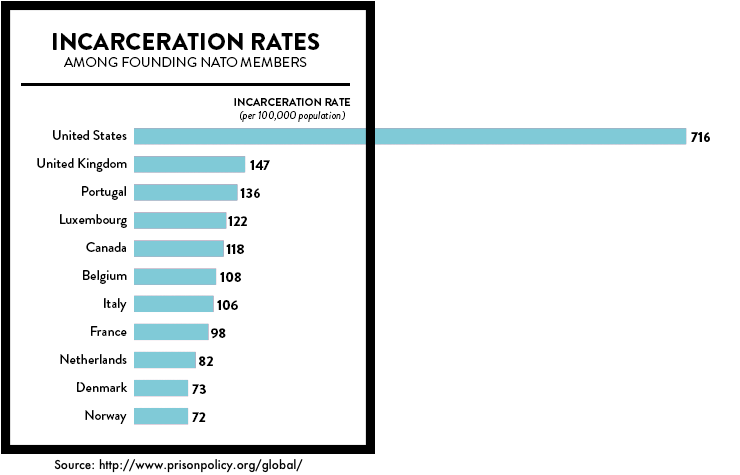
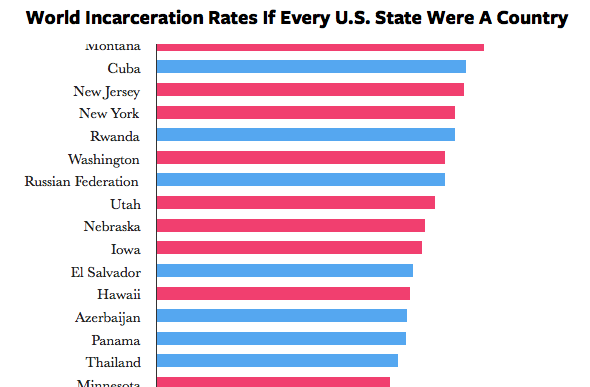
After learning that 14 individual U.S. states set record high prison populations this past year, many twitter followers also commented on how these individual states– as well as the U.S. as a whole –measure in comparison to other countries. Some commentators revisited statistics that the Prison Policy Initiative published last year, States of Incarceration: The Global Context:

Orleans Public Defender tweets:

Feel left out on all the action? Follow us on Twitter.


Sesame Street's series on incarceration, with videos, activities, and tips for parents, providers, and caregivers

by Bernadette Rabuy, September 18, 2014

A couple of months ago, John Oliver did a hilarious episode on prisons including a scene in which Oliver sings about prisons with Sesame Street muppets. A few days ago, thanks to a tweet by the Southern Coalition for Social Justice, we got to see another, animated video from the Sesame Street series, “Little Children, Big Challenges: Incarceration.”

It’s a heartbreaking video and also an opportunity to get a glimpse into the life of a child with an incarcerated parent. Along with a series of videos with muppets and real kids’ stories, the Sesame Street toolkit includes activities and tips for incarcerated parents, providers, and caregivers. We agree with John Oliver that it’s great to see Sesame Street addressing mass incarceration, but it’s beyond disturbing that our nation’s failed policies and practices leave more than 2.7 million children with an incarcerated parent.


New report serves as a sobering reminder that state-level criminal justice policy decisions are continuing to ensure that our nation remains the top incarcerator in the world.

by Peter Wagner and Leah Sakala, September 16, 2014

bjs report cover thumbnailThis morning, the criminal justice policy world got a new key metric on mass incarceration in the U.S.: the Bureau of Justice Statistics’ national update, Prisoners in 2013. This report serves as a sobering reminder that state-level criminal justice policy decisions are continuing to ensure that our nation remains the top incarcerator in the world. While the report indicates a few promising improvements, the overall picture is grim.

Key takeaways from the report:

  • Overall, the state and federal prison population increased slightly between 2012 and 2013. Although this is the first overall increase since 2009, the overall prison population has held fairly steady compared to the rapid rise of earlier decades.
  • The number of people incarcerated in California increased. In the past several years, in response to a Supreme Court mandate, California’s prison population declined enough to pull the national incarceration rate down.
  • While the total number of people incarcerated grew, the country as a whole grew faster, so there was a slight decline of less than half of a percent in the incarceration rate. This change is far too small to impact the results of our June report States of Incarceration: The Global Context finding that every state in this country uses incarceration far more than most of the world.

Here’s the good news:

  • For the first time, the federal prison population reported a decline. Over the last decade, the federal Bureau of Prisons had been reporting a growth rate more than 4 times faster than the states, so this is a significant change in direction.
  • Some states continue consistent declines in their prison population: New York and New Jersey have declined populations every year but one since 1999, Hawaii has declined for eight years in a row, and South Carolina 4 years in a row.
  • 21 states reported declines in their sentenced prison population
  • 10 states that had reported growing prison populations for both 2011 and 2012 reported a decline in 2013.

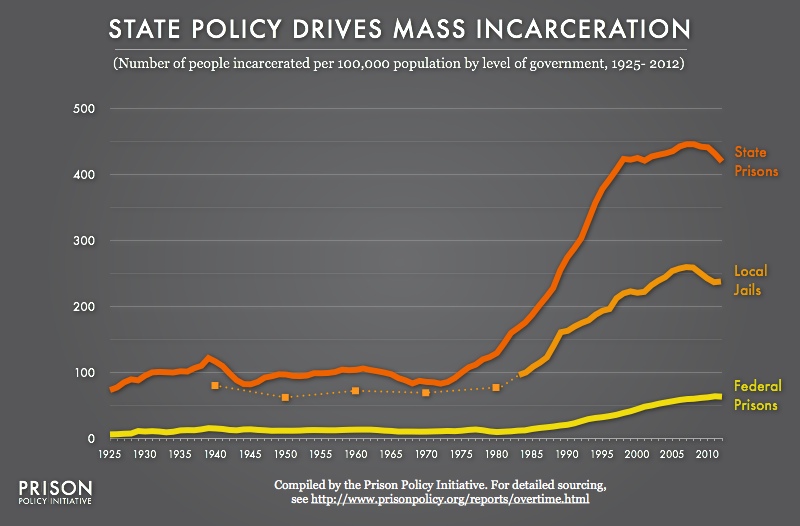
Graph showing the number of people per 100,000 population in federal prisons, state prisons and local jails from 1925 to 2012, with the highest rates for state prisons followed by local jails. Ending the U.S. experiment with mass incarceration requires us to focus on state policy because individual states are the most active incarcerating bodies in the nation. Graph from our May 2014 report, Tracking State Prison Growth in 50 States shows the number of people (per 100,000 national population at that time) that is confined in state, local and federal correctional facilities from 1925 to the present. State prisons are the largest part. (See larger or as raw numbers.)

And the bad news:

  • Reversing 3 years of declining populations, the total prison population increased.
  • The number of admissions to prison increased and the number of releases fell in 2013. Each are a bad sign and the combination of both is particularly harmful.
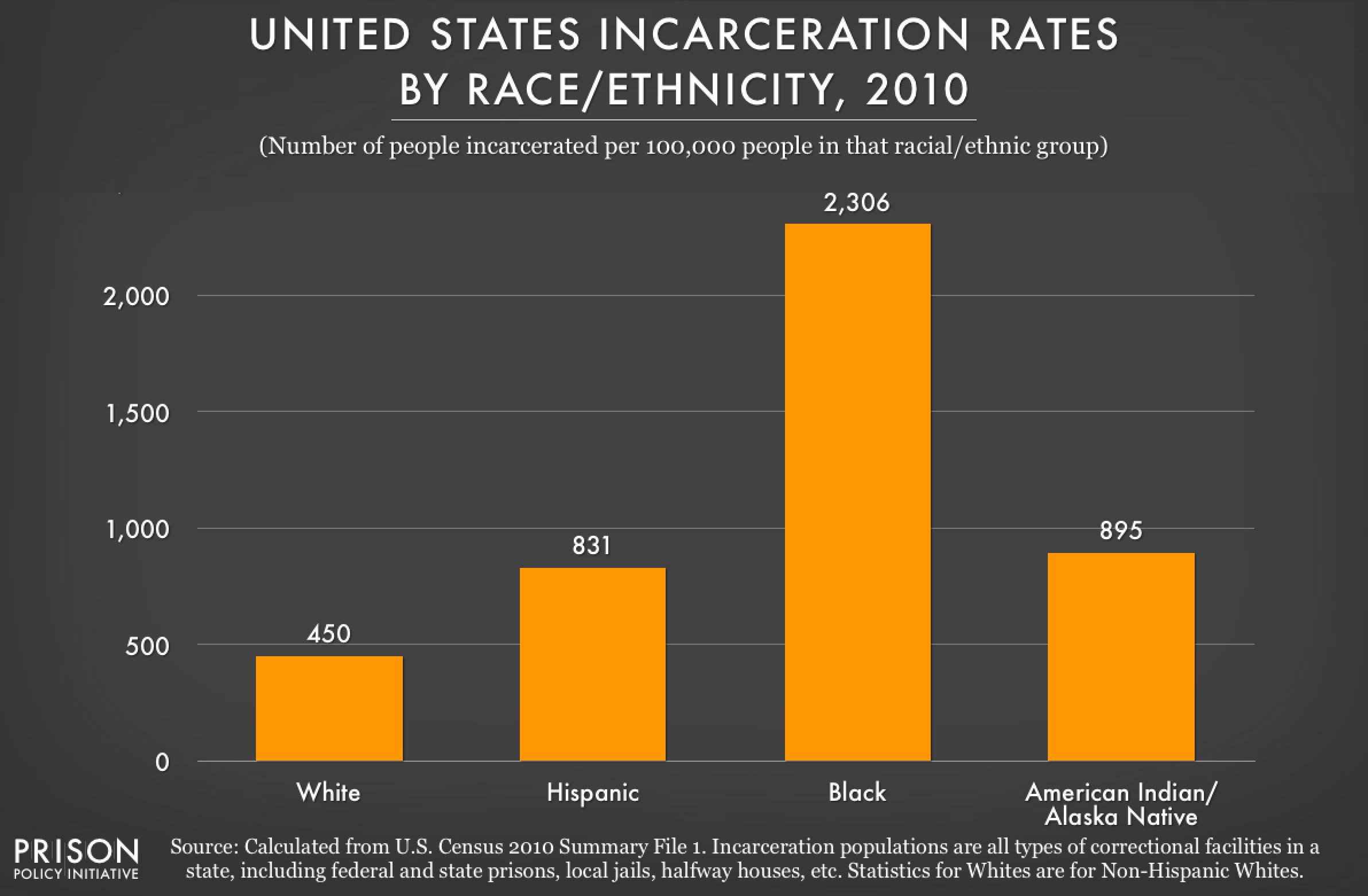
  • Racial disparities continue to constitute the defining characteristic of the prison system. For example, 3% of Black males of all ages are currently incarcerated in state or federal prisons. This is a rate 6 times higher than white males.
  • 14 states hit new record high prison populations in 2013: Arizona, Arkansas, Indiana, Kansas, Minnesota, Missouri, Nebraska, North Dakota, Ohio, Oklahoma, Oregon, Tennessee, Utah, and Wyoming.
  • Texas, one of the states with the highest incarceration rates and which had a much heralded “reform” of its prison population, saw an increase in both its total prison population, its sentenced population, and its incarceration rate.

And remember, this new report from the Bureau of Justice Statistics is just talking about the state and federal prison population, which form just a portion of the much larger incarceration pie of which jails are the next largest piece:

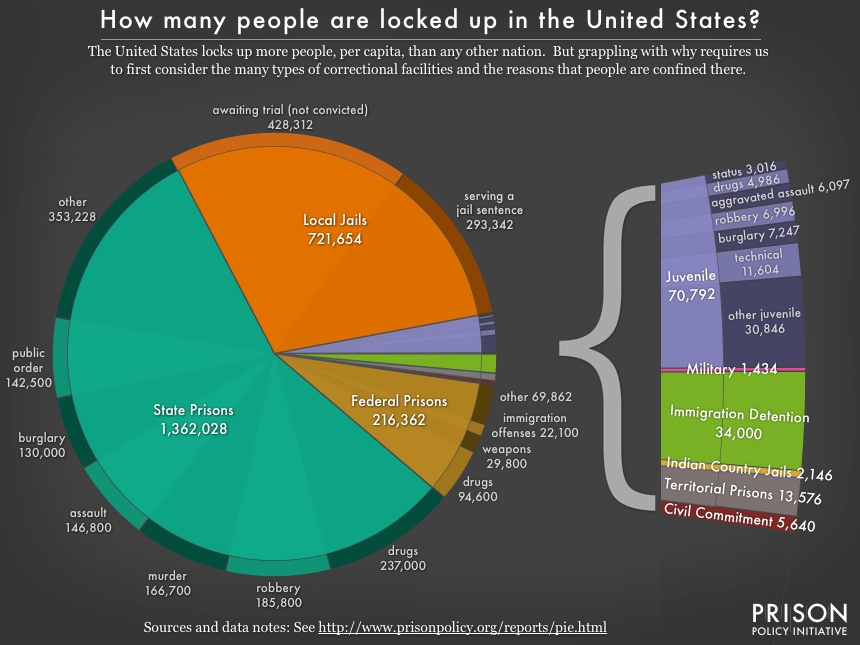
pie chart showing the number of people locked up on a given day in the United States by facility type and, where available, the underlying offenseLets not forget that people incarcerated in prison are just a portion of the people under control of the correctional system. There are jails, juvenile prisons, military prisons, immigration detention, Indian Country jails, territorial prisons, civil commitment, plus probation and parole of which there are 3,981,090 adults on probation, and 851,662 adults on parole.

For more information about ending mass incarceration in your state, see our state profiles.


by Peter Wagner, September 12, 2014

While New York State’s prison population has been dropping overall as a result of number of significant reforms, one group being left quite literally behind is the elderly. From 2000 to 2013, the number of people 50 years of age or older incarcerated in New York State prisons has doubled.

A campaign to reduce the number of elderly and infirm people in New York State prisons is being led by Muhajid Farid, lead organizer of the Release of Aging People in Prison campaign.

As the campaign’s website says:

RAPP focuses on this growing population of aging people in prison, many of whom are long-termers convicted of serious crimes. Many of these human beings have transformed their lives and developed skills and abilities they lacked before incarceration. They could be released from prison with no threat to public safety. Yet many are denied release, often for political reasons, and needlessly remain imprisoned into old age. These elders could be released if current mechanisms such as parole and compassionate release were correctly utilized; we also support legislation like the S.A.F.E. Parole Act to reform the parole system and increase the number of releases.

I got to spend some time with Farid at a conference in July, and offered to use our knowledge of the New York State prison system’s data to make a graph showing the problem. With the help of PPI summer research associate Sarah Hertel-Fernandez, we plotted the change in New York State’s prison population by age from 1996 to the present. What’s notable is that New York’s much-heralded prison population decline is confined solely to the population of people under 50. The elderly are being left behind.:

graph showing the rise of the number of people 50 and over in NY State prisons while the number of people under 50 declines

At that same conference Leah Sakala and I had a chance to interview Farid:

If you are in New York City on Sunday afternoon, Farid will be among the speakers at a Brooklyn Museum event Discussion: “What’s Age Got to Do with It? Incarcerating Children and the Elderly”.

Update September 15, 2014: Added the years 1994 and 1995 to the graph.

Note: We’d like to extend this graph further back in time. If you can help us locate the January 1 population reports from the New York State prison system for the years 1993, and 1991 and prior, please contact us.


Stay Informed


Get the latest updates:


Share on 𝕏 Donate