October 27, 2026: On October 27, 2026 at 1:30 p.m. EST, join the Prison Policy Initiative for a webinar focused on making public records requests. We’ll cover the basics of making a request and provide tips and tricks we’ve learned over decades of sending requests to jails, prisons, and other agencies that can make your requests more effective.
This Pi Day, the Prison Policy Initiative has an updated version of its mass incarceration pie chart, including more detail on jails and new infographic slideshows
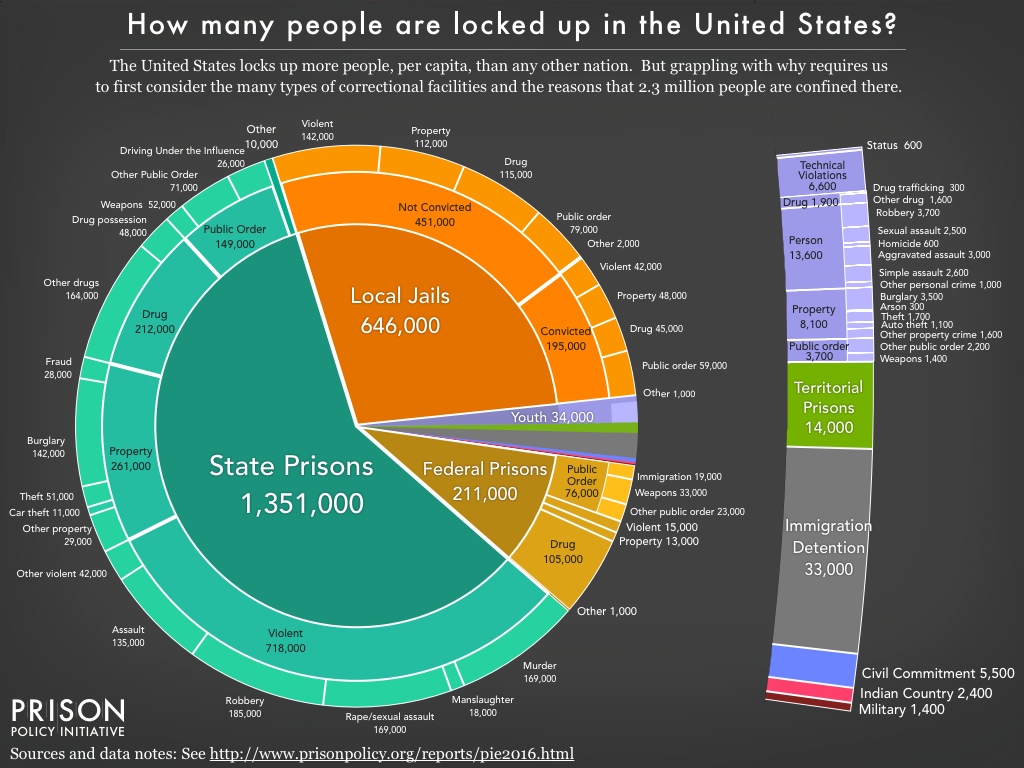
Easthampton, MA — With 2.3 million people locked up in thousands of correctional facilities operated by various agencies, getting the big picture is anything but easy. Today, with the publication of Mass Incarceration: The Whole Pie 2016, the Prison Policy Initiative provides the answer to how many people are locked up in the U.S., where, and why. Building upon our groundbreaking 2015 and 2014 reports, that, for the first time, aggregated the disparate systems of confinement, this updated version allows the reader to drill deeper, including into the reasons that so many people are locked up in local jails.
As we discuss in the report and accompanying infographics, looking at the “whole pie” allows us to cut through the fog to answer key questions such as:
After state prisons, what is the next biggest slice of confinement?
Are there more people in local jails that have been convicted of a crime or have not been convicted?
How does the number of people that cycle through correctional facilities in a year differ from the number of people locked up on a particular day?
Are most people in state and federal prisons locked up for drug offenses?
How many youth are locked up in the U.S. and in what types of facilities?
How does the number of people in correctional facilities compare to the even larger number of people under the supervision of probation and parole?
Just what are governors who talk about the need for prison reform doing trying to stop the FCC's historic effort to protect the families of incarcerated people from exploitative prison phone companies?
As New York’s experience shows, lowering the price of phone calls home from prisons and jails has many benefits: it allows families to better stay in touch, reduces contraband cellphone use, and strengthens family relationships in preparation for when incarcerated people are released and return to their families and communities. That’s why New York State Department of Corrections and Community Supervision Commissioner, Anthony Annucci, called New York’s decision to reduce the rates of phone calls to less than five cents per minute “among the most cost-effective family reunification options that we offer.”
Last fall, the FCC followed the lead of states like New York and decided that families of incarcerated people nationwide should be able to benefit from reasonable phone rates. Unfortunately, some states are taking a penny-wise and pound-foolish approach and trying to block the FCC’s historic rate caps. First, the state of Oklahoma tried to join a group of phone companies in opposing the FCC prison phone rate caps. Then, eight additional states moved to join Oklahoma’s resistance to the rate caps: Arizona, Arkansas, Indiana, Kansas, Louisiana, Missouri, Wisconsin, and Nevada.
What’s shocking is that the governors of most of the states challenging the FCC are governors that have previously supported criminal justice reform in general and specifically, reducing recidivism and keeping families together. But by trying to block the FCC’s prison rate caps, these states are working to do the exact opposite: they are promoting policies that increase the financial and emotional burden that incarceration already imposes on families.
For example, in 2011, Oklahoma Governor Mary Fallin signed a bill into law that worked to allow people to serve their sentences closer to home by expanding community sentencing programs and electronic monitoring of people convicted of low-risk, nonviolent offenses. She has also spoken about the need for maintaining family connections when a parent is imprisoned in a correctional facility: “A child with a parent in prison is five times more likely to end up in the correctional system. We can do something about that. Many of our children who have a parent who’s in a correctional facility will grow up to live in poverty.” Making it possible for incarcerated parents to talk to their children for less than $1 per minute is one common-sense way of reinforcing these family ties.
The governors of Arkansas and Indiana have also explicitly expressed support for strengthening family ties and reducing recidivism rates, two goals that will be served by the FCC rate caps. Governor Asa Hutchinson of Arkansas, in his keynote address at the Charles Koch Institute’s Advancing Justice Summit, stated that his goal for criminal justice reform is to “give those who are re-entering society – the ex-offenders – a better second chance at a new life” by strengthening community connections.
Similarly, Indiana Governor Mike Pence has repeatedly advocated for a focus on rehabilitation: “first-time offenders ought to be dealt with in a way that’s focused on reformation, that’s focused on coming alongside these young men and giving them access to a full range of programs and individuals that will inspire them to be more and to make better choices in their lives.” Families are often the greatest source of inspiration and hope for people upon release. Governor Pence also emphasizes how high recidivism rates and prison time break apart families: “[recidivism is] tearing at the fabric of our neighborhoods, tearing at the fabric of our families, and that’s why I’ve been so committed … from the outset of this administration to drive new ideas and new innovations.”
As New York’s example shows us, FCC rate caps would surely make it easier for families to stay in touch. If the elected officials of these states are seeking to reduce recidivism and strengthen family and community ties, then why exactly are they opposing the FCC’s efforts to support these same goals?
Are you interested in joining our dedicated team to fill critical data and messaging gaps in the movement for criminal justice reform? Do you want to produce cutting edge research and take the lead on a series of projects similar in scope to those in our National Incarceration Briefing Series?
If so, our new Policy Fellowship might be for you. Please spread the word, and if you think the position is for you, please apply.
Building on our last series of comments to the FCC, in which we identified solutions to four unresolved issues in the prison phone industry, we recently submitted comments calling for oversight of video visitation and electronic messaging.
Our latest video visitation comments encourage facilities to employ video systems that charge users on a per-minute basis and do not require advanced scheduling. We also highlight examples of video visitation companies attempting to profit from contracts that mandate the elimination or restriction of in-person visitation, and point out the danger in allowing government officials to cede control over visitation policies to private companies. Demand for video services should be achieved through reasonable pricing and flexible scheduling, not at the expense of traditional in-person visitation.
We recommend that the FCC put these safeguards in place to ensure that these new technologies facilitate communication rather than take advantage of people with no other options.
Please welcome our new Policy & Communications Associate, Alison Walsh.
Alison is a 2009 graduate of Vassar College with a degree in American Culture, where her weekly classes with people incarcerated at the Otisville Prison and Dutchess County Jail through the Green Haven Prison Program introduced her to the need for prison reform.
Easthampton, MA — Given the extreme distances that separate incarcerated people from their families, technological innovations that allow more frequent and faster communication between incarcerated people and their families would be a welcome improvement. A new report by the Prison Policy Initiative finds that while many facilities are still stuck in the last century, the growing number of facilities experimenting with electronic messaging are all too often providing incarcerated people and their families a product of questionable value at inflated prices.
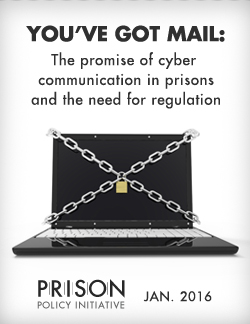
The report, You’ve Got Mail: The promise of cyber communication in prisons and the need for regulation, analyzes the current state of electronic messaging in correctional facilities. The report finds that electronic messaging — which is often referred to as “email for prisoners” — actually has very little in common with the email services available to free-world users. For example:
Some electronic messaging systems are “inbound only.” With these systems, free-world users are able to electronically send a message to an incarcerated person, but the incarcerated person must respond with a handwritten letter.
While email is free for those of us in the free-world, private companies charge incarcerated people and their families anywhere from 5¢ to $1.25 per message to communicate electronically.
“Calling the electronic messaging offered to incarcerated people and their families ‘email’ would be an insult to email,” explains Stephen Raher, author of You’ve Got Mail. “Once again, it seems that the prison phone giants are providing more of the same old exploitation rather than providing true innovation.”
The report builds on the Prison Policy Initiative’s work uncovering the previously hidden prison and jail phone industry and exposing the harmful trend of video visits replacing traditional in-person jail visits. The report was submitted to the Federal Communications Commission in response to its request for comments on advanced communication services in prisons and jails and provides the FCC with nine recommendations. The report also offers seven other recommendations for legislators, state public utility commissions, and correctional administrators, all with an eye toward transforming electronic messaging from a poorly designed and expensive technology to a fair and reasonable tool for communication.
In response to the FCC’s call for further comments on their regulations of the prison and jail phone industry, we submitted our analysis of and recommendations on four unresolved issues:
Single Calls: we explain how the FCC’s attempt to rein in “single call” programs left a significant loophole that can be easily closed.
Western Union and MoneyGram: we highlight an unintentional loophole in the FCC’s regulation of fee-sharing schemes between the phone companies and money transfer providers, and suggest that the FCC could instead copy Alabama’s solution to the problem.
Bundling unrelated services: we outline how bundling phone services with unrelated financial and other technology services is creating a growing opportunity for companies to create an end run around the FCC’s current regulations in the short term as well as undermine the FCC’s long-term goals of fostering a self-regulating ICS market through competition.
Video visitation: we updated the FCC on issues surrounding video visitation, showing that a national consensus has developed acknowledging that the growing trend of video visitation replacing traditional in-person visitation is a major step in the wrong direction and providing 5 recommendations for regulation.
Reply comments are due February 1, and can be submitted online for docket number 12-375.
Last week, the Massachusetts House unanimously approvedH. 3039, which would repeal the state’s practice of automatically suspending driver’s licenses for drug offenses unrelated to driving.
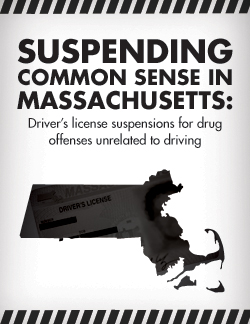
Last year, our report, Suspending Common Sense in Massachusetts: Driver’s license suspensions for drug offenses unrelated to driving, found that the state automatically suspends the driver’s licenses of thousands of residents each year for drug convictions unrelated to driving. These suspensions make roads more dangerous, waste taxpayer and law enforcement resources, and prevent people with previous involvement in the criminal justice system from fulfilling responsibilities that require driving.
The Senate unanimously approved a stronger version of the bill last year. Next, legislators will likely negotiate a compromise, and then it will land on Governor Baker’s desk. The bill has broad support from Attorney General Maura Healey, the Massachusetts District Attorneys Association, sheriffs, and editorial boards all over the state. Stay tuned for next steps and for a Prison Policy Initiative report on the other states that have yet to reverse this ineffective relic from the War on Drugs.
In its new report, “Policing for Profit,” the Institute for Justice (IJ) details exactly how law enforcement and prosecutors snatch “…hundreds of millions in cash, cars homes and other property – regardless of the owner’s guilt or innocence.”
While forfeiture is hardly a new proceeding, its use has clearly become overuse in the last 30 years if the IJ’s numbers are any indication. Annual deposits from forfeiture reached $4.5 billion, an amount almost 50 times higher than it was three decades ago.
Here’s a quick overview of how it works:
Civil forfeiture accounts for 87% of all government seizure, according to the IJ’s analysis. This fact is much more disturbing than the sheer amount of money and property involved. It means that criminal forfeiture accounts for only 13% of all government seizure of property. So almost 90% of forfeiture proceeds come from situations where citizens may have done nothing wrong: we’ve legalized plunder.
Calling civil forfeiture “one of the most controversial practices in the American criminal justice system” seems appropriate in light of the stories of victims of civil forfeiture told through the report.
In 2014, Charles Clarke had his life savings – $11,000 – confiscated at the Ciincinnatti/Northern Kentucky Airport when security officials thought his luggage smelled like marijuana. No drugs were ever found in his property and the mere suspicion as to why Clarke was traveling with such a large amount of cash (his bank had no local branches and his family was moving so he understandably wanted to keep his money with him) justified the seizure of every dollar the man had to his name.
Also in 2014, the IRS cleaned out Fairmount, North Carolina convenience store owner Lyndon McLellan’s entire business account – $107,000 – because the deposits to the account were less than $10,000 and the tax agency suspected him of “structuring” his deposits so as to evade certain reporting requirements. McLellan was not the person making the deposits – that was his niece – and she was only following the bank teller’s instructions because the smaller deposits meant less paperwork for the bank.
The same happened to Carole Hinders of Iowa, who deposited the proceeds of her cash only restaurant faithfully and honestly. The IRS saw a number of cash deposits and assumed that Hinders was somehow committing a crime, so the federal government’s tax arm seized $33,000 from her account.
Chris Sourovelis of Philadelphia almost lost his house when his son sold $40 of drugs outside his home. Sourovelis had to appear nine times in forfeiture court to keep his rightfully owned property when he hadn’t even been charged with, much less committed, any crime.
And, if these stores weren’t bad enough, the report exposes another level of insidious incentives in our forfeiture laws: equitable sharing. A program of ‘equitable sharing’ allows local and state law enforcement agencies to use federal laws to collect property for the federal government with the understanding that they will get a kick-back from the collective forfeiture pie.
There is hope that things are turning around and improving; just last week, the New York Times reported that the Department of Justice has placed the sharing program on hold because Congress took $1.2 billion dollars from the asset forfeiture program to cover budget shortfalls.
The biggest revelation of the Institute for Justice’s “Policing for Profit” report is that our justice system is no longer about public safety and stopping people who break the law. The United States has allowed justice to careen so out of control that it’s now unabashedly grabbing up the innocent and bankrupting them for the sake of government revenue.
2015 was a year of big victories for the Prison Policy Initiative. Beyond a record number of ground-breaking reports, our campaigns won major policy changes.
2015 was a year of big victories for the Prison Policy Initiative. Beyond a record number of ground-breaking reports, our campaigns took some very big steps forward and, in some cases, those victories culminated in major policy changes.
Here are some of the biggest wins in our campaigns this year:
The Federal Communications Commission extended their regulation of inter-state calls to also apply to in-state calls, and further lowered the maximum rates and fees that can be charged. The FCC is also now requesting comments on closing the last of the loopholes, which include video visitation, email, etc.
Our report, combined with investigative reporting by Portland, Oregon’s Street Roots, led the Multnomah County Sheriff to announce that he would amend the county’s Securus video visitation contract to bring back in-person visits. This was the first time that a video visitation contract was ever amended to bring back in-person visits.
We collaborated with comedians to produce four hilarious short videos that take on the video visitation industry’s offensive claim that expensive, glitchy video visitation is just like Skype.
We shamed the largest provider of video visitation, Securus, into changing its policy of explicitly requiring, right in its contracts, that correctional facilities using its service ban in-person visitation. Because Securus has shifted responsibility for this repugnant decision to elected sheriffs, we now have more political leverage to encourage the use of video visitation as a supplement to in-person visitation and never as a replacement.
Thanks in part to our research and advocacy, a new law in Texas recognizes that virtual visits are not the same as in-person visits and mandates that each county jail provide a minimum of two in-person visits each week.
Supported by our Suspending Common Sense report, the Massachusetts Senate unanimously voted to repeal a law which automatically suspends the driver’s licenses of people convicted of drug offenses unrelated to driving. This law, a relic of the War on Drugs, makes it harder for people with drug convictions to rebuild their lives. The unanimous support of the Senate and the strong state-wide editorial support from the Boston Herald to the Boston Globe to the Berkshire Eagle has us feeling good about our chances in the House.
Thank you for helping us do all of this work. Here’s to an even more successful 2016!
October 27, 2026: On October 27, 2026 at 1:30 p.m. EST, join the Prison Policy Initiative for a webinar focused on making public records requests. We’ll cover the basics of making a request and provide tips and tricks we’ve learned over decades of sending requests to jails, prisons, and other agencies that can make your requests more effective.
 Please welcome our new Policy & Communications Associate, Alison Walsh.