Join us in telling the FCC to ensure that ALL families can afford to stay in touch with incarcerated loved ones
by Leah Sakala,
November 21, 2014
If you’ve been looking for an opportunity to weigh in on federal regulation of the prison and jail telephone industry, the time has come.
Today the Federal Communications Commission (FCC) published a Public Notice in the Federal Register announcing the Commission’s “Second Further Notice of Proposed Rulemaking” to make calls home from prisons and jails more fairly priced. For a refresher on what the FCC is proposing to do, check out our play-by-play blog post.
This Federal Register publication kicks off a new FCC public comment period that will run until January 5, 2015*, followed by a reply comment period that will end on January 20, 2015*. You can make your voice heard by submitting a comment to the FCC. We’re working on a series of submissions here at PPI, and hope that you’ll join us in telling the FCC that it’s time to enact comprehensive regulation to ensure that ALL families can afford to stay in touch with incarcerated loved ones.
*December Update: The FCC has granted a one-week extension. Comments are now due January 12 and reply comments are due on January 27.
We applaud the University for doing the right thing and retaining a valuable member of the academic community.
by Leah Sakala,
November 14, 2014
It’s a good day for the University of Illinois: the University will continue to benefit from our colleague James Kilgore’s accomplished scholarship and acclaimed teaching.
The university had originally decided not to renew Mr. Kilgore’s contract after the local newspaper published a series of attack pieces about his decades-old criminal record from the 1970s. The University of Illinois was fully aware of Mr. Kilgore’s history during the hiring process, and Mr. Kilgore received overwhelmingly positive performance reviews throughout the years that he has been on faculty.
The university’s decision sparked a groundswell of support for Mr. Kilgore, both from the University of Illinois faculty, staff, and students, and from the national community of scholars and advocates who have benefited from his work. We submitted a letter back in May urging the university Chancellor to not allow journalistic fear-mongering to lead the university to dismiss an accomplished faculty member.
Today, the University of Illinois Trustees announced that they would follow a special committee’s recommendation to keep Mr. Kilgore on staff. We applaud the University for doing the right thing and retaining a valuable member of the academic community.
Musician Alicia Keys calls for movement-building and uses PPI data
by Bernadette Rabuy,
November 12, 2014
Yesterday, musician Alicia Keys wrote a piece for The Guardian describing the motivation behind her activism and calling musicians to use their platforms for true movement-building. Describing how motherhood has fueled her awareness of social injustices, Keys writes, “A woman becomes a lioness when she sees her unborn child’s future juxtaposed with the horrors of the world.” Recently, Keys went out in the streets to protest outside the Nigerian consulate in New York for the six-month anniversary of Boko Haram’s abduction of Nigerian girls. We were also excited to see Keys bring attention to racial disparities in the criminal justice system as an issue she cares about. She even used our data! We hope that other musicians will join Alicia Keys and move beyond social justice tweets to getting into the thick of the movement.
Today, in a partial reversal, the Dallas County Commissioners Court approved a new contract with jail telephone giant Securus.
by Peter Wagner,
November 11, 2014
Today, in a partial reversal, the Dallas County Commissioners Court approved a new contract with jail telephone giant Securus.
In September, after hours of eloquent and unanimous testimony, the County’s legislative body rejected a proposed contract that would have explicitly banned in-person visits at the jail and replaced them with expensive computer visitation. The County voted to reopen the bidding to the previous finalists based on new criteria that would prioritize family communication. The County then discovered — so it says — that this step was prohibited by Texas law, so negotiations with Securus ensued to make changes to their previous proposal.
The new contract drops the mandatory ban on in-person visitation, but maintains a troubling requirement that Securus, in addition to the installation of video visitation machines for incarcerated people to use, builds an on-site video visitation center at a cost of more than $200,000 to be paid for by the families. This is troubling because the only purpose for such machines would be to replace the current system of through-the-glass visitation that the county and its sheriff claim they intend to keep.
County Judge Clay Jenkins, the county’s top elected official, led a strong resistance, calling for more time for public debate and offering a compromise proposal endorsed by Texas CURE, SumOfUs and the Prison Policy Initiative that would have barred the construction of the on-site video visitation center, phased-out the commissions on telephone calls after this year, lowered Securus’s video visitation charge and their deposit fee, and required the contract to automatically include within 30 days any new consumer protections imposed by the Federal Communications Commission.
Unfortunately, Judge Jenkins was unsuccessful at both stopping the contract and winning permission to allow all of the assembled Dallas residents to speak. (Two of the Commissioners voted against extending the time, with one claiming that the issue had received more attention than any other. Judge Jenkins responded that while that was true, unlike other controversial issues, the public and the media were speaking with one voice in opposition to this contract.) Judge Jenkins voted against the contract, but all four of the other commissioners voted to approve the contract today.
However, there were at least four smaller victories today:
- The county forced Securus to offer a per-minute rate rather than a fixed price for each phone call. While the per-call price can sometimes be cheaper for very long calls, in actual use, this pricing structure is more expensive and gives the vendor a financial incentive to “accidentally” drop calls and require expensive reconnection.
- The contract does not ban in-person visits, and the current elected officials are all on record in opposition to banning in-person visits. (We’ll need to carefully monitor the situation to ensure that the county doesn’t directly change course or find more subtle ways to discourage through-the-glass visitation.)
- Judge Jenkins’s fair-minded compromise and the underlying principle on “the gross unfairness of imposing hefty fees on those least able to afford them: the poor who dominate the inmate population” was endorsed by the Dallas Morning News.
- From all of the attention this issue received from Texas public, the media and nationally, it’s clear that almost this entire country — basically everyone who doesn’t have a financial stake in the alternative — thinks that maintaining direct communication between incarcerated people and their loved ones is important. Now that that has been established, it will be much harder for the industry to win further victories elsewhere.
Infamous Sheriff Joe Arpaio replaces in-person visits with video visitation
by Bernadette Rabuy,
November 10, 2014
Video visitation at Maricopa County, AZ jails has seemed fishy from the beginning. At first, Sheriff Joe Arpaio cut back visitation last December, just in time for the holiday season. The sheriff’s spokeswoman told the Phoenix New Times that the cut from three 30-minute visits per week to one 30-minute visit per week was necessary in order to “update/improve MCSO’s video visitation program.” What she didn’t mention was that, one week later, the Maricopa County Sheriff’s Office would announce its plan to get rid of the remaining face-to-face visits in Maricopa that still existed in half of Maricopa’s six jails.
As of last Monday, Sheriff Joe has completely phased out in-person visits in all Maricopa jails. Families and friends now have two options: travel to the jail and visit their incarcerated loved one via a video screen or schedule a remote visit (using a personal computer) for a fee. The confusion doesn’t stop there. While Securus, the provider of video visitation services in Maricopa, is currently offering promotional pricing for remote video visits at 25 cents a minute, this price will only last until the end of the year. So by January, those visits are going to cost 65 cents a minute.
Will the FCC ban commissions, cap all calling rates, and eliminate fees?
by Leah Sakala,
October 27, 2014
Last week, the Federal Communications Commission proposed several new regulations to protect the families of incarcerated people from the predatory prison telephone industry. These rules would fill major gaps in the current regulations and help ensure that no child who wants to talk to his or her incarcerated parent will fall through the cracks.
As we promised, here’s an overview of the FCC’s 77-page notice:
The FCC is calling for feedback on its new proposal to…
- Ban kickbacks altogether. The FCC’s previous order said that companies aren’t allowed to treat the kickbacks as part of the cost of doing business, but the FCC is now seeking comment on getting rid of this perverse incentive that drives up the cost of calls.
- Cap in-state and out-of-state calling rates. The previous FCC regulation capped only the rates for calls between states, which tend to be more expensive but also only make up about 20% of all calls from incarcerated people. This new proposal would make sure that a family wouldn’t have to pay more to talk to an incarcerated loved one just because that person was in the same state.
- Cap, limit, or flat-out prohibit “ancillary fees.” Our research found that fees drive up the phone bills families have to pay, so this step would make a huge difference for the more than 2 million kids with an incarcerated parent.
The FCC also requests more feedback on…
- How to address additional communication services, such as video visitation, that suffer from many of the same market failures as phone services.
- Strategies to make the prison phone market more competitive, and increase access for individuals with disabilities.
- Applying the new regulations to existing contracts.
- Coordinating with state regulatory efforts.
- The costs and requirements for phone systems among different kinds of facilities.
- The actual cost of providing communications services in correctional facilities, and cost/benefit analyses of the regulatory proposals.
Here at PPI, we were pleased to see that the FCC cited our research, presentations, petition submissions, and technical comments throughout their proposal to take a huge step forward. We’ll certainly continue to weigh in as soon as the comment period opens up (when notice is published in the Federal Register, which should be any day now). The comment period will run for 45 days, and we hope that you will share your thoughts with the FCC too. We’ll be sure to keep you all posted as soon as the comment period opens.
We need your help now to counter the powerful prison phone lobby.
by Peter Wagner,
October 17, 2014
We need your help now to counter the powerful prison phone lobby.
Today, by a 3 to 2 vote, the Federal Communications Commission agreed to take the next steps to regulate the prison and jail telephone industry. In the Further Notice of Proposed Rulemaking the FCC is actively considering, among other things:
- Extending the existing regulation and price caps on interstate calls to all calls, including calls within the same state.
- Further restricting the ability of the industry to make kickback payments to the prison and jail facilities, which currently drives up the call rates.
- Fully addressing the ancillary charges for opening, maintaining, funding and closing accounts that consume an estimated 400 million dollars per year.
The actual notice is not yet public, and we’ll have a more detailed analysis of the new order when it’s out, but it’s clear that we have a lot of work to do in a short period of time — and we need your support to get the work done.
The notice is likely to ask hundreds of detailed questions about how the current system works. We’ll need to provide those answers — and rebut the telephone industry’s recent proposal that would stunt reform — in a short amount of time. We won’t know the exact date until the notice is published in the Federal Register, but we estimate that the first round of comments will be due in early December.
The Prison Policy Initiative’s track record is clear. But we need your financial support to gather all of this information and organize the stories of the millions of people being exploited by this industry all in the next few months. Can you help us affect change once again with a gift today?
Right now, a group of donors will match the first $19,000 we raise. Please help us reach this goal as soon as possible so we can get back to the work of protecting the nation’s poorest families from the predatory prison and jail industry. Please contribute generously today.
Can you make a gift today and join the Individual donors who are fueling the movement for justice reform?
by Peter Wagner,
October 6, 2014
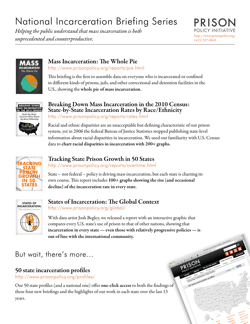
As we wrote in our brand new annual report, this has been an especially prolific year for the Prison Policy Initiative. For example, in addition to our ongoing campaign work, we were frustrated that major data gaps were holding back the movement for justice reform. So, we stepped up to the plate by creating our first National Incarceration Briefing Series: four ambitious reports (and 50 state incarceration profiles) that reveal the current state of the U.S. carceral crisis.
These publications — funded entirely by individual donor support — were so popular that they overwhelmed our server and sparked more media attention than we could keep track of.
We’re just getting started. We’re primed to start working on a follow up Briefing Series, on top of keeping up the momentum on our major campaigns, but we need your help. Can you take a minute today to propel the movement for justice forward by making a gift to support our work?
Your generous gift will be doubled thanks to a matching challenge sponsored by other donors. Thank you for your partnership in this movement for justice.
A year and a half of hard work has brought a big win for local families.
by Leah Sakala,
October 3, 2014
This week brought great news for families in Santa Barbara County, California: the local jail has decided to end its ban on all incoming letters from families and friends. Previously, people who wanted to write to incarcerated loved ones were only allowed to use postcards.
As our report found, letter bans jeopardize family ties that are key to reducing recidivism, running contrary to correctional best practices (you can also check out our short video for more info on letter bans). Furthermore, a federal court found that banning letters from home was unconstitutional.
We were deeply concerned when we learned of Santa Barbara County’s plans to institute the letter ban a year and a half ago, so we immediately organized a sign on letter with more than 50 local and national organizations urging the county to reconsider. Local community members in Santa Barbara have also been hard at work organizing the Right to Write Campaign to overturn the ban (here’s a powerful video they put together about their work).
Now, Santa Barbara has joined the growing number of counties that have decided that letter bans are a step in the wrong direction. Congratulations to the Right to Write Campaign, sign on letter participants, and everyone else whose hard work brought about this big win for families in Santa Barbara County!
Center for Public Integrity releases first part of a series on web of prison bankers, private vendors, and corrections agencies profiting off families of the incarcerated.
by Bernadette Rabuy,
September 30, 2014
Daniel Wagner and Eleanor Bell of the nonprofit investigative news organization, the Center for Public Integrity, have recently released “Prison bankers cash in on captive customers” and the video Time is Money, part one of a two-part series on the growing web of prison bankers, private vendors, and corrections agencies that profit off the backs of families of the incarcerated.
The Center for Public Integrity’s six-month investigation found plenty of families making necessary sacrifices in order to support and maintain contact with their incarcerated loved one. In order to send money to their incarcerated loved one, family members would sometimes be forced to forego medical care, skip utility bills, and even limit visits with their loved one. Meanwhile, corporations such as JPay, which handles deposits into incarcerated individuals’ accounts, generated well over $50 million in revenue in 2013. Vincent Townsend, president of prison phone company, Pay-Tel Communications, agrees that there’s something wrong with this, telling the Center for Public Integrity, “My industry has abused the public and I’m willing to admit that.” And beyond prison vendors’ profits, there is still the share of profits that gets returned to corrections agencies, often called commissions or kickbacks.
Stay tuned for part two, which will run this Thursday!


