New Prison Policy Initiative report finds video visitation actually punishes families
January 14, 2015
FOR IMMEDIATE RELEASE: January 14, 2015
Contact:
Bernadette Rabuy
(413) 527-0845
Easthampton, MA — New technology that is supposed to make it easier for families to stay in touch with incarcerated loved ones is actually doing harm, charges a new report by the non-profit Prison Policy Initiative.
While prison and jail video visitation is often described as similar to well-known free services such as Skype or FaceTime, these pay-to-visit video systems are often being used to replace essential human contact. The report, Screening Out Family Time: The for-profit video visitation industry in prisons and jails, finds that most county jails are implementing video visitation with an approach that is a step backwards for families and correctional best practices: video visitation actually punishes families.
Rather than offering video visitation as a supplement to traditional visitation, county jails and video visitation companies are replacing free, in-person visits with free but restricted onsite video visits and low-quality, remote video visits that cost up to $1.50 per minute. “Families are unhappy with video visitation because it replaces the real living person on the other side of the glass with a grainy computer image,” explains Bernadette Rabuy of the Prison Policy Initiative.
“While this technology goes back to the 1990s, this report provides what has before now been entirely lacking: a comprehensive national survey of the video visitation industry starting at its promised benefits and analyzing how it works in the real world,” says Peter Wagner, Executive Director of the Prison Policy Initiative.
The Prison Policy Initiative analyzed over a quarter of the industry’s contracts with state prisons and county jails to describe the trends and contrast the industry’s marketing claims with the evidence. The report finds that, with some notable exceptions, this technology is poorly designed, does not work well, and makes a trying time for families even more challenging.
The report offers 23 recommendations for federal and state regulators, legislators, correctional facilities, and the video visitation companies, all with an eye towards making video visitation into a positive, rather than negative, communication option.
For the executive summary, see: http://www.prisonpolicy.org/visitation/exec_summary.html
For the report, see: http://www.prisonpolicy.org/visitation/report.html
-30-
On Monday evening, we submitted 6 major briefings on the need to regulate the prison and jail telephone industry to the Federal Communications Commission.
by Peter Wagner,
January 14, 2015
On Monday evening, we submitted 6 major briefings on the need to regulate the prison and jail telephone industry to the Federal Communications Commission:
by Peter Wagner,
December 29, 2014
In this new video, our Board President, Eric Lotke talks about his new novel, Making Manna and the connection to the struggle for prison phone justice and the Prison Policy Initiative:
Our six favorite data visualizations from Prison Policy Initiative reports in 2014.
by Peter Wagner,
December 29, 2014
2014 was a big year for ground-breaking data visualizations from the Prison Policy Initiative. These are our six favorites:
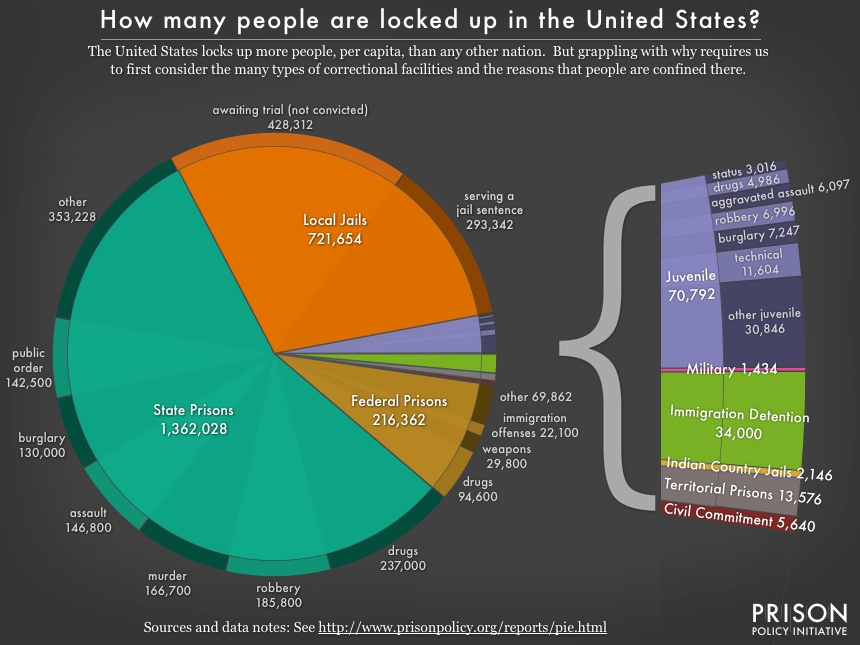 From: Mass Incarceration: The Whole Pie.
Josh Begley made this graph as part of our collaboration for States of Incarceration: The Global Context.
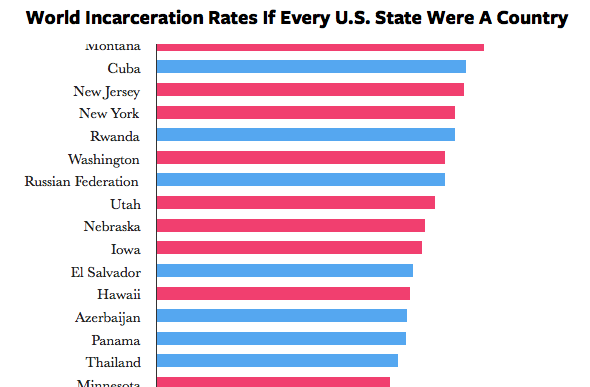
Josh Begley made this interactive graphic of “World Incarceration Rates If Every U.S. State Were A Country” as part of our collaboration for States of Incarceration: The Global Context.
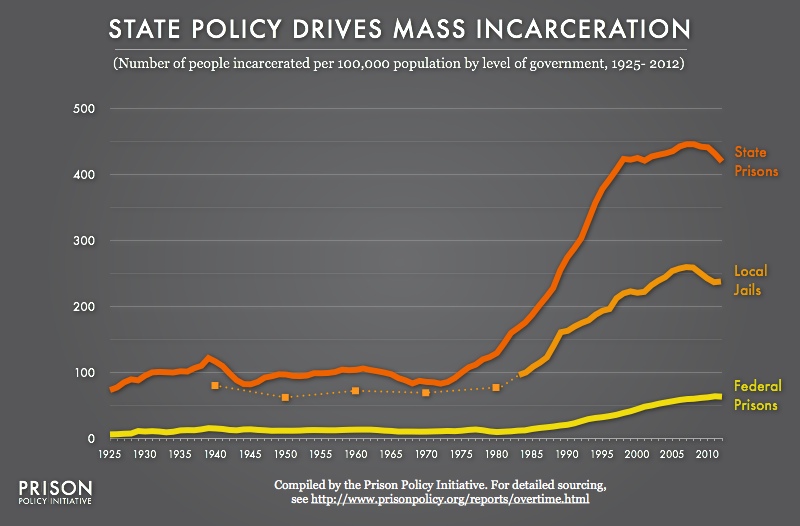
From Tracking State Prison Growth in 50 States. (Also see larger or as raw numbers.)
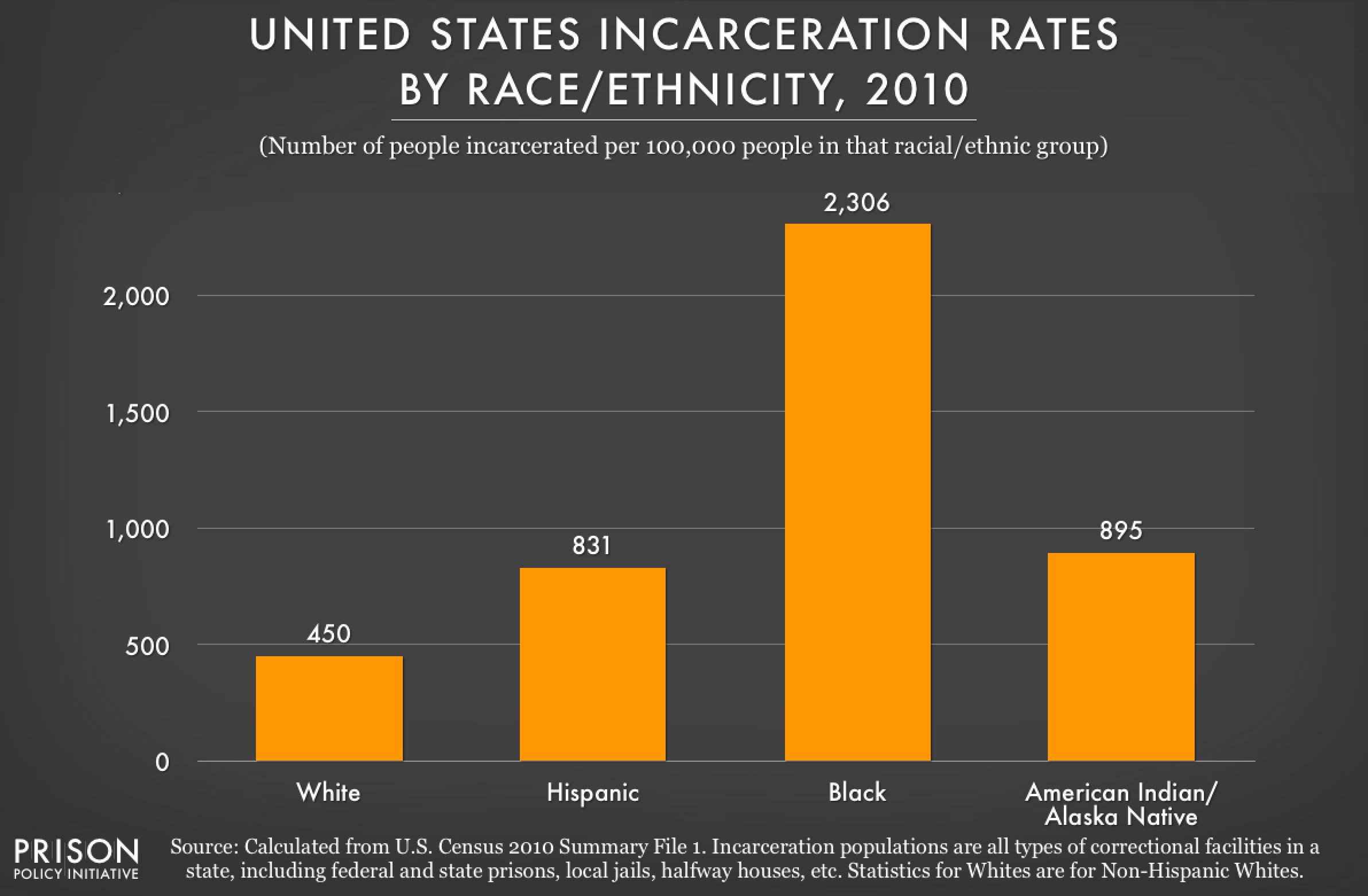
From: Breaking Down Mass Incarceration in the 2010 Census: State-by-State Incarceration Rates by Race/Ethnicity. This data, plus much more, is also available in 50 state profiles.
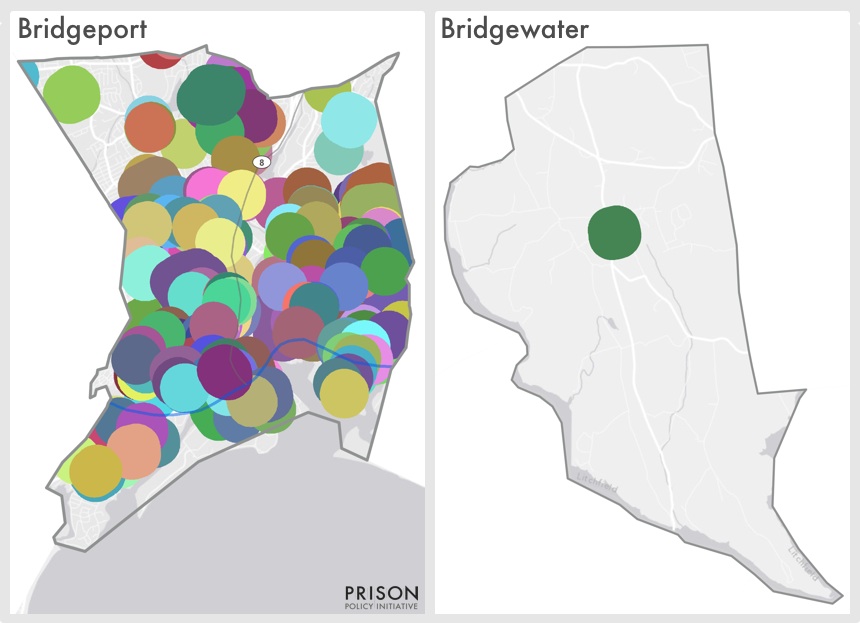
From Reaching too far: How Connecticut’s large sentencing enhancement zones miss the mark comes this map, showing that overlapping sentencing enhancement superzones blanket Bridgeport Connecticut, covering 92% of the city’s residents while more rural Bridgewater contains just one zone, covering 8% of the town’s residents.
With 2014 drawing to a close, we review our biggest wins. Thank you for helping us come so far!
by Peter Wagner,
December 24, 2014
2014 was a year of big victories for the Prison Policy Initiative. We published some insightful new reports, reshaped the criminal justice reform debate through the press, and won a prestigious award, but most importantly our campaigns took some very big steps forward and in some cases we took those victories all the way to major policy changes.
Here are some of the biggest wins in our campaigns this year:
- The effort to reform Connecticut’s extreme 1,500 sentencing enhancement zone didn’t pass the full legislature, but Aleks Kajstura’s report was very helping in getting the bill out of a committee for the very first time.
Massachusetts
- Helped by Leah Sakala’s report about the state’s practice of automatically suspending the driver’s licenses of people convicted of drug offenses unrelated to driving, a reform bill passed out of committee in both chambers. We’re feeling good about our chances for next year.
- Governor Patrick signed legislation making Massachusetts the 21st state to end the inhumane practice of routinely shackling incarcerated mothers who are pregnant or giving birth.
Thank you for helping us do all of this work. Here’s to an even more successful 2015!
For more on these and other victories, be sure to see our most recent annual report.
Today, we share the most important news stories of 2014 that we played a role in
by Bernadette Rabuy and Peter Wagner,
December 23, 2014
Yesterday, we published our list of the best investigative criminal justice journalism of 2014. For that list, we decided to exclude any story that we were featured in or involved with in any way. Today, we share the most important news stories of 2014 that we played a role in:
- America’s prison population: Who, what, where and why
by Jon Fasman
The Economist, March 13, 2014
This article reviews our Mass Incarceration: The Whole Pie report and then reviews their past editorials to conclude: “America locks up too many people for too many things.” Today, nine months later, this article is still one of the major drivers of traffic to our website.
- The Leader of the Unfree World: Mass incarceration, perhaps the greatest social crisis in modern American history, is without parallel on a global scale
by Matt Ford
The Atlantic July 23, 2014
This article connects the dots between our Mass Incarceration: The Whole Pie and States of Incarceration: The Global Context reports and concludes:
None of this is new information for the activists and scholars who’ve worked on prison and criminal-justice reform for years. But for the general public, a crucial first step is to denormalize the current system. This is not the way it has always been–and this is not the way it has to be.
- Phoning From Prison, at Prices Through the Roof
by David Segel
New York Times, February 2, 2014
In this “The Haggler” column, the New York Times takes on the prison telephone industry to show why the exploitation of families of incarcerated people is an urgent consumer protection matter.
- Unfair Phone Charges for Inmates
by New York Times editorial board
New York Times, January 6, 2014
This editorial about our public comment to the Federal Communications Commission about the need to regulate the video visitation industry put the issue of video visitation on the national agenda. Our connections in Dallas and much of the press work we did on video visitation grew out of this editorial.
(Stay tuned for a a big release from us on this topic in January 2015.)
- Mass Incarceration in the US
by Hank Green
VlogBrothers
More than a million people have watched Hank Green’s 4-minute video that helps this country understand that the war on crime is failed policy and that “we are living inside a $75 billion a year failed experiment.”
- Orange Is the New Green: Is Knox County’s New Video-Only Visitation Policy for Inmates Really About Safety — or Is it About Money?
by Cari Wade Gervin
Metro Pulse (Knoxville, Tenn.), July 2, 2014
This was one of, if not the, most comprehensive pieces about the video visitation industry in 2014. Sadly, this paper suddenly closed in mid-October 2014. It will be missed.
- Serial’s $2,500 Phone Bill and the Prison-Calling Racket
by Joshua Brustein
Bloomberg Businessweek, December 17, 2014
This story artfully reviews the coming showdown at the FCC between the companies who say they want reform and the people who really do.
- Captive Constituents: Prison population beefs up some Alabama districts
by Tim Lockette
The Anniston Star, June 29, 2014
This piece nicely profiles a city council ward where more than a quarter of the people in one ward are incarcerated. And the councilman who represents that district? He agrees with us — and hundreds of similar communities across the country — that the prison gerrymandering that results from the Census Bureau’s method of counting people in prison is wrong.
- Prison Overcrowding Threatens Public Safety and State Budgets
by Audrey Williams
American Legislator, April 8, 2014
This article on the blog of the conservative American Legislative Exchange Council (ALEC) discussed our Mass Incarceration: The Whole Pie report to conclude:
The Prison Policy Initiative has, indeed, given us the “whole pie”–ipso facto altering the original question. Rather than asking “how many people are locked up,” the question has become “does it really make sense to be imprisoning this many people?”
- R.I’s new House speaker has a captive constituency
by Edward Fitzpatrick
Providence Journal, April 1, 2014
ProJo columnist Ed Fitzpatrick, who has long covered prison gerrymandering and other democracy issues, ruminates on the origins of the House speaker’s political power.
- A price too high for calls from jail
by The Dallas Morning News Editorial Board
The Dallas Morning News, November 10, 2014
In this editorial, The Dallas Morning News urges Dallas County elected officials to carefully weigh the pros and cons of video visitation. It powerfully declares, “The county should not be in the business of exploiting prisoners and their families to balance the budget.”
- Idea blackout
by Houston Chronicle Editorial Board
Houston Chronicle, September 12, 2014
This piece stresses that video visitation is not the same as in-person visitation and describes the crucial tie between family bonds and rehabilitation.
As 2014 winds to a close, the Prison Policy Initiative recognizes the eight sorely needed investigative news stories that did the most to bring public attention to criminal justice reform.
by Peter Wagner and Bernadette Rabuy,
December 22, 2014
As 2014 winds to a close, the Prison Policy Initiative wanted to recognize the eight sorely needed investigative news stories that did the most to bring public attention to criminal justice reform. In no particular order:
- Stop and Seize
by Michael Sallah, Robert O’Harrow Jr., Steven Rich
Washington Post
A 6-part series about how aggressive policing takes hundreds of millions of dollars from motorists not charged with crimes.
- How municipalities in St. Louis County, Mo., profit from poverty
by Radley Balko
Washington Post
While the nation waited for the grand jury’s decision on whether to indict the officer who killed Michael Brown, Radley Balko explores the cycle of fines, fees and arrests in Ferguson and other St. Louis suburbs.
- As Court Fees Rise, The Poor Are Paying The Price
by Joseph Shapiro
National Public Radio
An NPR investigative series finds an explosion in the use of fees charged to criminal defendants across the country, which has created a system of justice that targets the poor.
- Prison bankers cash in on captive customers: Inmates’ families gouged by fees
by Daniel Wagner
Center for Public Integrity
In a groundbreaking article and 22 minute film, we have the first-ever exposé of JPay, the company that has come to dominate the market for sending money to incarcerated loved ones.
- Debit cards slam released prisoners with sky-high fees, few protections: ‘They kept charging me every time I used it’
by Amirah Al Idrus
Center for Public Integrity
For more than a year, people have been asking the Prison Policy Initiative to look into the practice of correctional facilities requiring incarcerated people to take their release money — money earned via prison jobs and anything that loved ones sent in — not in cash or by check but on expensive high-fee debit cards. Despite the requests, we weren’t able to start this research, but Al Idrus has done the world a huge favor to be eclipsed only when federal or state regulators end the practice.
- Unfair Punishment Part One: Victim Discrimination
by Sam Levin
East Bay Express
A California program that’s supposed to help crime victims rejects people who have had run-ins with the law.
- Americans Don’t Know that Crime Rate Keeps Falling
by David Mendoza
The Mendoza Line
With a short article and an infographic, David Mendoza effectively explains the point that we’ve been trying to find a good way to say for 11 years: the public’s perception of crime rates has nothing at all to do with the actual rates of crime.
- Ferguson, MO and Police Militarization
by John Oliver
Last Week Tonight with John Oliver
In the wake of the shooting of Michael Brown in Ferguson, MO, John Oliver explores the racial inequality in policing as well as the increasing militarization of America’s local police forces. In the second part of the piece, Oliver explains exactly why allowing the police to use surplus military equipment is a very dangerous idea for the future of our democracy.
(Equally eloquent and a runner-up for this list of great investigative reporting was Oliver’s August segment on something Americans can’t get enough of: prisons. To Oliver, one of the key problems in our criminal justice system is the willful ignorance and indifference of the people running the system. As John Oliver points out, imprisonment is now so common that Sesame Street saw the need to create a puppet with an incarcerated parent; but the head of the Federal Bureau of Prisons doesn’t even know basic information like the size of the Bureau’s tortuous solitary confinement cells.)
Note: The purpose of this list is to highlight journalists who filled critical gaps in the public’s knowledge about criminal justice issues. To keep things fair, we excluded from consideration any articles that we are quoted in and articles that we consulted on in any way.
Eight ideas for criminal justice reforms that are ripe for legislative victory.
by Peter Wagner,
December 22, 2014
This report has been updated with a new version for 2022.
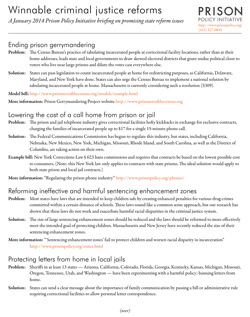 With the 2015 legislative sessions about to start, it’s time to unveil our second annual list of under-discussed but winnable criminal justice reforms.
The list is published as a briefing with links to more information and model bills, and it was recently sent to reform minded state legislators across the country. The reform topics we think are ripe for legislative victory are:
- Ending prison gerrymandering
- Lowering the cost of a call home from prison or jail
- Repealing or reforming ineffective and harmful sentencing enhancement zones
- Protecting letters from home in local jails
- Requiring racial impact statements for criminal justice bills
- Repealing “Truth in Sentencing”
- Creating a safety valve for mandatory minimum sentences
- Reducing pretrial detention
Let us know what you think of this year’s list. We look forward to working together to make 2015 a year of great progress for justice reform!
Generous friends have agreed to match any donations to PPI through 2014, making your gift go twice as far.
by Leah Sakala,
December 2, 2014
The national movement for fair prison and jail phone charges is making progress by leaps and bounds. The Federal Communications Commission’s first ruling is already lifting some of the burden of exorbitant phone bills, and the Commission just opened up a new comment period asking the public to weigh in on comprehensive reform that would protect ALL families with incarcerated loved ones from the predatory prison phone industry (more on that below!).
The Prison Policy Initiative has been at the forefront of these major historic victories, holding the billion dollar prison phone industry accountable with lots of hard work and the support of individual donors like you. This is so important that we are going to put every dime we raise through the end of the year towards this urgent campaign.
Please join us in fighting for fair phone charges for families on this Giving Tuesday by making a donation to the Prison Policy Initiative. Generous friends have agreed to match any donations to PPI through the end of the year, making your gift go twice as far. Then, please help to spread the word by forwarding this post to four friends, and/or Tweeting something like:
- “Please join me in making a #givingtuesday prison #phonejustice donation to @prisonpolicy: http://www.prisonpolicy.org/donate.html”
Thank you for your generosity!
One company produces a video explaining to Sheriffs how the status quo is bad for them.
by Peter Wagner,
November 25, 2014
NCIC, one of the smaller companies in the prison and jail telephone industry, has made a two minute video that explains how some players in the industry cheat families, the jails, and state regulators by charging the families hidden fees and then quietly pocketing that money.
The perspective of the video is different than a lot of what we post on this blog; it comes from a more-ethical company speaking directly to jails about how the the current system isn’t as good for the jails as they have been led to believe.
For more on hidden fees and other nasty tricks that hurt families without bringing in a dime for the facilities (like Text-To-Collect and other “single-call” programs) see our 2013 report Please Deposit All of Your Money: Kickbacks, Rates and Hidden Fees in the Jail Phone Industry.