We have two ideas for state legislative strategies to further reduce the cost of calling home from prisons and jails.
by Peter Wagner and Aleks Kajstura,
October 21, 2015
On Thursday, the Federal Communications Commission is scheduled to vote on a proposal to cap the cost of all calls home from prisons and jails and to curtail or ban the abusive fees charged by the industry.
By capping the cost of calls and the fees, the FCC will have established a ceiling on what can be charged. But states and individual counties should — and many will — go even further. There are at least two types of state legislation that could be passed.
Idea 1: Simple fix that the facilities might not like but is really the best way to go.
Ban commissions and require all contracts to be negotiated on the basis of the lowest price to the consumer. New York Corrections Law § 623 is a great model, although an even better version would apply to contracts with local jails as well as state prisons.
Idea 2: Long-term market re-alignment.
Create a statutory ceiling on commission payments on a per minute basis in order to re-align incentives for facilities to effectively negotiate with the vendors for the lowest rates for consumers.
Currently, commissions are typically negotiated on a percentage basis, so facilities have an incentive to tolerate high customer costs, so changing to a fixed per-minute commission would change the incentives, to give the facilities an incentive to favor low-cost higher-volume calls home.
Let me explain.
The FCC’s order caps the maximum that can be charged at 11cents a minute in prisons and, depending on the size of the facility, 14-22 cents a minute in jails. For the sake of this illustration, let’s talk about jails in the 14 cents a minute category.
First, capping the cost at 14 cents will constitute a tremendous and long-needed rate reduction across the country. But how can a state easily ensure that rates continue to move downwards, even in facilities that will not waive their commission?
Under the status quo in the states that allow commissions, the facilities have an incentive to set the rates at the maximum and then demand that the vendors pay the maximum commission. So rates are likely to be at 14 cents forever. As the cost of providing service declines with further advances in technology, the cost might stay at 14 cents while the facilities demand 13.9999 cent commissions.
But if a state were to set a maximum commissions at, say, 3 cents a minute, it would give facilities an incentive to push the rates down in order to increase usage. With such a maximum per minute commission, the rates wouldn’t ever go below the commission level of 3 cents, but the facilities would have an incentive to push the rates down as close to that 3 cents as they can. (We don’t have a position on what the commission amount per minute should be, and we used 3 cents just to illustrate the math.)
As we’ve seen in New York and nationwide, lowering the total price to the families increases the call volumes.
This structure would also give the facilities an incentive to ensure that the vendor doesn’t charge unnecessary fees. Prior to the FCC’s October 2015 ruling, the companies charge hidden fees as a way to recoup lost profits from paying unsustainably high commissions. (The business model is called fee harvesting and shortchanges both the families and the facilities; but since the facilities are already receiving windfalls on the call rates, they often don’t object to the extra fees.)
The new FCC ruling will ban most of the fees that were previously charged by the industry and caps all fees that remain. But as fees eat into the money that families can spend on the actual calls, this proposal gives the facilities a financial incentive to insist on even lower fees as that would further increase the number of minutes used.
 Are you interested in joining our dedicated team to produce cutting edge research to expose the broader harm of mass criminalization? Do you want to shape innovative advocacy campaigns and spark critical discourse to create a more just society?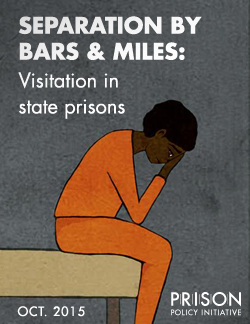
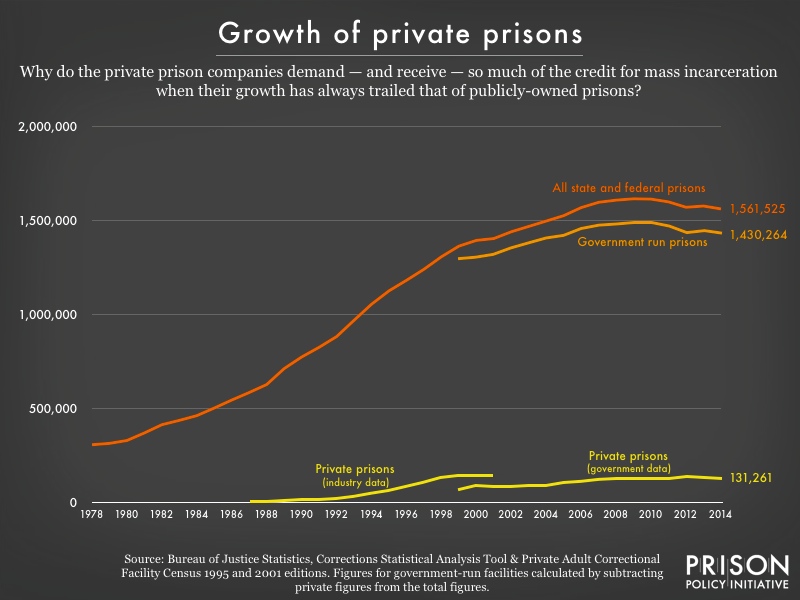 Note that the federal government didn’t even bother to track the size of private prisons until 1999 and that we calculated the size of the government-run prisons by subtracting the private prisons from the total. The data from 1987 to 2001 was collected and published by an academic in Florida with a
 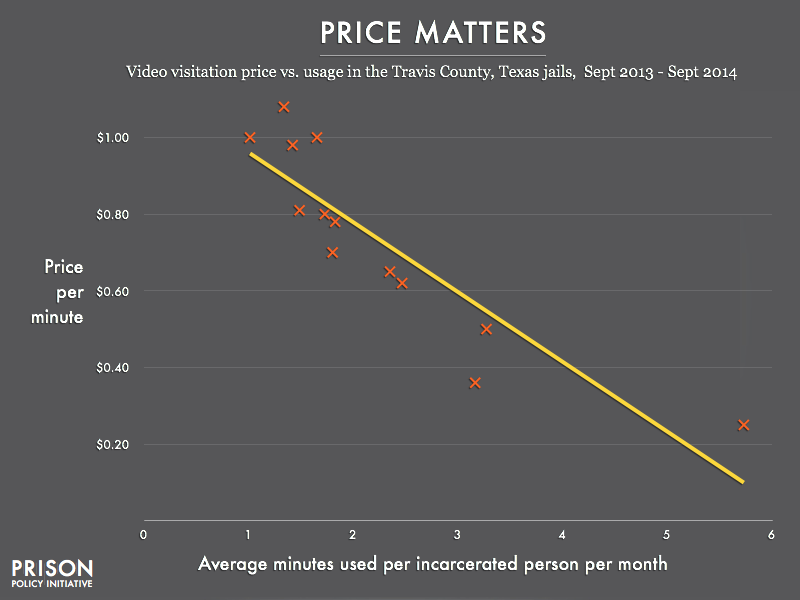 Through an open records request, we collected the video visitation usage data of Travis County, Texas from September 2013 to September 2014, finding that when Securus and the county charged the typical rate of $1 per minute, families barely used remote video visits. When promotional rates were offered, usage went up. But overall video visitation remained unpopular even when offered at approximately $0.20 per minute.