Jail churn and pre-trial detention are even more important than a quick look at the data suggests. Here, we correct for the fact that a sizable number of people are housed in jails for other agencies.
by Peter Wagner,
December 8, 2015
In August, I wrote a piece called Jails Matter. But Who is Listening? about the importance of focusing on jails, given their locus as the place where most of the people who go to prison or jail in a year are initially locked up.
In that piece, I talked about the tremendous churn of people through our jail system (11 million people a year) and about how 99% of the growth in the jail population in the last 15 years has been in the “unconvicted” or pretrial population. Only a minority of people in jails have been convicted and are serving a typically short misdemeanor sentence. Of the larger, unconvicted group, I wrote:
These people are legally considered innocent until proven otherwise in court. But if they don’t have the money to post bail, the principle that they are legally innocent is not enough to keep them from being locked up until trial.
And:
getting to the bottom of this country’s jail problem is going to depend on both reducing the number of people we send to jail each year and making it far easier for those who have been arrested to resume their lives while the judicial process proceeds.
Holding people in jail for even a few days has been demonstrated to do permanent harm, so this should be an obvious priority. If you are, at this point, fully convinced of that point, you can stop reading now. If you needed to know that more than 99% of the jail population growth is pretrial detainees, or if you are really interested in jail data calculations, keep reading.
We just connected the dots on an interesting quirk in how the data for convicted/unconvicted is calculated for jails that makes focusing on the flawed policies that send people to jails and keep them there even more important.
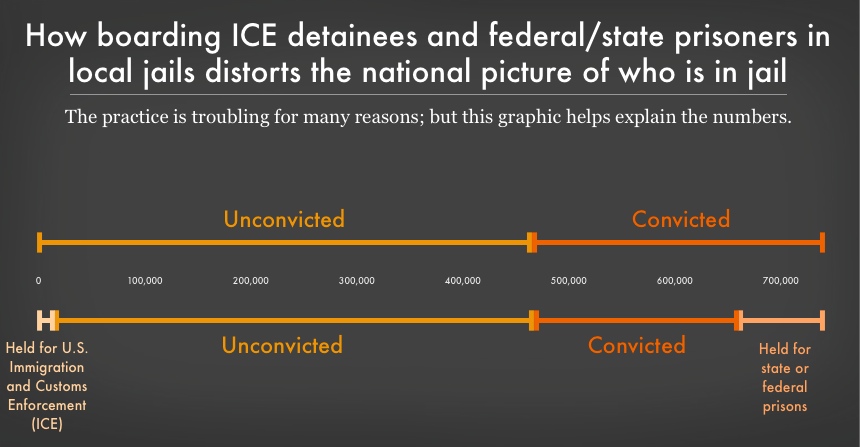
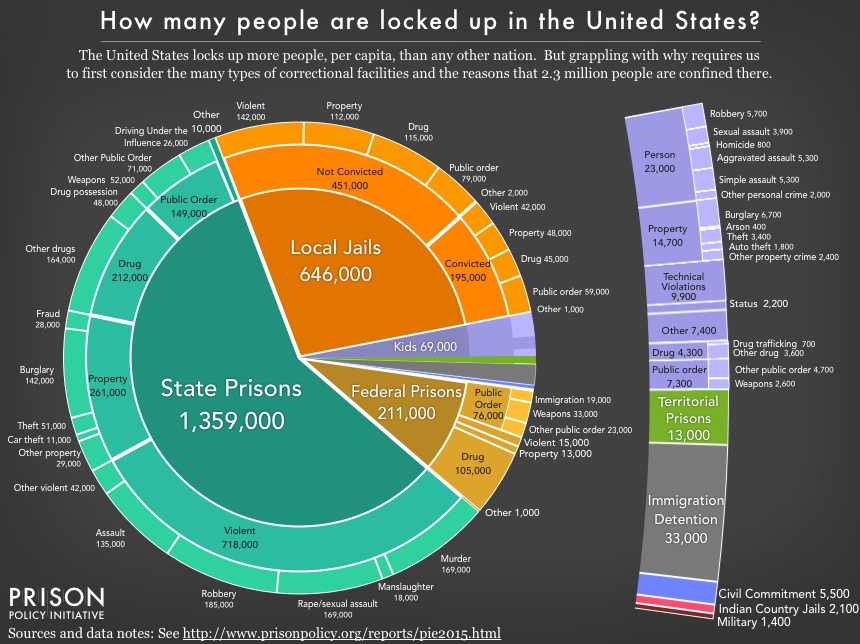
Jails, as we know, house people for other agencies, with the two largest groups being for Immigration and Customs Enforcement (ICE) at about 2% of their population, and also for state and federal prisons.
As the Bureau of Justice Statistics shows in Prisoners in 2014, 81,738 people were held in jails on behalf of federal or state prisons. The numbers of people held for federal authorities is small, but the number held for state authorities constitutes 6% of the total state prison population. Some states don’t do this at all, but in Kentucky, Mississippi, and Tennessee, more than a quarter of the state prison population is in local jails, and in Louisiana more than half of the state prison population is in the local jails.
So what’s important here is that there are a lot of people reported as convicted in jails who aren’t serving short misdemeanor sentences after being convicted in local courts but are serving state or federal prison sentences and just housed in local jails.
Of course, this isn’t the Bureau of Justice Statistics’s fault. They are asking a very useful question and getting useful data that answers their question. It just so happens that their data needs some adjustment to answer the slightly different question of: How important is it for local officials to focus on pretrial/unconvicted populations?
The answer: It’s very important that we get local officials to focus on the policies that impact the size of their pretrial populations because that’s the overwhelming majority of the people in jail on a given day. Excluding people confined under contract with ICE from the unconvicted population and excluding people confined under contract with state or federal prisons from the convicted population leaves us with this breakdown:


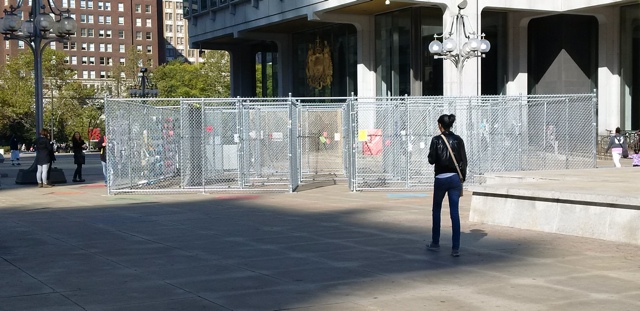
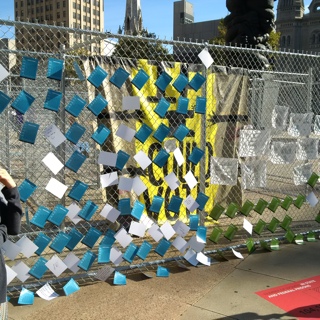
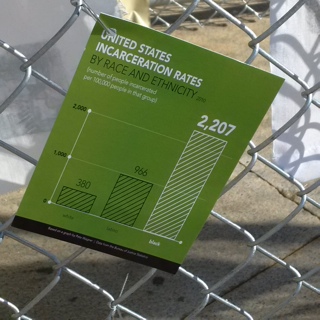
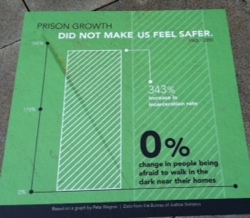 For the month of October, some of our research is hanging in a public art installation about mass incarceration just outside of Philadelphia City Hall. The central element of artist Sam Durant’s installation “Labyrinth”, designed in collaboration with men incarcerated at Graterford State prison, is a large maze made of chain-link fencing.