Heather Ann Thompson, professor in the Departments of African American Studies and History at Temple University, shares her work and why she joined PPI's board.
by Leah Sakala,
November 21, 2013
Heather Ann Thompson is an associate professor of history in the Department of African-American Studies and the Department of History at Temple University. She is currently writing the first comprehensive history of the Attica Prison Rebellion of 1971, and also writes regularly on the current crisis of incarceration. She joined the PPI board in 2012.
What research projects are you currently working on?
Heather Ann Thompson: I am completing a history of the Attica Prison uprising of 1971 for Pantheon books. I’m also continuing to write contemporary pieces on the current incarceration crisis and the history of how we got here.
How have you used the PPI Research Clearinghouse in your scholarship?
HT: PPI’s Research Clearinghouse has been invaluable to the talks that I have been giving around the nation as well as in other countries on the carceral crisis. When I speak of the ways in which incarceration impacts communities in various states, for example, I rely on the important research PPI provides in that regard. I also cite PPI research regularly in the contemporary pieces that I write on this issue. My latest piece in the Atlantic depended on the important work PPI has done on prison gerrymandering.
How can other academics and advocates benefit from the Research Clearinghouse as well?
HT: For academics who seek to remain abreast of the most important research out on the carceral state and the criminal justice system, there is no site better for them to check regularly than the PPI site. Not only will they find an endless supply of articles and reports that will help their own scholarship to be better informed and completely up to date, but they will also find original research done by PPI staffers that is invaluable to them.
Drew Kukorowski, attorney at the Council for Children's Rights, shares how he began working with PPI and why he joined PPI's board.
by Peter Wagner,
November 21, 2013
Drew Kukorowski is an attorney at the Council for Children’s Rights. He graduated from University of North Carolina School of Law and joined the PPI board in 2013.
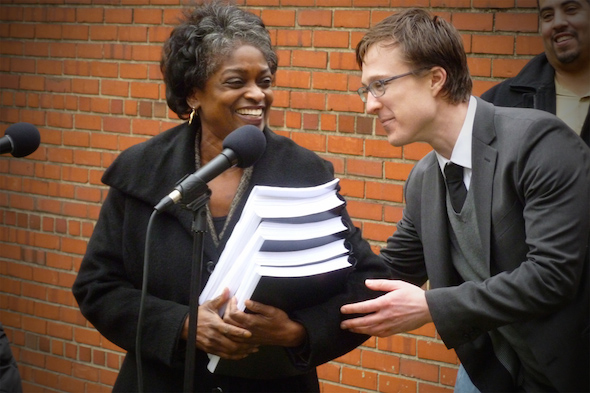
Drew Kukorowski delivering 36,690 petitions that we collected with SumOfUs to FCC Commissioner Mignon Clyburn.
Why did you write your first report on the prison phone industry?
Drew Kukorowski: After graduating from law school, I returned to work with PPI on the project to end prison gerrymandering. During this time I became outraged that phone companies were colluding with state prison systems to rip off poor families. I saw a real need for a comprehensive policy paper, so in the evenings, on my own time, I wrote “The Price To Call Home: State-Sanctioned Monopolization In The Prison Phone Industry.”
What prompted the FCC to rule to regulate the industry
DK: After 13 years, the FCC finally responded to the tidal wave of political pressure from families, from advocates, from the public, from the media, and from members of congress.
What are the next steps for the movement for fair prison and jail phone charges?
DK: We need to ensure that the FCC enforces its ruling, expands the regulation to apply to in-state calls, and closes the door on any loopholes that allow companies to charge unreasonable fees to deposit money, request refunds, or even just to have an account.
PPI submits letter to Alabama Public Service Commission supporting proposed regulations to reign in exorbitant costs jails and prison phone calls.
by Aleks Kajstura,
November 14, 2013
The Alabama Public Service Commission is still seeking comments on a recent order proposing to cap all prison and jail call rates and place strict limits on fees and other charges (summarized here).
Yesterday, we submitted the following letter in support of the Commission’s proposed regulations:
November 13, 2013
Walter L. Thomas, Jr., Secretary
Alabama Public Service Commission
P.O. Box 304260
Montgomery, AL 36130
Dear Commissioners:
We are writing in support of your Order Proposing Revised Inmate Phone Service Rules (Oct. 7, 2013, Docket 15957). As the Executive Director and Legal Director of the Prison Policy Initiative, we have investigated the high cost of calls from correctional facilities and would first like to thank you for addressing the issue of fees in your proposal.
We believe that regulating fees is an integral part of comprehensive regulation of prison and jail phone companies, and we commend Alabama for being the first state to, in our knowledge, directly address this major but hidden part of the industry.
Our research found that fees make up 38% of the $1 billion customers spend on prison and jail phone calls each year. Your action to address fees is essential because simply capping rates would, as our report argues, be ineffective at protecting consumers if the industry was still free to continue to create additional fees out of thin air.
We agree with your conclusion that commissions paid to correctional facilities are ultimately to blame for both the high rates and fees charged by prison and jail phone companies. For that reason, the Prison Policy Initiative supports the proposed rules that would reign in both the exorbitant rates and fees now charged to Alabama consumers.
Sincerely,
Peter Wagner, Executive Director
Aleks Kajstura, Legal Director
The deadline for submitting comments is December 6, 2013.
Companies and correctional facilities can no longer collude to profit off of keeping families apart.
by Peter Wagner,
November 13, 2013
The Federal Communications Commission’s (FCC) historic order reining in the exploitative prison and jail telephone industry has finally been published in the Federal Register, making it official. (The footnoted version of the order is still available on the FCC’s website.) Starting February 11, a single call home from prison or jail will no longer cost a family as much as $17 and new rules will improve how this market operates. The FCC Commissioners are also requesting public comments, due December 13, on a series of questions related to expanding the scope and operation of their order.
Here’s a breakdown of the details of the FCC’s order:
Continue reading →
"Peter Wagner ’03 was recently honored with the National Association of Criminal Defense Lawyers’ 2013 Champion of State Criminal Justice Reform Award."
by Leah Sakala,
November 8, 2013
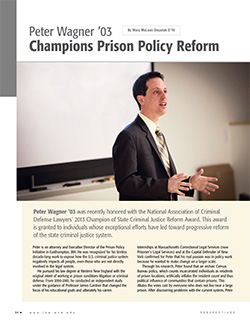
The newest issue of the Western New England College of Law alumni magazine Perspectives includes a nice profile of Peter Wagner (class of 2003):
Peter Wagner ’03 was recently honored with the National Association of Criminal Defense Lawyers’ 2013 Champion of State Criminal Justice Reform Award. This award is granted to individuals whose exceptional efforts have led toward progressive reform of the state criminal justice system.
Peter is an attorney and Executive Director of the Prison Policy Initiative in Easthampton, MA. He was recognized for his tireless decade-long work to expose how the U.S. criminal justice system negatively impacts all people, even those who are not directly involved in the legal system.
Prison phone company that recently raised their exorbitant fees even higher, recently took steps to bolster their still unregulated single call program.
by Aleks Kajstura,
November 8, 2013
Securus, the same prison phone company that recently raised their exorbitant fees even higher, recently took steps [“Securus Technologies Buys ‘America’s Most Promising Company'”] to bolster their still-unregulated “single call” program.
Our report found that the phone companies set up these $10-15 “single call” programs to extract additional income from desperate consumers. Before the call can be connected, the recipient must first agree to either have a $9.99 to $14.99 “premium message” charged to their cellphone, or to pay that amount by credit or debit card. These “single call programs” are currently unregulated and far more profitable for the phone companies than the prepaid systems: Securus’ $14.99 charge is $1.80 for the call and a $13.19 “processing fee”.
Securus seems to be committed to this profit mechanism, recently acquiring 3Cinteractive, a “mobile platform company”, having already previously secured 3Cinteractive’s patents for collect calls to cell phones.
But luckily for folks who live in Alabama, the Alabama Public Service Commission is keeping an eye out for $13 processing fees. The Commission recently concluded: “As more calls are completed using ‘text-to-collect’ and ‘pay now’, the average price for inmate calling will trend upward regardless of regulatory caps established for ICS usage rates and authorized fees.” And the Commission’s proposal to bring these calls under the same rate and fee caps as other prepaid and collect calls would create the country’s first regulation of this profit mechanism.
The Alabama Public Service Commission is still seeking comments on their proposed ICS reform, so we’ll keep you posted.
As soon as we learned of the Massachusetts Department of Corrections's plan to use dogs to screen people entering prisons starting this week, we wrote them another letter.
by Leah Sakala,
November 7, 2013
If you visit a Massachusetts prison this week, you may be subjected to a dog sniff search.
As soon as we learned of the Massachusetts Department of Corrections’s plan to use dogs to screen people entering prisons — including friends and families visiting their loved ones — starting this week, we wrote them another letter.
We reminded the Commissioner of the Department of Corrections that the research clearly shows that helping incarcerated people maintain close relationships with their families and communities increases the chances that they will succeed after they are released. Using dogs to screen visitors not only adds an additional humilitating experience for visiting family, but it is also out of step with the vast majority of correctional security systems in the country.
If you want to weigh in on this issue as well, make your voice heard by contacting the Department of Corrections, Executive Office of Public Safety, and the Office of the Governor.
by Peter Wagner,
October 19, 2013
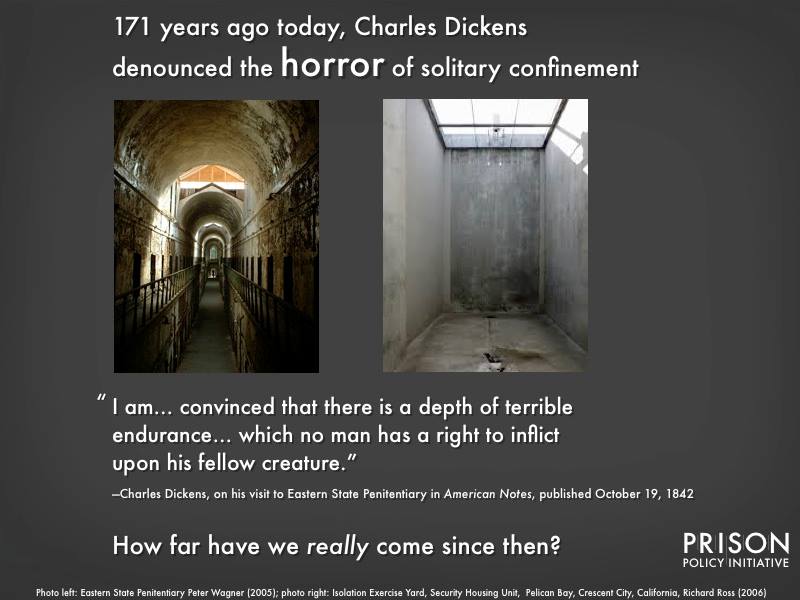
When Charles Dickens came to the United States, he wanted to see two things: Niagara Falls and Eastern State Penitentiary. He expected to be impressed with this radical new type of prison with a solitary confinement system. Instead, he was horrified. PPI’s Leah Sakala made this graphic to commemorate this anniversary:
We produced a map to illustrate the ACLU’s testimony against a counterproductive zone law.
by Peter Wagner,
October 17, 2013
The Michigan ACLU testified yesterday against a bill proposing counterproductive and ineffective restrictions on where people on the sex offender registry would be allowed to “loiter”. This bill would expand the current restrictions to also include all areas within 1,000 feet of a day care center, creating “a nearly impossible burden on listed offenders and on law enforcement.” Here at the Prison Policy Initiative, we produced a map to illustrate the ACLU’s testimony by demonstrating that the simple-sounding law would blanket dense urban areas with a confusing pattern of imperceptible zones.
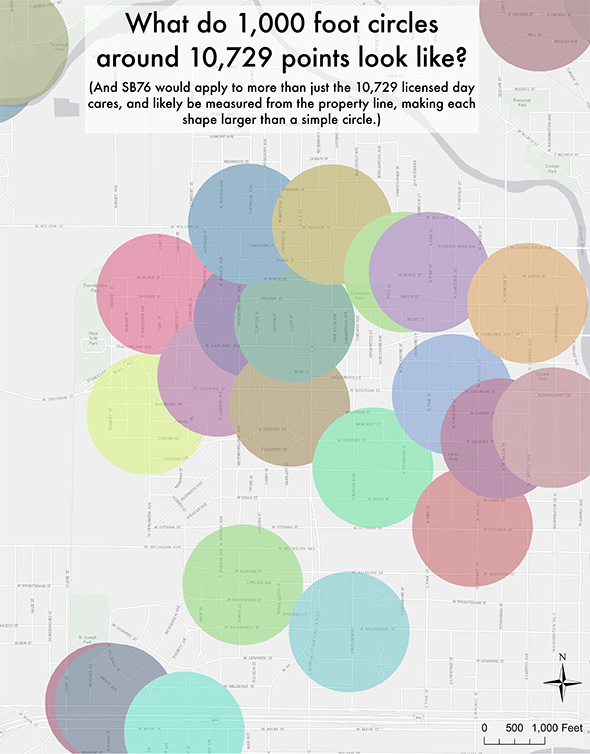
Our map showing that most of the Michigan capital city of Lansing is within 1,000 feet of just two dozen of the 10,729 day care centers in the state.
Litigator Kung Li stopped by our office in August to talk about her experience working with us on the Southern Center for Human Rights’ Whitaker v. Perdue case.
We’ve also prepared similar analysis for court cases in Colorado, Georgia, Massachusetts and elsewhere. This work grew out of our research on sentencing enhancement zones, the drug laws that give enhanced penalties based on where an offense occurs, not on its dangerousness. These laws are all too common, and the basic differences are the number of protected places, the distances involved, and how that distance is to be measured.
In all the cases we’ve looked at, a few key points about geography and geometry keep coming back:
- Drawing large circles around thousands of places blankets entire cities in “protected” or “off-limits” areas.
- Doubling the distance in one of these statutes makes the protected area four times as large (remember pi r squared?).
- 1,000 feet — and most distances, for that matter — are actually much further than most people assume.
- Laws that measure the distance as the crow flies extend coverage to areas that are, for all practical purposes, very far away.
- Laws that measure the distance on a property line-to-property line basis cover considerably more area than simple 1,000 foot circles drawn around the center point of a particular property.
Most importantly, however, the laws that fail to work as intended share the same fundamental flaw of covering too much area. This might sound like it would produce more safety but it actually produces less for the simple reason that when you make everywhere special, nowhere is special.
Alabama Public Service Commission caps phone rates and limits fees charged for phone calls from correctional facilities.
by Aleks Kajstura,
October 9, 2013
In a sweeping proposal to rein in the exorbitant costs of calls to people in jails and prisons, the Alabama Public Service Commission seeks to cap all call rates and place strict limits on fees and other charges. We are particularly happy to see this comprehensive proposal addresses fees because, as we explain in our recent report, we found that fees account for 38% of the money spent on calls from correctional facilities.
The proposed rules seek to cap calls at $0.25 per minute, and video visitation at $0.50 per minute, noting that “[a]ffordable VVS [Video Visitation Service] rates are in the best interests of Alabama inmates, their families, and the confinement facilities.” (Video visitation still accounts for only a small part of communication with family members in jail and prison, but this cap is an important component of regulation because video visitation is a quickly growing service.)
We have previously identified commissions paid to correctional facilities as a major factor in the exorbitant rates charged for phone calls in jails and prisons, and the proposed rules similarly blame commissions for the high rates and fees charged by ICS (Inmate Calling Services) companies. The Commission found that “[e]ither ICS providers are operating at a loss, or are generating revenue by means other than inmate calls, or are shielding some portion of ICS revenue from commissions.” Furthermore, the commission found that “unnecessary or excessive ICS provider fees decreases the amount [of funds] devoted for inmate calls and reduces commissionable revenue.” To put it simply, high fees hurt incarcerated people as well as jails.
Continue reading →


