Leah reports back from a hearing on the zone law before the Massachusetts Supreme Judicial Court.
by Leah Sakala,
October 8, 2013
The Massachusetts Legislature took a step in the right direction last year when it reformed the state’s sentencing enhancement zone law. But now the highest court in Massachusetts must decide just when the new law began to take effect.
Basically, lots of states have sentencing enhancement zone laws that aim to keep illegal drug activity away from kids by saying that if you commit drug offenses within a certain distance of a place like a school, you get a mandatory extra sentence for your crime. But until last August, the Massachusetts law created enormous 1,000-foot zones that blanketed entire urban areas. Our two reports found that huge zones end up defeating the whole purpose of the law because when you make everywhere special, nowhere is special. Furthermore, the law increases racial disparities in the justice system because dense, urban communities that are disproportionately made up of people of color are most impacted by zone laws.
Last August, the Massachusetts legislature realized that the 1,000-foot zones weren’t doing the job, and were actually causing harm. So lawmakers took our advice to reduce the size of the zones, reining them in to a more reasonable 300 feet.
Yesterday I attended a hearing in Boston before the Massachusetts Supreme Judicial Court to consider which version of the law should apply to people who were arrested before last year’s law change, but sentenced afterwards. Since this case is largely revolves around a procedural question, much of the hearing was spent talking about the technicalities of the legislation.
For me, the most memorable moment was when the District Attorney raised a concern that applying the law retroactively could create a disparity between people who had their court dates before the law was changed, and everyone else. Without skipping a beat, Justice Gants responded by pointing out that the legislature changed the law precisely because the old policy created disparities by giving prosecutors incredible power to bring an extra sentencing charge against people who primarily come from urban communities of color.
At the end of the day, as FAMM’s Barbara Dougan argued in her Amicus Brief, it’s clear that last year’s reform to shrink the size of the zones was intended to immediately improve a major flaw in the 1,000-foot law. Sentencing people to extra prison time based on a law that the legislature has since rejected is clearly not a good policy.
We’ll be following the outcome of this case closely, so stay tuned for updates and a ruling. Also, keep your eyes peeled for our newest video on sentencing enhancement zones. We’re hoping to wrap it up this week!

"...locking up unprecedented numbers of citizens over the last forty years has itself made the prison system highly resistant to reform through the democratic process."
by Leah Sakala,
October 7, 2013
Chances are, your high school U.S. History class didn’t quite tell you the whole story about how the criminal justice system has cast its shadow on U.S. democracy for centuries. Here’s a chance to get the record straight.
Heather Ann Thompson, historian and Prison Policy Initiative board member, just published a must-read new article in The Atlantic, “How Prisons Have Changed America’s Electoral Politics.”
As Heather writes,
…locking up unprecedented numbers of citizens over the last forty years has itself made the prison system highly resistant to reform through the democratic process. To an extent that few Americans have yet appreciated, record rates of incarceration have, in fact, undermined our American democracy, both by impacting who gets to vote and how votes are counted.
Of course, one of the ways mass incarceration distorts democracy is via prison gerrymandering. Heather explains:
Today, just as it did more than a hundred years earlier, the way the Census calculates resident population also plays a subtle but significant role. As ex-Confederates knew well, prisoners would be counted as residents of a given county, even if they could not themselves vote: High numbers of prisoners could easily translate to greater political power for those who put them behind bars.
The full article is absolutely worth a read. We, the people, deserve to know the whole story.
Disturbing laws that allow state and federal governments to keep certain people convicted of sex offenses behind bars indefinitely.
by Peter Wagner,
October 2, 2013
Our friend and colleague James Ridgeway has released a must-read expose on disturbing laws that allow state and federal governments to keep certain people convicted of sex offenses behind bars indefinitely:
Through a legal procedure called “civil commitment”, you can be classed as a sexually violent predator based solely on the subjective opinion of a state-employed psychologist or sex expert.
Once placed under a civil commitment, you are essentially in prison indefinitely. This can quickly become a nightmare, particularly in instances such as an “agreed disposition” – similar to a plea bargain in a criminal trial – where a person may have been pushed to waive his right to appeal during negotiations.
The article concludes:
While there are, undoubtedly, some irremediable sex offenders who need to be confined for reasons of public safety, the civil commitment protocol denies some of the basic rights afforded other criminal defendants. These include the right to a speedy trial, full right to counsel and, perhaps most importantly, the right to introduce testimony from a defendant’s own experts. Without the protection of this last right, some defendants are sent off to prison for an indefinite sentence on the basis of questionable opinions from the state’s expert witnesses.
Civil commitment for sex offenders needs to be reformed root-and-branch or abandoned. The policy may be popular in law enforcement circles, fewer than half of US states have such laws. But in those states that have it […] most do not escape this largely invisible American gulag.
While the harmful older zone law has been scaled back, questions still remain in the courts.
by Leah Sakala,
September 24, 2013
Massachusetts has just passed the one-year anniversary of scaling back harmful and ineffective 1,000-foot “sentencing enhancement zones.” As our research found, the old zones were too big to meet the indended goal of deterring drug activity from particular areas. We also found that the old policy led to alarming racial disparities, so we were certainly glad when the legislature reduced the size of the zones to 300 feet.
But, as our friends at Families Against Mandatory Minumums (FAMM) can tell you, a lingering question remains in the courts: should the old rules or the new rules apply to the people who committed offenses before the law was changed, but who were sentenced after the change?
Advocates at FAMM are urging the court to apply the more reasonable 300-foot zone policy to all cases that were pending when the law was changed. We completely agree, and are thrilled that our two reports were cited throughout FAMM’s friend-of-the-court brief.
The case, Commonwealth v. Pagan, will be argued in the Massachusetts Supreme Judicial Court on Monday, October 7, and the public is welcome to attend. I’ll be there, and I hope to see you there, too!
Our map showing which countries allowed the execution of juveniles as recently as 2002 was just featured in a great new Vlogbrothers video.
by Leah Sakala,
September 23, 2013
We’re excited to share that our map showing which countries allowed juveniles to be executed as recently as 2002 was just featured in a great new Vlogbrothers video, “42 Amazing Maps” (watch closely at about 1:55):
Many honor Johnny Cash's contribution ton country music, but few know of his passionate advocacy for incarcerated people.
by Peter Wagner,
September 12, 2013
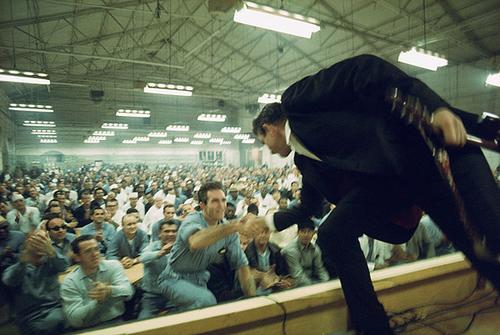
Johnny Cash shaking hands with Glen Sherley during Cash’s performance at Folsom Prison, 1968 (photo by Jim Marshall).
Today marks the 10th anniversary of the death of Johnny Cash at the age of 71. The country music star was famous for his At Folsom Prison and At San Quentin live albums, and his hit Folsom Prison Blues
What is less known is how deep Johnny Cash’s activism went. Earlier this year, the BBC Magazine wrote a great article to accompany a two part radio documentary about Cash’s work and effectiveness:
Cash’s classic albums recorded at Folsom Prison and San Quentin are well known, but few are aware that these were just two of many prison concerts he played over three decades.
Cash’s experiences in these jails turned him into a passionate prison reformer who donated his own money to the cause, took a released prisoner into his own home and even met President Richard Nixon to force the issue.
Johnny Cash never served time in prison himself, but he struggled with his own demons, and the Man in Black identified with:
…the poor and the beaten down,
Livin’ in the hopeless, hungry side of town,
…the prisoner who has long paid for his crime,
But is there because he’s a victim of the times.
Johnny Cash deserves a lot of credit for putting the issue of prison reform on the minds and radio waves of a generation, and for setting out a shining example of how our cultural leaders can help make social change.
Since Cash’s death, I discovered an even rarer and more important song that I think illustrates the depth of Cash’s passion and vision for prison reform: Jacob Green. The song was first performed at a Swedish prison and released on the 1974 LP “Pa Osteraker” (Inside a Swedish Prison), and then on the recording of a 1976 concert at the Tennessee State Prison, A Concert Behind Prison Walls visible on YouTube:
Note: After this blog was published, the video referenced was removed from YouTube.
As I wrote 10 years ago in a short homage to both Johnny Cash and his song San Quentin: “We’ll miss you Johnny. May all the world never forget you sang. All the world will rejoice you did so much good.”
The Huffington Post just published the first article we’ve seen on the prison phone regulation that includes a public interview with the CEO of Securus.
by Leah Sakala,
September 10, 2013
The Huffington Post just published the first article we’ve seen on prison phone market regulation that includes a public interview with Richard Smith, the CEO of Securus, which is the second-largest corporation in the prison telephone industry.
In the year we’ve spent doing detailed analyses of this industry’s shenanigans, we can’t help having gotten a little jaded. But the industry keeps on shocking us with new lows. Here’s a teaser from the article.
First, Mr. Smith likens corporate phone companies to selfless public servants:
It’s almost like throwing firemen and policemen under the bus, it just isn’t fair.
He then turns right around and admits that the corporate bottom line is his top priority:
It isn’t an altruistic business. It’s a business for profit.
The article also cites our work, pointing out that in the few weeks since the FCC has voted to regulate the prison phone industry Securus has actually raised its deposit fees even higher. Now, instead of costing $7.95 to make a deposit over the phone, Securus charges $9.95.
Check out the interview with us about our work to expose how mass incarceration harms families, communities, and our nation.
by Leah Sakala,
September 10, 2013
Yesterday our friends at Juvenile-In-Justice featured the Prison Policy Initiative on their blog, posting an interview with us about our work to end prison gerrymandering, and our projects to preserve family communication in prisons and jails via telephone and letter. Check it out!
A harmful new trend is sweeping through local jails as a growing number of sheriffs are banning letters from home.
by Leah Sakala,
September 9, 2013
Our new video reveals that a harmful new trend is sweeping through local jails as a growing number of sheriffs ban letters from home:
Want to learn more about this disturbing trend? Check out our page on jail letter bans.
While the FCC drags its feet on regulating the prison phone industry, the industry is wasting no time raking in the profits.
by Peter Wagner,
September 5, 2013
While the Federal Communications Commission (FCC) drags its feet on regulating the prison phone industry, an industry leader is wasting no time raking in the profits. Just this week, Securus, the second largest company in the prison phone industry, has quietly raised some of its fees.
In our report, Please Deposit All of Your Money: Kickbacks, Rates, and Hidden Fees in the Jail Phone Industry, we wrote that the companies’ hidden fees can double the price of a call. Unlike the regular phone industry, these companies want their money upfront, and they charge additional fees to take, hold, and refund families’ money.
Securus, for example, didn’t think it was enough to charge a family $7.95 to accept a deposit via the web or over the telephone. Now, the company charges $9.95 to deposit money with a credit card over the phone. The company charges this same higher rate regardless of whether you speak to a customer service agent or use the automated system. (By contrast, I can’t think of a business that I use regularly that charges me a fee to take my money. Generally, companies absorb those costs because they want my business. Because this industry has its customers locked in (pun intended), they don’t have to worry as much about competition. But Securus is clearly out of line compared to its competitors. The prison phone company PayTel, which has none of Securus’ economies of scale, charges $3.00 for an automated payment and $5.95 for payments made via a live operator.)
Securus has another, hidden profit-boost as well. Buried in its long list of questionable monthly charges is an increase in one: Securus is keeping the bill processing charge ($1.49/month), Billing Statement Fee ($3.49/month), Federal Regulatory Recovery Fee ($3.49/month), USF Administrative Fee ($1.00/month) and increasing the “Wireless Administration Fee” from $2.99/month to $3.99 a month.
Food for thought: Is Securus raising its fees because it wants to raise every dollar it can now, before the FCC rules take effect, or does this have to do with the recent sale of the company from one investment bank (Castle Harlan) to another (ABRY Partners)? I note that competitor NCIC, which isn’t owned by an investment bank, lowered some fees after our report brought public attention to fees.
Bonus question: Are any sheriffs out there aware that these fees are not commissionable and that their partner Securus just increased its corporate profits at local taxpayers’ expense?
Extra bonus question: Is the FCC aware of what the industry is doing while we wait for the publication of the order to regulate the industry?
Sources:


