The article includes a nice summary of Peter's invited presentation on a panel about the true costs of providing prison phone service.
by Leah Sakala,
August 29, 2013
David Ganim of Prison Legal News wrote a great piece about last month’s FCC workshop on prison phone call charges (beginning on page 26).
The article includes a nice summary of Peter’s invited presentation on a panel about the true costs of providing prison phone service:
Peter Wagner, an attorney and executive director of the Prison Policy Initiative, who was the last panel speaker at the FCC workshop, rebutted several of the arguments made by prison phone companies and their supporters. He further addressed the issue of extra fees charged by prison phone service providers – such as fees to fund pre-paid phone accounts as well as account closure, inactivity and refund fees.
Wagner noted that 12 million people pass through the U.S. jail system annually and that the extra fees associated with prisoner calls are a means for prison phone companies to generate revenue outside the commission system, since commissions aren’t paid on fees. He said that small prison phone providers have smaller fees but that the larger companies, including Global Tel*Link and Securus, have some of the highest fees in the industry. Wagner concluded by stating the extra fees demonstrated that the prison phone industry, which he termed a “dark, neglected corner of the telecommunications industry,” is unable to regulate itself – and that to be effective, reforms must address the problem of such fees.
For more great reporting from Prison Legal News, subscribe online, like them on Facebook, or follow them on Twitter.
Ending the letter ban would help keep Santa Barbara's community safe and families intact.
by Leah Sakala,
August 28, 2013
A new Santa Maria Times article reports that the Santa Barbara County Board of Supervisors are exploring a potential solution to the decades-old problem of overcrowding in the local jail. The county is considering studying the impact of allowing private investors to finance social service programs, with an eye towards reducing recidivism and therefore government expenditures.
While I certainly support the Supervisors’ creative long-term efforts to reduce recidivism, Santa Barbara County is missing a simple and more immediate opportunity to keep people from returning to jail: stop banning families from writing letters to incarcerated loved ones.
When Sheriff Brown started banning letters from home earlier this year, he apparently ignored the significant body of social science research that says that one of the most effective ways to help incarcerated people succeed when they return home is to allow them to preserve family ties. He also ignored the best practices on correspondence touted by major professional organizations such as the American Correctional association, the American Jail Association, and the American Bar Association, government bodies like Immigration and Customs Enforcement, and regulatory agencies such as the Texas Association on Jail Standards.
In March, when the Santa Barbara County letter ban was first announced, more than 50 national criminal justice and civil rights organizations submitted a letter to Sheriff Brown urging him to cancel the ban. But a child in Santa Barbara is still currently prohibited from writing a letter or sending a drawing to an incarcerated parent.
Working with Sheriff Brown to end the jail’s ban on letters from home is a simple and evidence-based step that the Board of Supervisors can take today to keep Santa Barbara’s community safe and families intact.
Peter Wagner was an expert witness in the case, finding that the ordinance essentially amounted to complete banishment from the city of Englewood.
by Peter Wagner,
August 23, 2013
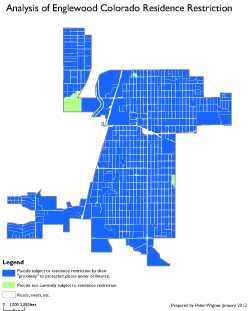
The map that I prepared for the case (area in blue is off limits).
The ACLU of Colorado has announced that federal Judge R. Brooke Jackson has invalidated an Englewood, Colorado city ordinance that severely restricts where persons convicted of certain sex offenses can live, ruling that the ordinance violates the Colorado Constitution.
I was an expert witness in the case, and I found that the ordinance essentially amounted to complete banishment from the city of Englewood. Judge Jackson summarized my findings in his opinion:
During trial the City presented a map showing the parts of the City that are off limits under Ordinance 34 as well as a list of residence addresses that are located in parts of the City that are unrestricted. Exhibit 7. The result, according to the City, is that 209 addresses within the City are not restricted, of which 126 addresses are residential. However, according to Peter Wagner, plaintiff’s geographic information systems and mapping expert, the correct number of parcels available to sex offenders is 55 unrestricted parcels out of 11,314 parcels total in the City. Either way approximately 99% of the City is off-limits to most sex offenders.
The case was brought by the ACLU of Colorado and pro bono counsel from Faegre Baker Daniels LLP. For more on our other litigation efforts on prison gerrymandering and the issue of banishment of people on sex offender registries, see our litigation page.
A New York Times Magazine article exposes how the broken prison commissary industry leaves the people footing the bill out of the equation.
by Leah Sakala,
August 20, 2013
A fascinating “It’s the Economy” column by Adam Davidson in this week’s New York Times Magazine, ‘Orange’ Is the New Green, takes a good, hard look at some serious market failures in the U.S. prison system. Along the way, the article provides great first-hand reporting about how the prison commissary system works, and it explains the economic theory in a way that may be helpful to our allies working to bring justice to the prison and jail telephone industry.
(As a refresher on what’s wrong with the prison phone industry, state prison systems and local jails grant exclusive monopoly contracts to telephone corporations. In exchange, the corporations charge sky-high bills to the families of incarcerated people and kick back the lion’s share of the profit to the prisons and jails.)
In our reports, we explain that the prison and jail telephone industry is so broken because the customers, which is to say the people who are actually using the provided service and footing the bills, aren’t actually the customers in the eyes of the corporations.
The New York Times article makes it clear that the prison phone industry is unfortunately not unique in this regard. The prison commissary industry, too, operates in what Davidson calls a “third-party-decider economy.”
Davidson found that allowing prison systems to be the “third party” in these industry transactions actually means that the corporations that are less responsive to the needs of incarcerated people are more successful in the marketplace. As he explains:
How can that possibly be? Because the people choosing the company aren’t the ones using the products.
This immediately looked familiar to us. In our most recent report, we found that some companies in the prison phone industry actually profit by providing bad service, such as forcing customers through convoluted refund processes or dropping calls.
But to add to Davidson’s argument, it’s important to remember that the people choosing the companies are also not the ones paying for the products or service, which is how you end up with the families of incarcerated people paying an outrageous $17 for a single 15-minute phone call from a loved one. From a corporation’s perspective, the literally captive market in prisons and jails is a boon for the bottom line.
Fortunately it looks like some relief for families is in sight, at least in the prison phone industry. The FCC has voted to rein in charges for the most expensive interstate calls, and may take more action in the future. But there’s lots more work to be done. The uniquely American project of mass incarceration has created many markets rife with perverse economic incentives to line the pockets of prison systems and corporations by dunning poor families. And corporations are not about to pass that up.
the FCC is finally stepping up to the plate to protect families from having to choose between staying in touch and paying the bills.
by Leah Sakala,
August 9, 2013
This afternoon the Federal Communications Commission voted to approve a new set of regulations to control the exploitative prison and jail phone industry. Currently, prisons and jails grant exclusive contracts to telephone companies that charge families outrageous bills and kick back a hefty portion of the profit to the correctional facilities. But now, the FCC is finally stepping up to the plate to protect families from having to choose between staying in touch and paying the bills.
While the official text for the order and notice won’t be available until next week, today the FCC announced that the regulation will mandate:
- That “all interstate inmate calling rates, including ancillary charges, be based on the cost of providing the inmate calling service.”
- Interstate rate caps of $0.21/minute for debit and pre-paid calls and $0.25/minute for collect calls, and “safe-harbor” rates of $0.12/minute for debit and prepaid calls and $0.14 cents/minute for collect calls. The rates must also include the costs of security features and technology.
- The expense of kickbacks back to prisons and jails must not be factored into interstate rates or charges
- People who need assistive hearing or speech services not be charged higher rates
- A call for “mandatory data collection, annual certification requirement, and enforcement provisions to ensure compliance with this Order”
The FCC also opened a new comment period to gather information on two topics:
- Regulating in-state rates
- Encouraging competition to bring down rates
Advocates for fair phone rates have been calling for regulation for more than a decade, beginning with a 2000 class action lawsuit brought against the Corrections Corporation of America and several prison phone companies. A federal judge decided that the case fell under the jurisdiction of the FCC, where it sat for years. Today’s ruling marks the first definitive action from the FCC to control the broken prison and jail telephone industry.
This victory was the result of a strong and sustained campaign, and we are proud to be celebrating with our movement partners. Stay tuned for a more in-depth analysis next week when the details are available!
2002 footage shows how much the industry has changed in 10 years.
by Leah Sakala,
August 9, 2013
The campaign for phone justice just posted a 2002 video of prison phone providers talking about the industry:
Talk about a blast from the past. The video is a perfect example of how much the industry has changed in the last decade. Here’s why:
- The video features representatives of Verizon and AT&T, public-facing companies you’ve actually heard of. Neither of these companies in the prison phone business anymore after investment banks took over the industry, and now Verizon publicly deplores the price-gouging in the current prison phone market.
- The video features leading prison phone companies actually engaging with the media. By contrast, coverage of today’s upcoming FCC vote on prison phone regulation has been rife with sentences such as: “American Securities, which owns Global Tel*Link, declined to comment.”
- The spokespeople in the video acknowledge that it’s not a fair industry to the families of incarcerated people: the corporate bottom line depends on prisons staying full and families footing the expensive phone bills. “Unfortunately, this is a growth industry,” says the Verizon representative at the start of the video, noting that prison expansion is expanding their customer base.
But now? The nation’s largest prison phone company, Global Tel*Link (which most people have probably never heard of), has been conspicuously silent. Not only are Global Tel*Link representatives not responsive to the public and to the media, but they’re also not talking to the Federal Communications Commission, refusing to participate in discussions about regulation or provide data the FCC is requesting.
Calls home from prisons and jails were outrageously expansive when the video was shot, and they’re outrageously expensive now. That alone is reason enough for the FCC to approve comprehensive regulation this morning. But the extreme price gouging combined with a shocking lack of transparency from prison phone corporations should leave no question in the Commissioners’ minds: It’s time to get this broken industry under control.
Tune in at 11AM EST to watch the historic vote and see what happens.
Successful community organizing led Sheriff John Hirokawa to cancel plans to limit correspondence to postcard only.
by Leah Sakala,
August 9, 2013
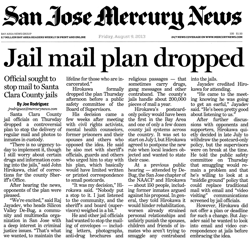
Great news for families in Santa Clara County, California: Sheriff John Hirokawa has scrapped a destructive plan to ban families from writing letters to loved ones in jail. As my report, “Return to Sender: Postcard-only policies in jail,” found, jail letter bans jeopardize the critical family ties that help incarcerated people succeed when they return home.
Santa Clara residents were rightly outraged when they discovered that the Sheriff was planning on banning letters from the jail. With the leadership of local media and community organizing group Silicon Valley De-Bug, they held a powerful public forum to share their concerns with the Sheriff’s Department. And, to the sheriff’s credit, he called off the ban.
Meanwhile, Santa Barbara County residents in Southern California are still fighting to overturn the letter ban in the local jail. Santa Barbara Sheriff Bill Brown would be wise to follow Santa Clara County’s example and end the letter ban that undermines public safety and drives families apart.
New album with photos from NACDL's award ceremony where Peter was honored.
by Leah Sakala,
August 8, 2013
At the end of July, the National Association of Criminal Defense Lawyers awarded Peter the “Champion of State Criminal Justice Reform Award” at the 12th Annual State Criminal Justice Network Conference in San Francisco, California. It was a great honor!
We recently got some pictures from NACDL of the award ceremony, and took a few shots of the award going up in the office:
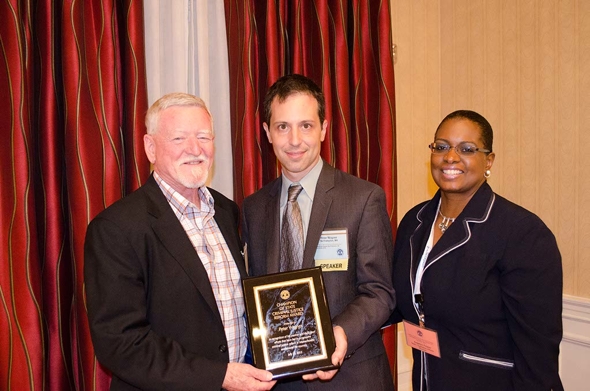
NACDL President Jerry J. Cox, Peter Wagner, and State Legislative Affairs Director Angelyn Frazer at the NACDL conference (Image source: NACDL)
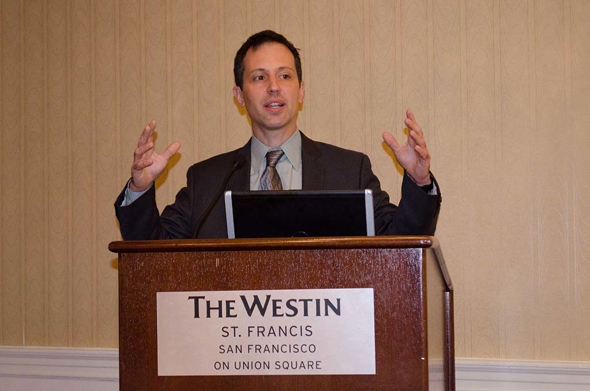
Peter speaking at the NACDL conference (Image source: NACDL)
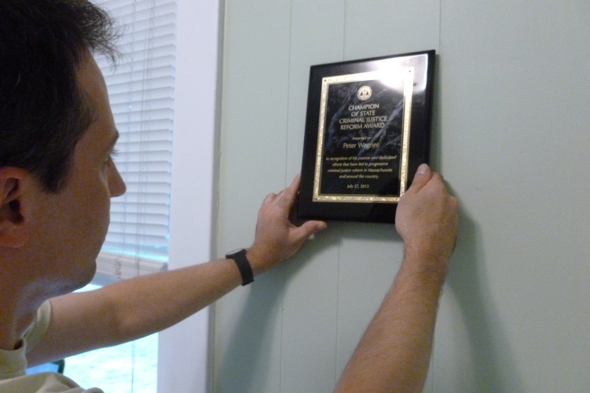
Hanging the award in the Prison Policy Initiative office
Letter to FCC: crafting effective regulation for prison phone market requires taking a comprehensive view of the commission system, ending high rates.
by Aleks Kajstura,
August 3, 2013
On Thursday we submitted a letter to the FCC urging it to craft effective regulation for the prison and jail phone market by taking a comprehensive view of the commission system that leads to high rates. We wrote:
[S]ome states and at least one county have already started banning commissions in an effort to stem the high rates. However, our review has found that an overly narrow concept of commissions leaves some glaring loopholes that make these efforts far less effective than originally expected. We would like to share the examples of Dane County, Wisconsin and the State of California to illustrate the possible result of a too-narrow view of commissions: Commissions can instantly be rebranded as “administrative fees” with no actual change.
In 2007, the County Commissioners of Dane County, Wisconsin voted to ban the commissions that brought in nearly $1 million per year. County Supervisor Dave de Felice explained the county was “addicted to this money.” Recognizing the inherent conflict of interest that commissions created, he stated, “We’ve lost our moral compass and direction for a million bucks a year.” The addiction metaphor turned out to be truer than Supervisor de Felice imagined, because when the contract was up in 2009, the County specified that it “shall receive no commission from phone service revenue” yet it required ICSolutions to pay an annual “administrative fee” of $476,000 in monthly increments.
The California Department of Corrections & Rehabilitation also banned commissions and now collects an “Administration Fee” of $66,666.66 per month.
What may have started as an exploitation of regulatory loopholes is now clearly a trend. As Telmate notes: “[C]ommissions are no longer confined merely to a portion of the carrier’s revenues…. These include free ‘booking’ calls, live deposit acceptance, automated inmate grievance and other IVR systems, voice biometrics, commissary ordering, managed cell phone access, storage of recorded inmate calls, and in some instances computing equipment for corrections staff as well as law libraries or religious services. The volume of such non-financial consideration has likewise been increasing….”
As we explained in our report, Please Deposit All of Your Money: Kickbacks, Rates, and Hidden Fees in the Jail Phone Industry, free booking calls ‘should be subsidized by state and local governments, not prison phone companies that must then compensate for the lost income by overcharging for all other calls.’ And,
As market-leader Global Tel*Link aptly stated: ‘Put simply, there is no free lunch.’ The kickbacks, via explicit commissions and payments-in-kind, are driving up the costs for the phone companies and, as a result, for consumers.
The FCC will vote on a proposal on August 9th, let’s see what happens!
Peter is being recognized for his tireless decades-long work to expose the how the U.S. criminal justice system negatively impacts all people.
July 25, 2013
For more information:
Ivan J. Dominguez
Public Affairs, NACDL
(202) 465-7662
idominguez@nacdl.org
FOR IMMEDIATE RELEASE
Washington, DC (July 25, 2013) – Peter Wagner, attorney and Executive Director of the Prison Policy Initiative, will be awarded the National Association of Criminal Defense Lawyers' 3rd Champion of State Criminal Justice Reform Award today at NACDL's 12th Annual State Criminal Justice Network Conference in San Francisco, California. The Champion of State Criminal Justice Reform Award honors individuals or groups whose exceptional efforts have led toward progressive reform of a state criminal justice system.
Mr. Wagner is being recognized with this award for his tireless decades-long work to expose the how the U.S. criminal justice system negatively impacts all people, even those who are not directly involved in the legal system. As a law student, Mr. Wagner discovered that the phenomenon of mass incarceration was self-perpetuating by using an archaic Census Bureau policy to garner undue influence in the legislature for areas containing large prisons. His report, Importing Constituents: Prisoners and Political Clout in New York, quantified the problem and put it on the map. In the decade that followed, Mr. Wagner has built and led a bipartisan urban and rural movement to abolish this practice of "prison gerrymandering," inspiring four states and more than 200 local governments to abolish the practice. The U.S. Supreme Court's endorsement of Maryland's law to end prison gerrymandering has been hailed as one of the major criminal justice and civil rights victories of the decade.
Mr. Wagner has also pioneered work in other areas to show how mass incarceration undermines our national wellbeing. Last year, his work to show how enormous "sentencing enhancement zones" around schools are ineffective and counterproductive helped Massachusetts advocates to reform this decades-old policy. Most recently, Mr. Wagner led a research team to expose the perverse incentives and price gouging in the prison and jail phone industry. Earlier this month, Mr. Wagner did an invited presentation of his research at a workshop held by the Federal Communications Commission on regulating the prison and jail phone industry.
Mr. Wagner's work has been featured in hundreds of papers around the country, and he has won editorial endorsement for criminal justice reform from publications ranging from The New York Times and the Boston Globe to the Terre Haute Tribune and Virginia's Roanoke Times.
NACDL State Legislative Affairs Director Angelyn C. Frazer said: "Peter's tireless efforts to educate the public, and in particular legislators, have been invaluable to criminal justice advocates seeking fairness and equity in an often unjust system. Through his extensive research and personal commitment, Peter successfully aided the advocacy community in Massachusetts as they sought reform of school zone laws for the first time since the 1980s. His work with Maryland legislators and others has led to effective campaigns seeking to abolish the practice of prison-based gerrymandering. He now continues in that vein by exposing the exorbitant costs of phone calls from jails and prisons. He is a trusted, passionate leader and I am honored to present him this award on behalf of NACDL's State Criminal Justice Network."
Mr. Wagner said, "I am deeply honored to receive this award from such an admirable organization of criminal defense lawyers who are in the trenches every day fighting to bring justice and fairness to our legal system."
Mr. Wagner is a 2003 graduate of the Western New England College School of Law.
###
The National Association of Criminal Defense Lawyers is the preeminent organization advancing the mission of the criminal defense bar to ensure justice and due process for persons accused of crime or wrongdoing. A professional bar association founded in 1958, NACDL's approximately 10,000 direct members in 28 countries – and 90 state, provincial and local affiliate organizations totaling up to 40,000 attorneys – include private criminal defense lawyers, public defenders, military defense counsel, law professors and judges committed to preserving fairness and promoting a rational and humane criminal justice system.


