New York has found that "there are significant benefits that can be attributed to lower calling rates."
by Leah Sakala,
July 10, 2013
The Federal Communications Commission is holding a workshop today to gather information on regulating the high cost of calls from prisons and jails, and the New York Department of Corrections and Community Supervision is weighed in by submitting a letter.
The letter explains that New York’s prison system knows about regulating prison calling charges from personal experience. In 2007, the system eliminated its 57.7% commission and lowered the rates from $4.48 to less than $1 for a 20-minute call.
And what was the result of lowering the price to call home in New York? More families are able to stay in touch, there are fewer contraband cellphones, and family relationships are stronger when incarcerated people return home. And it’s saving the state money in reentry programs, too: “…the Call Home Program is among the most cost-effective family reunification options” offered in the New York prison system.
The only drawbacks to lowering phone charges that the letter identifies is that making calls from prison more accessible requires vigilant prison security systems (which makes sense), and that the state has had to find alternate sources of revenue to make up for banning commissions.
In sum,
…the Department’s experience indicates that inmate calling rates can be reduced substantially if states eliminate their commission on the calls, and structure competitive bidding processes that ensure that the cost of the calls is among the primary attributes of their inmate calling contracts. Moreover, there are significant benefits that can be attributed to lower calling rates that seem to outweigh the operational challenges that also attach to the process.
The FCC should take heed from New York’s experience and act quickly to rein in the outrageous rates and high fees that families are forced to pay just to stay in touch.
The workshop is from 9am-5pm EST Wednesday July 10th, and the FCC needs to hear from you. Find out how to participate.
by Leah Sakala,
July 9, 2013
Tomorrow will be an important day in the fight to bring fairness to the prison and jail telephone industry.
As I write, our Executive Director, Peter Wagner, is on his way down to D.C. for the Federal Communication Commission’s Workshop on Reforming Inmate Calling Services Rates tomorrow. Peter will present our research findings on fees and commissions on a panel about the true cost of providing phone service in prisons and jails.
The workshop is from 9am-5pm EST tomorrow, Wednesday July 10th, and the FCC needs to hear from you. There are lots of ways to participate:
- The workshop is free and open to the public. If you are in the D.C. area, please consider attending in person at the FCC Commission Meeting Room, 445 12th Street, S.W., Washington, DC.
- If you can’t make it in person, watch the live stream of the workshop online starting at 9AM EST tomorrow morning.
- Spread the word and make your voice heard on social media. Join the discussion on Twitter using the hashtag #phonejustice (we’ll be Tweeting as usual under the handle @prisonpolicy).
- Ask questions you’d like answered at the workshop by emailing livequestions@fcc.gov or tweeting them at @FCC with the FCC’s suggested hashtag #InmateCallingRates.
After more than a decade, it’s time for the FCC to finally provide relief to the families of incarcerated people by regulating the prison phone industry. Tomorrow’s workshop is a step in the right direction.
Update July 11, 2013: A video of the complete workshop is now available on YouTube.
Our new video shines some light on the dark underbelly of the telecommunications industry.
by Leah Sakala,
July 9, 2013
Why are families forced to pay $17 for a 15-minute phone call from a loved one in the Hampden County Jail in Massachusetts?
Our new video has the answer:
Outraged? Learn more and get involved to bring fairness to the prison phone industry!
Evaluating legislation before it is passed is the best way to avoid harmful racial disparities down the line.
by Leah Sakala,
July 9, 2013
Last week Oregon made great strides towards racial justice when Governor Kitzhaber signed SB 463 into law, a bill that enables the legislature to evaluate whether a bill or human service program is likely to lead to increased racial disparities. The bill, sponsored by Senator Chip Shields and Representative Gallegos, passed both chambers with overwhelming bipartisan support.
This law gives legislators the tools they need to be able to avoid passing legislation that unintentionally increases racial inequality. It has two different provisions:
- Any two legislators, as long as they are from different parties, can ask the Oregon Criminal Justice Commission to evaluate proposed legislation or ballot measures and issue a statement on the expected impact on racial disparities. For ballot measures, the statement must also be printed in voter information pamphlets.
- State agencies awarding grants for juvenile court or child welfare services must require grant applicants to include racial impact statements in their applications.
This bill is designed to foster informed criminal justice policymaking. Preparing racial impact statements for proposed legislation means that policymakers and voters can consider the larger impact of a bill before it is passed, rather than discovering any racially disparate consequences only after the damage has been done.
Prospective evaluations of racial impact are especially critical in the criminal justice context. The U.S. prison system is infamous for perpetuating fundamental racial inequalities. Nationally, Black people are incarcerated nearly six times as much as White people are, and Latinos are incarcerated nearly three times as much as Whites:
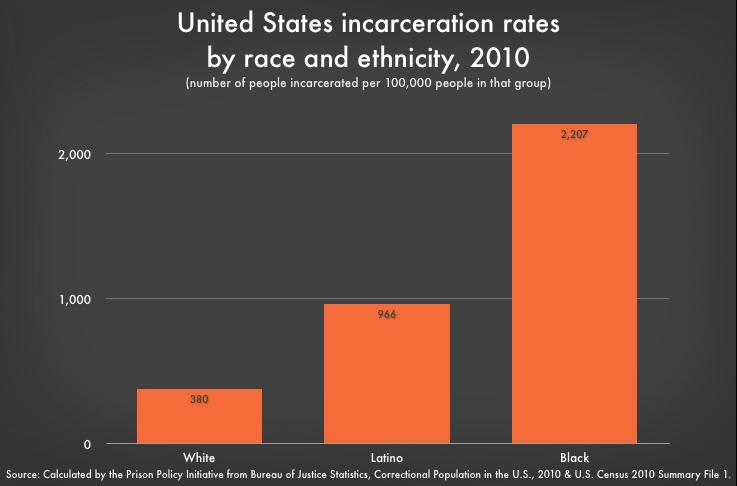
The racial disparities on the state level, too, are stark. In Oregon, for example, Black people make up 1.6% of the total population but more than 9% of the prison population. Latinos are 9% of the total population, but more than 13% of the prison population.
It’s impossible pinpoint a single reason for such stark racial inequality, but social scientists generally point to a complex combination of social disparities, policy decisions and systemic biases. Racial impact statements are a preventative measure to ensure that at least one critical factor in that equation — policy decisions — doesn’t unintentionally make things worse.
Not only are racial impact statement policies good for racial justice, but ensuring that bills are likely to do only what they are intended to do is just plain smart government policy. As SB 463 sponsor Rep. Gallegos said, “racial and ethnic disparities suggest that we are using state resources inefficiently and ineffectively.”
Bills like Oregon’s help policymakers:
- Ensure that legislation is narrowly targeted to have its intended effect.
- Consider the full impact of a measure before it is enacted.
- Avoid the expensive and time-consuming process of adapting existing legislation after the fact to remove unintended harm.
- Reduce the chances that new criminal justice policy in Oregon will increase the state’s significant racial disparities in the incarcerated population.
Oregon’s new law makes good common sense, but Oregon is only the third state to pass racial impact legislation, following on the heels of Iowa and Connecticut. It’s time for the rest of the states to join them.
We’ve been working on a comprehensive research review in order to help more states adopt similar racial impact statement policies. We aim to make two main contributions to the discourse on these useful policy tools:
- Racial impact statements fit entirely within a long and respected tradition of legislators requesting experts to evaluate proposed legislation for unforeseen impacts. It’s very common, for example, for legislators to ask for information on how a proposed bill is likely to affect the budget or the environment. Our movement needs to properly situate racial impact statements in the broader arsenal of smart and common policymaking practices.
- We should use the data we already have to make racial impact statements as useful as possible. Beyond the three states with racial impact legislation, a number of other states routinely request similar racial impact evaluations as part of the legislative process. Each state’s procedure is different, from the conditions that have to be met before a request can be made, to the nature of the information requested, to the time allocated for the request to be fulfilled. By doing a comprehensive review of current racial impact measures and how they are used, we can suggest best practices that will make similar legislation in other additional states as effective as possible.
The criminal justice system is at a crossroads right now, and evaluating legislation before it is passed is the best way to avoid harmful racial disparities down the line. By establishing that racial impact statements are a common-sense tool for rational policymaking, and giving lawmakers some clear best practice guidelines, we can pave the way for more states to follow Oregon’s lead.
But we need financial support to bring this project forward.
If you can support this research project to help bring racial justice to criminal justice in more states, or know of anyone who can, please get in touch.
And congratulations to Oregon!
The FCC wants to know about the many fees prison phone companies charge. While the companies aren't talking, we've got answers.
by Leah Sakala,
July 8, 2013
Now that the Federal Communications Commission (FCC) is thinking about how to regulate the predatory prison phone industry, the commissioners are asking for lots of information to guide their deliberations. Most recently, the Commission asked for more data on the many fees associated with prison telephone service.
It’s great that the FCC is looking into these fees because, as we found in our latest report, they’re a really big deal. Nationally, we estimate that 38 cents of every dollar spent on prison phone calls goes right to fee revenue for the phone service corporations.
Given how profitable these fees are in the prison phone industry, I shouldn’t be surprised that the phone companies have so far been totally unwilling to share information about their fees with the FCC. (If you ask me, that lack of response is yet another reason why the FCC should act without further delay.)
Fortunately, however, we’ve given the FCC a lot to work with. Our 28-page report, Please Deposit All of Your Money: Kickbacks, Rates, and Hidden Fees in the Jail Phone Industry, documents the many fees associated with prison phone service, and explains how exactly prison phone companies justify the charges. We documented our report’s 120 footnotes with 54 exhibits containing 1,225 pages of the industry’s own documents. We submitted all of that in to the FCC’s docket record in May.
In response to the FCC’s call for information on fees, on Friday we submitted a letter to the FCC, drawing their attention to several tables in our report containing extensive information on charges such as deposit fees, refund fees, and account maintenance fees. We also attached an exhibit that’s particularly relevant to the FCC’s question, Exhibit 48, which presents a chart of the account fees charged by 10 of the companies in the prison and jail telephone industry. Our exhibit includes the “justifications” for each fee in the companies’ own words.
Hopefully our submission will inspire the phone corporations to offer up some data of their own.
A new Forbes piece explores the international market for products made in prison, citing to our publication "The Prison Index."
by Leah Sakala,
June 29, 2013
It’s really exciting to see our work being used in creative and compelling ways. For example:

A new Forbes piece reveals that major international corporations are buying products, such as in-flight airline headphones, manufactured in inhumane Chinese work prisons.
While most people would rightly conclude that profiting from abusive forced labor is unconscionable, the author points out that this might also be a good time for some self-reflection. U.S. consumers regularly buy products from private U.S. corporations that capitalize on prison labor, and there’s a frightening push in this country to cut costs by replacing public sector jobs with work crews of incarcerated people. Citing to the “Prison Labor” section of our publication, The Prison Index, the author warns:
It’s not clear… whether U.S. citizens would feel comfortable using products that were made by prisoners making $0.13 cents per hour. But if U.S. citizens for some reason do become comfortable with it, there are plenty of companies and prison administrators worldwide who would be happy to oblige them.
We released the The Prison Index over ten years ago in order to give a broad overview of the criminal justice system by compiling reliable data on a wide array of criminal justice topics. We anticipated that it would have a shelf life of about two years, but, lo and behold, we’re thrilled that it’s still regularly cited by journalists, activists, and policymakers more than a decade later.
We’re working on raising the funds we need to update and expand The Prison Index. But in the meantime, check it out!
Peter Wagner and Jake Mitchell talk about their software to make prison phone justice documents on the FCC website accessible to the larger movement.
by Leah Sakala,
June 28, 2013
Our Executive Director, Peter Wagner, was featured in a Northampton Community TV segment about the Western Mass Hackathon’s Unlocking Prison Phone Data project, along with team member Jake Mitchell:
The project’s website will be launched shortly. Stay tuned!
Prison Policy Initiative's newest phone report is on the NIC homepage.
by Leah Sakala,
June 24, 2013
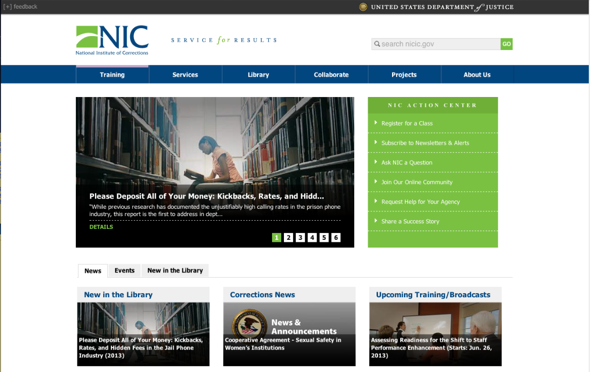
We’re very excited to see that the National Institute of Corrections homepage is featuring our newest prison phone industry report:
At sundown 60 years ago today, Julius and Ethel Rosenberg were wrongfully executed by the U.S. Government. What have we learned since?
by Leah Sakala,
June 19, 2013
At sundown 60 years ago today, Julius and Ethel Rosenberg were wrongfully executed by the U.S. Government after courts found them guilty of espionage. Now, six decades later, we know that their execution was a direct result of the mass hysteria about the dangers of communism at the beginning of the Cold War.
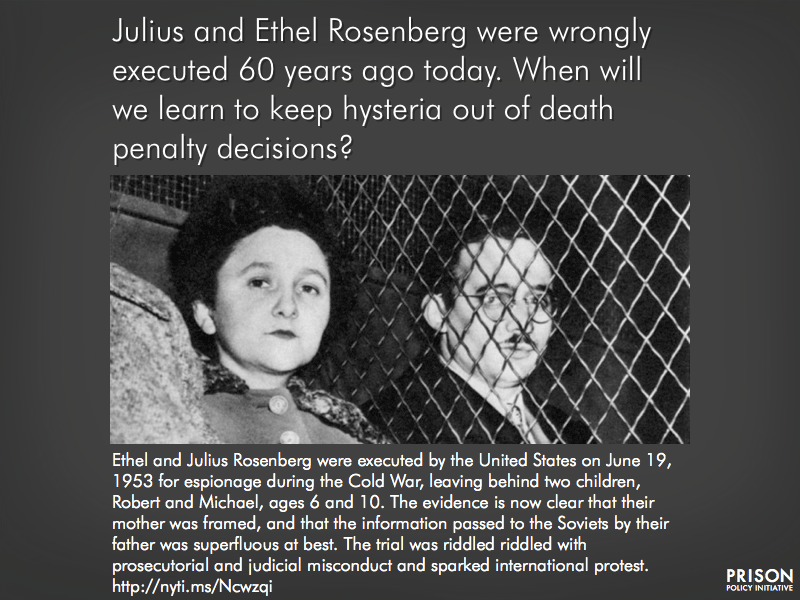
But what have we learned in the six decades since the Rosenbergs’s wrongful execution? Thanks to the tireless work of organizations like the Innocence Project and pro bono law clinics, the list of innocent people who have been exonerated from death row is steadily growing.
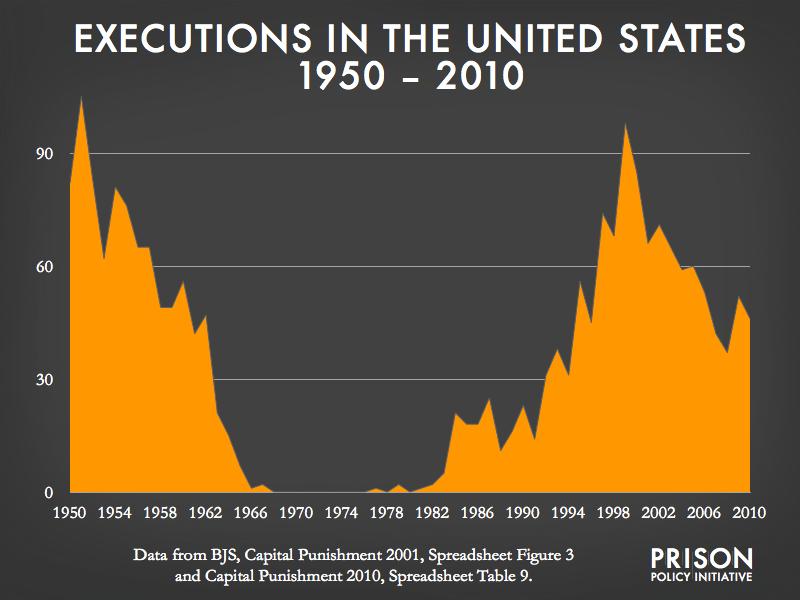
But, as the below graph shows, the struggle to abolish the death penalty still has a long ways to go:
We just submitted a letter in support of Bill H. 1638, “An Act to establish the Massachusetts innocence commission.”
by Leah Sakala,
June 18, 2013
We just submitted a letter to the Massachusetts Joint Committee on the Judiciary in support of Bill H. 1638, “An Act to establish the Massachusetts innocence commission.”
We wrote:
The experience of incarceration has a profound and lasting negative impact on any person’s life. Passing H. 1638 would be an important step to ensure that innocent people are kept out of the Massachusetts justice system. Furthermore, conviction errors not only destroy lives, but they also waste precious tax dollars that should instead be used to invest in the future by keeping communities safe and healthy.
There is no question that the criminal justice system will make mistakes. The question is whether Massachusetts will put in place a system to ensure that we learn from those mistakes and make wrongful convictions less likely in the future.
Want to get involved? The Massachusetts Conference of United Church of Christ Innocence Commission Task Team is doing great organizing to support this important bill.