On Sunday, some families had to choose between wishing dad a Happy Father’s Day on the telephone and putting food on the table.
by Peter Wagner,
June 18, 2013
On Sunday, some families had to choose between wishing dad a Happy Father’s Day on the telephone and putting food on the table. These days, most telephone calls are practically free, but for the 2.7 million kids in the United States who have an incarcerated parent, a call home can break the bank.
Most prisons and jails give their telephone contract to a single company that charges up to $17 for a 15 minute call. Phone bills are high in part because the prisons and jails demand that the phone companies kick back up to 84% of the revenue to the facility, and in part because the Federal Communications Commission has stalled on regulating the industry for more than a decade.
Continue reading →
Our letter explains why the Harrison County, Mississippi Sheriff's Department should cancel plans to implement dramatic mail restrictions.
by Leah Sakala,
June 13, 2013
The Mississippi Sun Herald printed my letter to the editor about why the Harrison County Sheriff’s Department’s plan to ban all non-legal letter correspondence to or from the jail is a bad idea:
Starting Monday, the Harrison County Sheriff’s Department plans to prohibit all non-legal mail except postcards. Such a policy would both decrease public safety and place an enormous burden on the families of incarcerated people. Also, as the courts have ruled, other jails have found that banning letters to and from home doesn’t actually cut costs.
My Prison Policy Initiative report, “Return to Sender: Postcard-only Policies in Jail,” finds postcard-only policies jeopardize critical social ties to families and friends, hindering re-entry and increasing the chances that people will commit more crime in the future. These policies also stifle important family communication and raise the price kids and other family members must pay to stay in touch.
If the sheriff’s department wants to increase public safety, it should immediately cancel the proposed postcard-only mail policy. The friends and loved ones of incarcerated people need to be allowed to maintain the connections that keep communities safe and families intact.
Check out our page on postcard-only policies in jails for more information on this harmful trend, and to learn how people around the country are fighting for the right to write letters.
But will they take their own advice and stop charging customers to get their own money back?
by Leah Sakala,
June 11, 2013
Yet another phone company is recognizing the broken nature of the prison phone industry, and this time it’s a big one.
In a letter filed yesterday with the FCC, the second-largest phone company in the prison phone industry, Securus, has agreed that, “certain practices, which serve to artificially inflate the cost of prison phone calls, are egregious and should be eliminated.”
Which practices? For example, Securus writes, charging customers extra fees to refund their money is “restrictive and unwarranted.”
The fact that Securus officials are speaking out against exploitative industry practices is great news. But will they take their own advice and stop charging customers $4.95 just to get their own money back? Only time will tell.
A team of civic-minded hackers in Western Massachusetts have built a tool to make it easier to access documents about the FCC proceeding on regulating the prison telephone industry.
by Peter Wagner,
June 3, 2013

Challenge representative Peter Wagner of the Prison Policy Initiative explaining how the FCC organizes data by separate “proceedings”. (Photo: Stephen Brewer)

Sondra Morin, Gyepi Sam, and Al Nutile exploring the name space of the FCC’s database structure. (Photo: Stephen Brewer)

Al Nutile (center) sharing an idea with Gyepi Sam (left) and Peter Wagner (right). (Photo: Stephen Brewer)

John Tobey and daughter weigh in on the database structure. (Photo: Stephen Brewer)

The team listening to the ideas of Aaron Smith (rear, left) about his discoveries on how the FCC was organizing their data. (Photo: Molly McLeod)

Gyepi Sam explains the team’s code to the Hack for Western Mass group. (Photo: Molly McLeod)
A team of civic-minded hackers in Western Massachusetts have built a tool to make it easier for advocates, policymakers and journalists to access documents and weigh in on telecommunications debates currently before the Federal Communications Commission.
Critical debates about telecommunications policy are archived in plain sight on the FCC’s website, but they are organized in a way that’s extremely difficult to use. Focusing on just one issue currently before the FCC — the possible creation of price caps to reduce the $1/minute cost of phone calls from prisons and jails — the team created an alternative interface for the FCC’s data. This dataset was particularly challenging because it includes the comments of about 100,000 people in approximately 7,000 pdf files, and the content ranged from well-formatted pdf files to bad scans of handwritten letters from incarcerated people.
On the first morning of Hack for Western Mass, I made a short pitch about the prison phone industry and the need to make the data more accessible. A team was formed to make this data searchable and to add some basic tag support so that journalists and others could more easily find relevant filings.
The software written by the team scrapes the FCC website for new comments, downloads the pdf files, extracts or OCRs any text, and stores that text in a database so that it can be searched. When someone finds a document of interest we then link back to the original PDF on the FCC’s website.
Our software also imports all of the meta data currently available on the FCC website (submitter, date, address etc.) and contains a tagging system so that documents can have metadata added that is useful to the people interested in a specific proceeding. For example, the FCC scans in all letters that come in to proceeding in batches and labels them all with the author “numerous”. To fix this, our system allows users to manually tag each page with two pieces of meta data: the state of origin and one of a number of different content types: whether the document or page is from telephone companies, correctional system administrators, state regulators, incarcerated people or the people who aren’t incarcerated and have to pay the high rates required by the monopolistic contracts. With these tags, users can search for keywords and filter by the existing tags. In this way, a journalist or a member of Congress could quickly find the comments of people from their particular area.
Current progress
The basic structure of the site and tool is done, but the data is still being processed. The scraper was written in Python, and a series of Python scripts then convert PDFs to the portable network map format, clean the images using OnPaper, and perform the optical character recognition using GOCR. Rails manages the database and ActiveAdmin GEM provides an interface to manage content for authenticated users. Solr is setup as well for fast search results. The scripts to download and process PDFs from the FCC website work, and thousands of documents are currently being processed. Tagging has already begun in a spreadsheet, and when the data is fully imported, we’ll set it up to add new FCC entries nightly and we’ll make an interface so that the tagging can be crowdsourced.
Future work and adaptability of the code
This project was conceived to empower people concerned about prison telephone regulation to have better access to this data. But it could be readily adapted to other issues of concern at the FCC. (And could, perhaps, inspire some improvements in how the FCC manages and publishes public comments.)
One idea we didn’t get to — and can’t until the text importation is complete — is to use our database of the text of the filings to perform various kinds of statistical analyses about who is making which arguments.
A final website with the data will be unveiled soon after the data processing is complete. The team’s code is available now on Github.
Many thanks to this weekend’s team:
- Jennie D’Ambroise
- Sam Duncan
- Jonathan Hills
- Jake Mitchell
- Sondra Morin
- Alfred Nutile
- Gyepi Sam
- Aaron Smith
- John Tobey
Stay tuned for the public launch of the FCC tool!
Some additional observations about prison phone fees, based on discussions we had with the phone companies after the report’s release.
by Peter Wagner,
May 29, 2013
 In our report, Please Deposit All of Your Money: Kickbacks, Rates, and Hidden Fees in the Jail Phone Industry, we catalog the many fees customers pay at every step of the way, including fees for making deposits, keeping accounts open, and getting refunds. Our report puts these fees in a larger context, and discussions we’ve had since the report’s release lead us to some additional observations about fees. In our report, we wrote:
To be sure, businesses in many industries incur some processing costs by accepting credit or debit cards in person, via the internet, or over the telephone.65 Businesses usually respond by setting minimum purchase levels for a take out food order, charging a slightly higher rate per gallon of gasoline, or by simply writing it off as the cost of doing business. But this section of the report suggests that prison telephone companies may be approaching the question from the other end: providing telephone services in order to make money by charging extra fees. Indeed, because the commission system reduces the potential for corporate profit from the telephone calls, fees that should be no more than supplemental income are turned into a central source of profit.
Continue reading →
As a result of the report, at least two companies, Turnkey and NCIC, made several clarifications and improvements to their fee policies.
by Peter Wagner,
May 28, 2013
 Several phone companies have been keeping busy in the couple of weeks since we released our new report exposing the hidden fees in the prison phone industry, mostly for the better.
I’m proud to report that, as a result of the report, at least two companies, Turnkey and NCIC, made several clarifications and improvements to their fee policies:
Continue reading →
The Massachusetts Executive Office of Public Safety and Security claim that “the department has received no public feedback about the plan” to begin using dog sniff searches to screen prison visitors is, at best, incorrect
by Leah Sakala,
May 23, 2013
We were concerned as soon as we heard about the Massachusetts Department of Corrections’ plans to start using dogs to screen families and friends visiting loved ones in prison. After all, encouraging in-person visits is key to allowing incarcerated people to maintain the family and community ties that are central to success after release. Using dogs to search family members, friends, clergy, volunteers, and other visitors is deeply invasive and degrading, and can turn essential family visits into potentially traumatizing experiences.
We (along with many other concerned Massachusetts residents) told the Department of Corrections, the Executive Secretary of Public Safety, and the Governor’s Office that the dog sniffing policy is a terrible idea. And on April 10th, the Boston Globe Editorial Board warned the Department of Corrections about the grave consequences the policy could have.
So, we were very surprised to read in a recent Valley Advocate article that Terrel Harris, spokesman for the Executive Office of Public Safety and Security, claims that “the department has received no public feedback about the plan.” It’s clear that this statement is, at best, incorrect, as we’ve clarified in a Letter to the Editor printed in this week’s issue.
The message is being sent loud and clear: the public knows that this policy will unnecessarily deter family visits and thereby make it harder for people released from custody to successfully rejoin their communities. The dog sniffing policy has already been put on hold; it should be canceled outright.
The newest Prison Policy Initiative report exposes the prison phone industry's hidden fees, which saddle the families of incarcerated people with staggeringly high phone bills.
by Leah Sakala,
May 8, 2013
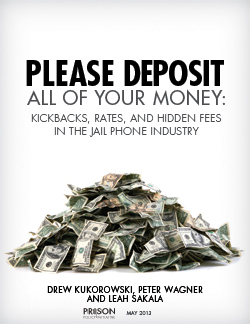
The newest Prison Policy Initiative report exposes the prison phone industry’s hidden fees, which saddle the families of incarcerated people with staggeringly high phone bills.
by Leah Sakala,
April 17, 2013
North Country Public Radio’s Brian Mann talks with Peter Wagner about an encouraging trend towards declining prison populations.
by Leah Sakala,
March 25, 2013
The Massachusetts Department of Corrections plans to begin using drug sniffing dogs to screen families and friends who come to visit loved ones in prison. We submitted a letter urging Department of Corrections Commissioner Louis Spencer to halt this harmful and degrading policy in its tracks.