Uncategorized archives

New BJS data shows suicide is still the leading cause of death in local jails. And most suicides occur shortly after jail admission.

by Bernadette Rabuy, December 22, 2016

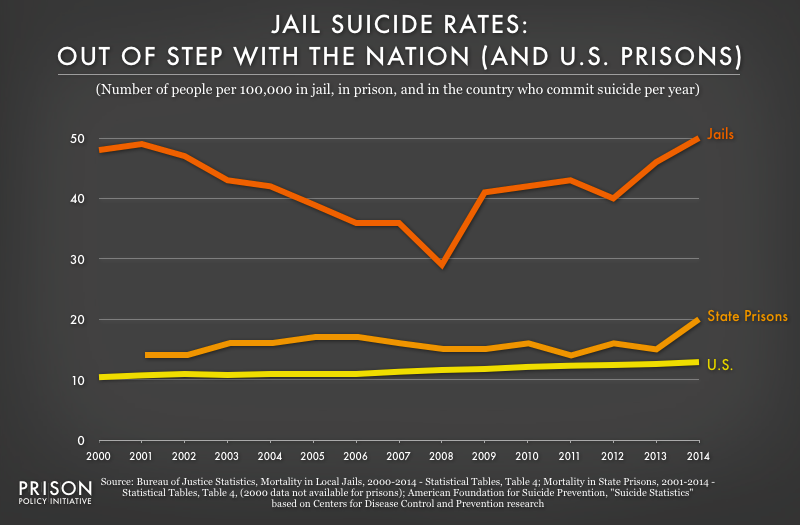
As we wrote last year, suicide in jails is an overlooked national crisis. The rate of suicide in local jails — which generally hold people detained pretrial or convicted of low-level offenses — is far greater than that of state prisons or the American population in general.

Graph charts the suicide rates for local jails, state prisons, and the general American population from 2000 to 2014. The jail suicide rate is out of step with the nation and prisons.

According to Bureau of Justice Statistics data released last week, the rates of suicide for 2014 were the highest rates of suicide in either prisons and jails in the fifteen years since the Bureau of Justice Statistics started collecting mortality data. Distressingly, suicide continues to be the leading cause of death in local jails.

Graph showing mortality rates for local jails by cause of death from 2000-2014. Suicide is consistently the leading cause of death.

In comparison to prisons, local jails experience far higher proportions of unnatural deaths, which include suicides, drug/alcohol intoxication, homicides, and accidents. For example, in 2014, 11% of deaths in state and federal prisons were due to unnatural causes while almost half (49%) of deaths in jails were unnatural. There are a number of reasons for why this could be true such as the disproportionate number of people in jails suffering from mental health challenges or substance abuse or because people are sometimes being booked into jails in their most desperate state.

One positive consequence of Sandra Bland’s tragic 2015 death in a Texas jail has been increased attention on jail deaths. For example, the Huffington Post began a groundbreaking project gathering names, cause of death, dates of arrest and death, and other key details for more than 800 people who died in jails and police lockups in the year following Bland’s death. The Huffington Post’s jail deaths database builds on the Bureau of Justice Statistics annual reports to provide more in-depth information on this national crisis. The data shines light on the particular jails in the U.S. with above average numbers of deaths and tells the stories of the people whose deaths might have been initially missing from the mainstream media.

While the Bureau of Justice Statistics reports that 41% of jail deaths occurred within the first week of a person’s jail stay, the Huffington Post’s data goes further, to show that even a few days in jail can be life threatening. The Huffington Post found that 26% of jail suicides occurred within just three days.

Graph showing number of people who committed suicide by number of days since jail admission. Most suicides occur shortly after jail admission.

Studying the datasets raises urgent questions about the way that jails function such as whether jails are adequately evaluating mental health during intake, how jail staff communicates with family members of the incarcerated during periods of incarceration and when a death occurs, and whether there is appropriate oversight of the thousands of local jails in the U.S.

The data also raises broader, but just as pressing, questions about the dehumanizing experience of incarceration. The high rate of jail suicide should prompt our country to consider whether increasingly popular jail visitation policies that replace in-person visits with video will only increase the isolation of incarceration. The data also supports the idea that mental health services could be more effectively delivered in the community and renews the call for more programs that divert people with mental illness from going to jail in the first place. Further, the high number of suicides that occur within the first few days since jail admission emphasizes why the detention of those awaiting trial, even for a few days, should be treated as a human rights crisis.

Jail suicides are yet another example of how interactions with our criminal justice system can become questions of life or death.


After decades of exponential growth, any news that the population under correctional control is decreasing is good news. But this progress is too slow.

by Wendy Sawyer, December 21, 2016

Today, the Bureau of Justice Statistics announced that the number of adults on probation fell again in 2015, marking the eighth year we have seen these numbers decline. This trend represents progress in the movement away from over criminalization.

But don’t get too excited about these probation numbers. 3.8 million people are on probation – still almost twice as many people as are incarcerated. And at the current sluggish rate of decline, it will take 20 years just to undo the increase in probation from the Reagan administration alone. (During that period of record growth, the number of people on probation more than doubled.)

Image charts the probation, parole, and incarcerated populations from 1975 to 2016. The probation population far exceeds other correctional populations. Note that the image was updated since the original post to add 2016 data.

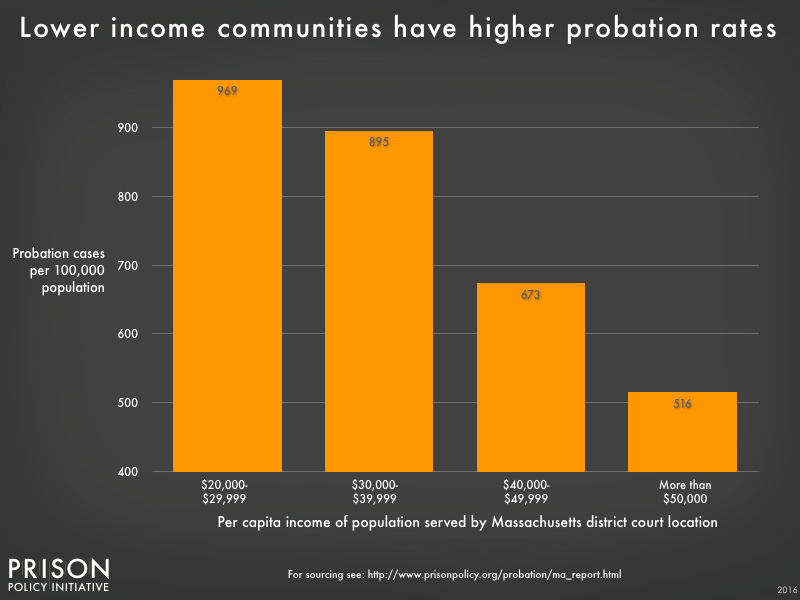
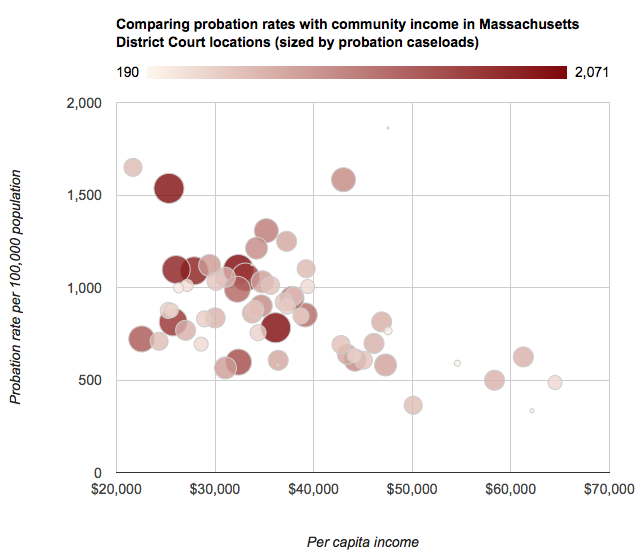
As we have shown, probation is not always the alternative to incarceration it is made out to be. People are often sentenced to probation for minor offenses, but for those who can’t afford fees or make it to every appointment, this seemingly “light” sentence too often leads to incarceration.

After decades of exponential growth, any news that the population under correctional control is decreasing is good news. But this progress is too slow. To make a real dent in the country’s bloated correctional population, policy makers need to advance criminal justice and social policies aimed at reducing the number of people on probation.

Note: The graphic charting the growth of probation, parole, and incarceration over time was updated in December 2018 to include yearend 2016 data (the most recent data available).


Can you help us raise $80,000 by the end of the year?

by Peter Wagner, December 8, 2016

There is another new opportunity to support our work for justice reform. I wrote last week about our $30,000 matching challenge, but another donor has come forward to raise the stakes by $50,000!

The first $80,000 we raise by the end of the 2016 will be automatically matched by other donors. We have a long ways to go to meet this goal (see thermometer installed at the top of the page).

Your support will help us to continue to lead campaigns and produce reports that are reshaping the debate around criminal justice in this country. Just today we released Punishing Poverty: The high cost of probation fees in Massachusetts, and we have another exciting top-secret report scheduled for release on Monday.

We have even larger plans for 2017, but we need your support to make these plans a reality. Can you consider making a gift to support our work today?

Thank you.


Please support our work this Giving Tuesday.

by Peter Wagner, November 29, 2016

Justice reform needs your support like never before. The good news is that after decades of prison growth, the public is starting to embrace criminal justice reform. The bad news is that we just elected a "law and order" President who says that crime is at record heights. (The truth is that crime is just off from a historic low.)

Our work just got harder, especially at the federal level. But there are many opportunities for change at the state level where most of the prisons are.

The Prison Policy Initiative excels at finding the missing data that is holding back criminal justice reform in the states. This year we:

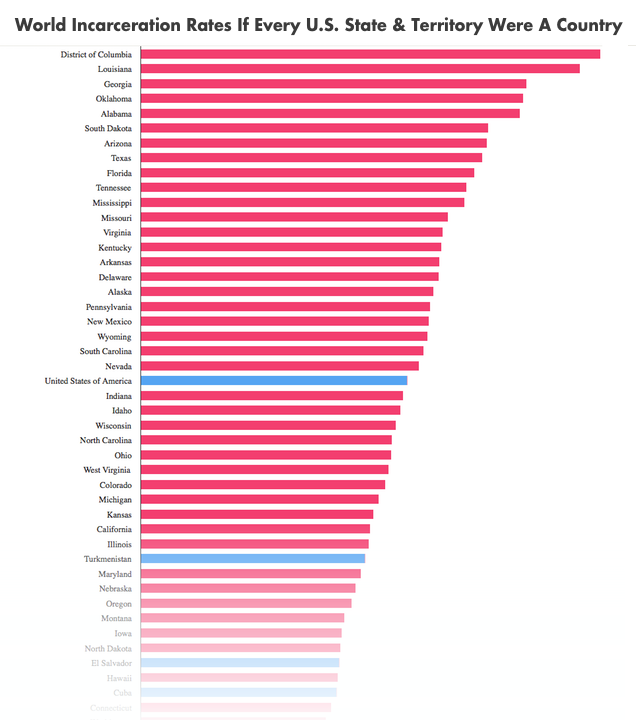
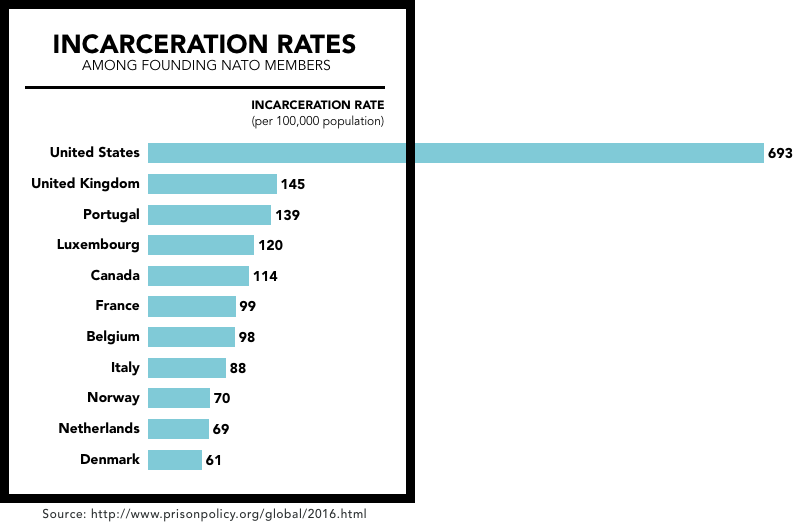
  • Produced a report, States of Incarceration: The Global Context, that showed that every state — even the “progressive” states — use incarceration far more than the other nations of the world.
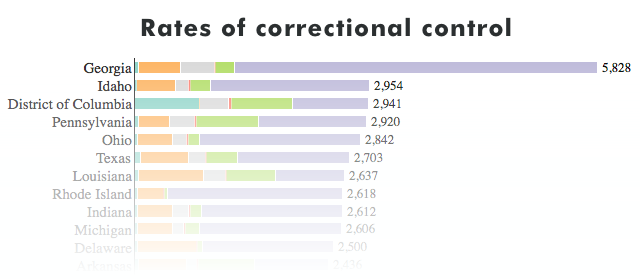
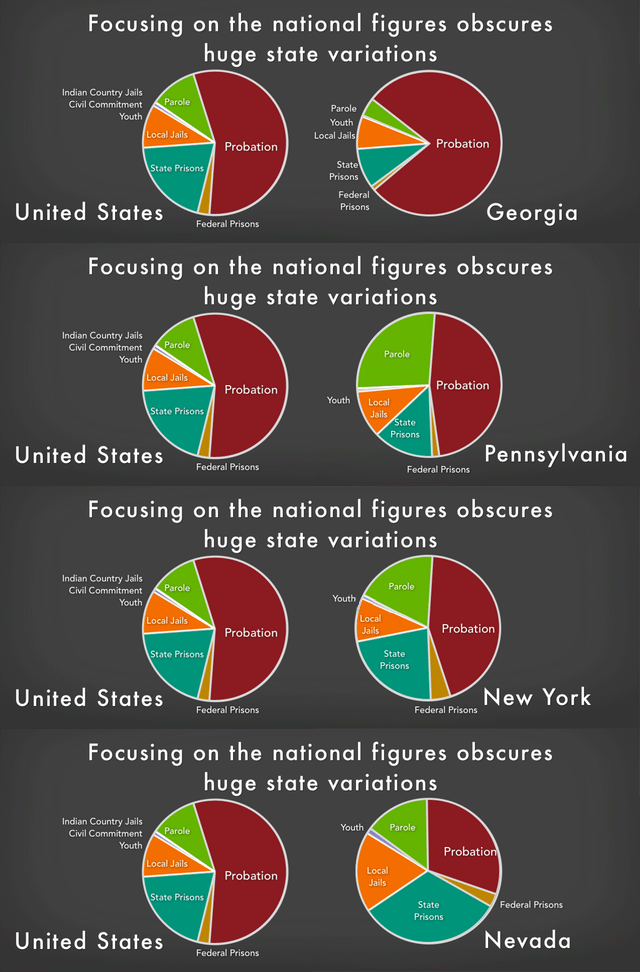
  • Broadened the movement’s scope by putting the numbers on the size of each state’s probation population. Our report, Correctional Control, showed that probation, intended as an alternative to incarceration, now reaches almost twice as many people as the prison and jail systems.
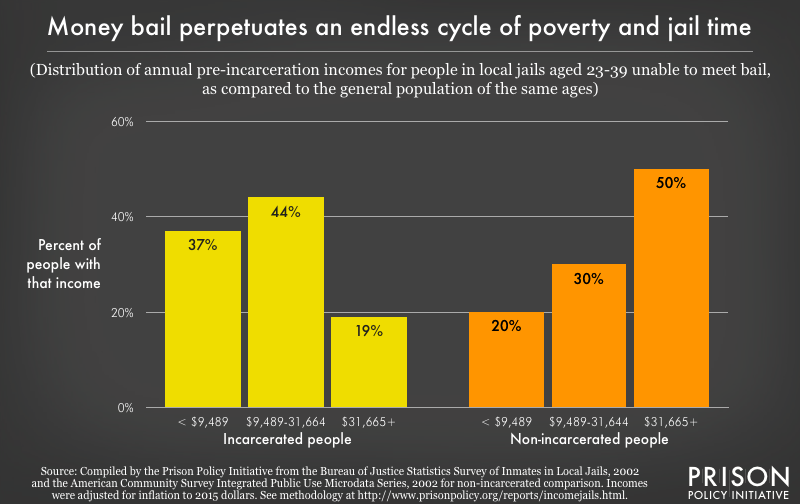
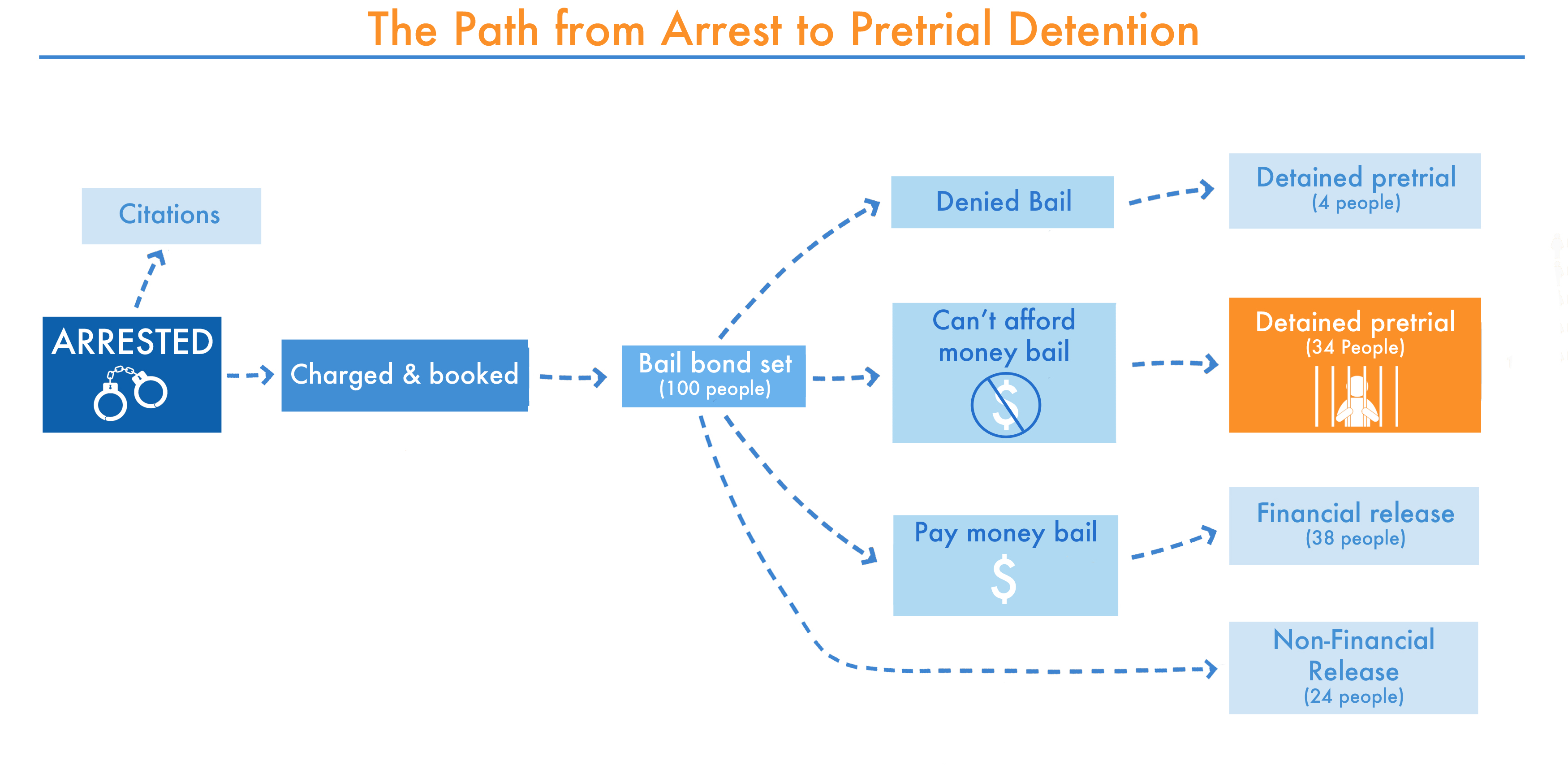
  • Unlocked rare government data to show that the ability to pay money bail is impossible for too many defendants because it represents eight months of a typical defendant’s income. Detaining the Poor also showed how much harder it is for women and people of color to afford bail.

These reports have reshaped the debate around criminal justice reform in this country. A small group of individual donors made these reports — and our legislative victories — possible. To continue this fight, we need your help. Can you make a gift to support our work today?

As a bonus, a group of donors will match the first $30,000 that we receive from this appeal. So any gift you can make will automatically go twice as far.

Thank you for taking a stand for justice, fairness, and truth at this time when all three are under attack.

Donate


A recent analysis finds that the most frequently incarcerated in New York City jails struggle with mental illness and are locked up for low-level offenses

by Bernadette Rabuy, November 16, 2016

A recent analysis uncovers a counterintuitive finding: the people most frequently incarcerated in New York City jails are also people who would be better served with social services in the community.

A 2015 report by the city’s department of health used health data to examine the 800 people who were most frequently incarcerated in New York City jails from November 2008 through December 2014. The authors found that, in comparison to the rest of the people incarcerated in New York City jails, the frequently incarcerated were:

  • Older
  • More likely to be Non-Hispanic black
  • More likely to be diagnosed as seriously mentally ill
  • More likely to have a history of significant drug and alcohol use
  • More likely to mention homelessness in their full history and physical examination

At the same time, the frequently incarcerated individuals were:

  • More likely than the other people admitted to New York City jails to have low-level offenses. Two-thirds of the frequently incarcerated group was locked up for low-level theft, possession of small quantities of drugs, trespassing, or fare evasion.

During the six-year period, the group had a median of 21 incarcerations with a median length of stay of 11 days in jail. As a result, it cost the city $129 million to lock up and provide health care to just these 800 people.

The report’s findings on the needs of the most frequently incarcerated makes the growing popularity of “mental health jails” troublesome. Instead of recognizing that jail may not be the best solution to mental illness or substance abuse, municipalities are adopting reforms that call jails by other, gentler names without addressing the systemic issues that make jails a particularly tough place for those struggling with mental health and substance abuse.

In California, for example, the public has shown overwhelming support for alternatives to incarceration, yet even still, county legislators and sheriffs have been staunch supporters of new jail construction. At the same time, there is evidence that these county officials recognize the growing movement for reform that’s taking place in California and beyond and, in response, have moved away from the tough-on-crime narrative. Activist and author James Kilgore calls these attempts to repackage jails as social service providers, “carceral humanism.” It explains why Los Angeles County’s proposal for a new women’s jail has sometimes been called a “women’s village” and why San Mateo County is so proud of its “compassionate jail.”

But even brief jail stays can be incredibly disruptive. They separate families, some of whom struggle to keep in touch. And they can lead to a loss of employment for people who already struggle to find gainful employment.

This report shows that America’s use of jails to address mental health and substance abuse is not working. And there are already too many examples of jails failing to provide adequate mental health and substance abuse services. It’s time for our social policies to be more creative and look beyond institutionalized settings like jails.


Our just completed year was our most successful yet. Recap our victories and help us plan for more wins this year.

by Peter Wagner, November 8, 2016

We just released our 2015-2016 Prison Policy Initiative Annual Report, and I’m thrilled to share some highlights of our work with you. We had another great year of leading innovative campaigns while also strengthening the movement with long-absent data and resources.

thumbnails from Prison Policy Initiative 2015-2016 annual report

Part of what makes the Prison Policy Initiative unique is the way in which we analyze and present obscure or underutilized data to fill information gaps that are stalling the movement against mass incarceration. For example, detaining people because they are poor is an offensive idea, but it was difficult to prove that this is exactly what the American cash bail system does. This year, Bernadette Rabuy and Daniel Kopf were able to support this claim with evidence in our report Detaining the Poor: How money bail perpetuates an endless cycle of poverty and jail time by putting an obscure government dataset to good use. In addition, Aleks Kajstura and Russ Immarigeon wrote a report putting each state’s incarceration of women into global context and showing that even the most progressive U.S. states are out of step with the rest of the world.

We did all of this while continuing to achieve real change on our focused campaigns:

To assist us in our mission to continue fueling the movement against mass incarceration, we have grown and added two new full-time members to our team. As the organization grows, so do our financial needs. Generous contributions from funders and individual donors will allow us to complete exciting new reports (along with some much-needed updates to old ones) in the new year. We would love you to join these donors by making a one-time or monthly contribution to our work (link no longer available). And please know that any gifts we receive through the end of 2016 will be matched by other donors, so your generosity will be able to go twice as far.

Thank you for taking the time to celebrate this year’s success with us.


Americans’ respect for local police is apparently much higher than their confidence in the police in general.

by Wendy Sawyer, October 26, 2016

Good news from Gallup this week that “surging” numbers of Americans respect the police needs a gentle reminder that this is only a small part of the picture.

Gallup asks Americans two similar-sounding questions about attitudes towards police every year that get very different responses. In the fall, Gallup’s poll asks about respect specifically for local police; in the summer, another question asks about confidence in the police as an institution in American society.

The positive responses reported this week were for the question “How much respect do you have for the police in your area?” Americans’ respect for local police is apparently much higher than their confidence in the police in general.

Last year, the Prison Policy Initiative’s Rachel Gandy charted confidence in the police, which showed that in 2015, just 52% of Americans had “a great deal” or “quite a lot” of confidence in the police as an institution in American society. This June, Gallup reported that confidence went up only 4% from last year’s 22-year low, and just “a slim majority of Americans have confidence in the police as an institution.”

Jesse Walker on Reason.com offers a quick analysis of cultural conditions in 2016 that may account for the increase in respect for police, and points out the important differences between the measures of respect and confidence.

Most obviously, when Gallup asks about respect for police, it asks about local police, who may be familiar faces to many Americans – even neighbors and relatives on the force. This question also comes at a time when the memories of the shootings of police officers in Dallas and Baton Rouge are still fresh. Respect for police is a given. It dominates presidential debates and is a common refrain used to denounce critics of police brutality.

Of course Americans respect the police. But do they trust them? That is the question of confidence.


Consumer Financial Protection Bureau’s new regulations increase protections for people released from prison and jail, who are often forced to use release cards.

by Aleks Kajstura, October 5, 2016

Today, the Consumer Financial Protection Bureau issued a final rule on prepaid debit cards. Last year, the Prison Policy Initiative and other groups urged the CFBP to use this rulemaking to address abusive practices related to prepaid debit cards issued to people upon their release from prison or jail. The CFPB’s decision today is a partial win, but more work remains to be done.

The good news is that release cards will be covered by the new consumer protections contained in the final rule. Specifically, correctional facilities will have to provide clear fee disclosures, card issuers will have to provide reliable access to account histories, and cardholders will have some ability to dispute inaccurate charges.

Prison Policy Initiative had argued that correctional facilities should be prohibited from requiring that people receive their money on prepaid cards. The CFBP declined to impose such a prohibition at this time. Instead, the Bureau acknowledged the concerns about release cards, but said more research would need to be done before it could consider taking action.

Finally, the CFPB ruling clarified that at least some release cards should be conforming to existing (and new) regulations:

[T]o the extent that… prison release cards are used to disburse consumers’ salaries or government benefits…, such accounts are already covered … and will continue to be so under this final rule.

As the CFPB proceeds with the “additional public participation and information gathering about the specific product types at issue”, correctional facilities are increasingly using these expensive cards to repay people they release — money in someone’s possession when initially arrested, money earned working in the facility, or money sent by friends and relatives.

Before the rise of jail release cards, people were given cash or a check. Now, they are instead given a mandatory prepaid Mastercard, which comes with high fees that eat into their balance. These cards charge for basic things like:

  • Having an account (up to $3.50/week)
  • Making a purchase (up to $0.95)
  • Checking your balance (up to $3.95)
  • Closing the account (up to $30.00)

To put this into perspective, if someone is released with $125, a $2-per-week maintenance fee is equivalent to a finance charge of 77% per year. If that same hypothetical cardholder makes ten purchases of $12 each, then a $0.50 per-transaction-fee would amount to $5, or 4% of the entire card balance (on top of maintenance fees). If the cardholder wishes to convert a prepaid card into cash, he or she must pay $10 to $30 (8% to 24% of the entire deposit amount) merely to close the account.

But while the new CFPB regulations take a more robust stance on fee disclosure, allowing many people to avoid predatory pricing, they won’t help incarcerated people, who have the cards foisted on them with no choice.


On Saturday, I was honored to accept, on behalf of the Prison Policy Initiative, the Foundation for Improvement of Justice's Paul H. Chapman Award for our report and campaign to end Massachusetts' suspension of drivers licenses for unrelated drug offenses.

by Peter Wagner, September 30, 2016

On Saturday, I was honored to accept, on behalf of the Prison Policy Initiative, the Foundation for Improvement of Justice’s Paul H. Chapman Award.

report thumbnail for driver's license suspension reportThe Atlanta-based foundation recognized the Prison Policy Initiative for our report Suspending Common Sense in Massachusetts: Driver’s license suspensions for drug offenses unrelated to driving. This report exposed a little-known, but extremely harmful, law that automatically suspended driver’s licenses for drug offenses, regardless of whether the offenses involved driving or road safety. The state would then charge $500 for reinstatement, further ensuring that people with drug convictions would have a hard time getting employment or fulfilling familial needs.

Our report provided persuasive evidence of the law’s failure as a crime deterrent, pointed out that the law actually made the roads less safe because it increased the number of unlicensed and uninsured drivers, and included a detailed analysis of the resources wasted on enforcing unnecessary license suspensions.

Our followup advocacy helped the state understand that the law was punishing entire communities, not just a few individuals; and the law was repealed earlier this year.

Thirteen other states and the District of Columbia have similar laws, so we will be using the prize money to expand our campaign for reform of this outdated relic of the War on Drugs.

Below are some pictures of the award ceremony.

Paul Jones (left) board member of the Foundation for Improvement of Justice with Peter Wagner (right), Executive Director of the Prison Policy InitiativePaul Jones (left) board member of the Foundation for Improvement of Justice with Peter Wagner, Executive Director of the Prison Policy Initiative.

Peter Wagner with the other winners of the Paul H. Chapman Award.Winners of the 2016 Paul H. Chapman Award. From left to right: Carol Tracy, Brenda Lawrence, Peter Wagner, Dirk C. Moore, Arleen Joell and Julia R. Wilson.


by Joshua Aiken, September 30, 2016

While comprehensive criminal justice reform for adults has failed to pass in Congress, a bill lingering in the Senate could still overhaul how our juvenile justice system works. The bipartisan legislation, which passed the House by an overwhelming 382-29 vote, would create several new policies that juvenile justice advocates have been requesting for years.

The proposed reauthorization of the Juvenile Justice and Delinquency Prevention Act would withhold funding from states that put youth in adult prisons, require states to collect data on racial disparities in the juvenile justice system, ban the practice of shackling pregnant girls, and prohibit states from locking up youth for “status offenses.”

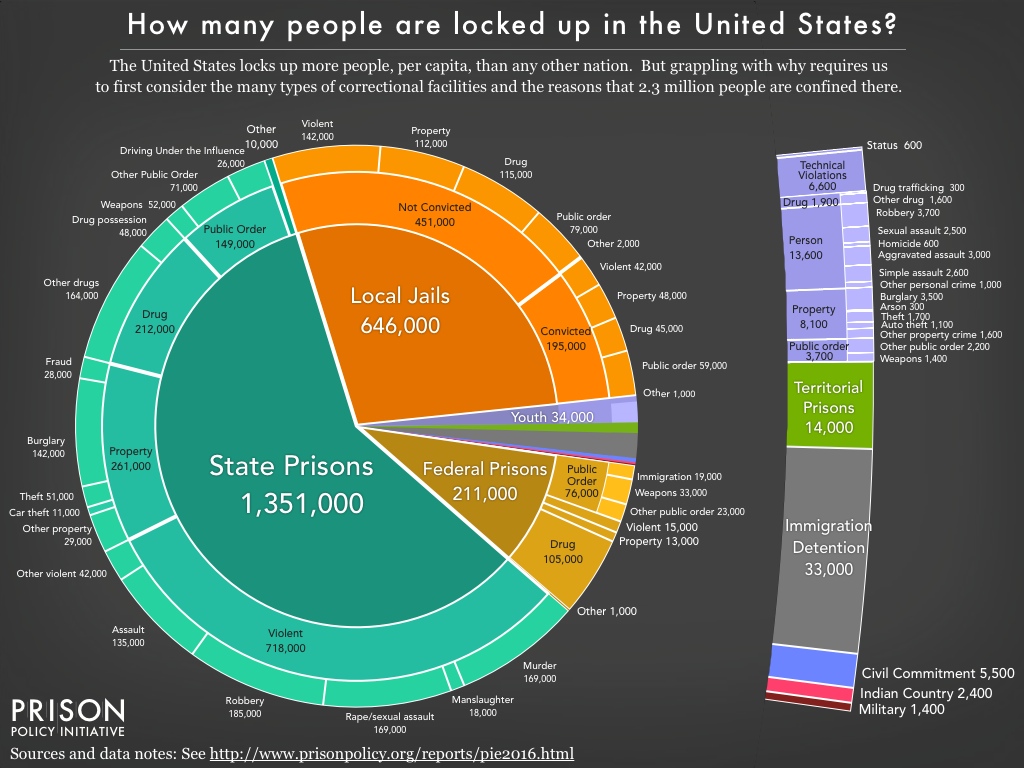
These reforms are desperately needed. In our 2016 report, Mass Incarceration: The Whole Pie we highlighted one of the most disturbing facets of our juvenile justice system: that we lock young people up for behaviors that are not law violations for adults—like running away or skipping school.

Image shows that most incarcerated youth are locked up for nonviolent offenses. For over 7,000 youth, they are locked up for offenses that aren't even crimes.

Talking about “status offenses” is important because status offenses aren’t even crimes. These offenses relate to a person’s age: skipping school, breaking curfew, or even talking back can land a young person behind bars. Increasingly, those young people are girls.

In an incredible piece for Mother Jones last week, Hannah Levintova details how bias and over-criminalization are ensnaring more and more girls into the criminal justice system. Levintova explains:

Between 1995 and 2009, cases of breaking curfew rose by 23 percent for girls—and just 1 percent for boys. In 2011, girls made up 53 percent of runaway cases brought before a judge. Between 1996 and 2005, arrests for “simple assault”—which could be as minor as a daughter throwing a toy at her mom—went up 24 percent for girls and down 4 percent for boys. By 2013, girls were almost twice as likely as boys to be in detention for simple assault and certain other nonviolent offenses.

Girls, argues Professor Andrew Spivak, are faced with types of “judicial paternalism” where “courts think that they need to protect girls and give them guidance.” Professor Stacy Mallicoat, in a 2007 study, showed that probation officers often attribute girls’ offending behaviors to their sexual behavior, drug use, and negative family relationships. Girls, and especially girls of color, get blamed. Meanwhile, when describing boys, probation officers were less likely to see their criminal behaviors as coming from these sources. As Levintova puts it, the justice system sees boy’s behaviors as “lifestyle choices” while the morals of girls are punished.

The disparate prosecution of status offenses sheds light on the deeply gendered ways our criminal justice works. And these offenses end up having a disastrous and long-lasting impact on girls:

Even a brief period in detention can lead to mental and
physical health issues, higher unemployment rates, lower lifetime
earnings, and substance abuse. The moral judgment that underlies the charges girls face can also change how they see themselves. “Once they internalize that they are ‘bad girls,'” says [Jeannette] Pai-Espinosa, “it almost creates a self-fulfilling prophecy.”

The bill’s sponsors in the House are hopeful that the legislation can reach President Obama’s desk, but some legislators are strongly opposed.


Stay Informed


Get the latest updates:


Share on 𝕏 Donate