October 27, 2026: On October 27, 2026 at 1:30 p.m. EST, join the Prison Policy Initiative for a webinar focused on making public records requests. We’ll cover the basics of making a request and provide tips and tricks we’ve learned over decades of sending requests to jails, prisons, and other agencies that can make your requests more effective.
Any amount of time spent in solitary confinement increases the risk of death after release from prison, including deaths by suicide, homicide, and opioid overdose.
A recently published study of people released from North Carolina prisons confirms what many have long suspected: solitary confinement1 increases the risk of premature death, even after release. Personal stories, like those of Kalief Browder’s isolation and subsequent suicide, are canaries in the coal mine. Underneath seemingly isolated events, researchers now find that solitary confinement is linked to more deaths after release from prison. These preventable deaths aren’t outliers; in the U.S., where the use of solitary confinement is widespread, an estimated 80,000 people are held in some form of isolation on any given day, and in a single year, over 10,000 people were released to the community directly from solitary.
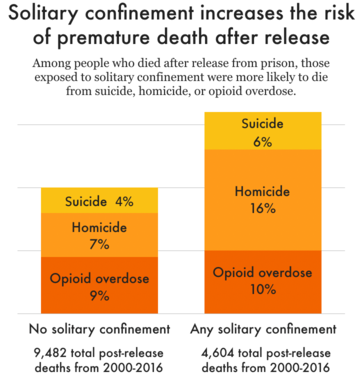
Premature deaths – by suicide, homicide, or opioid overdose – after release from prison are more likely for those that spent any amount of time (even one day) in solitary confinement than those who have never experienced solitary confinement.
The new study shows that the effects of solitary confinement go well beyond the immediate psychological consequences identified by previous research, like anxiety, depression, and hallucinations. The authors, from the University of North Carolina, Emory University, and the North Carolina Departments of Public Safety and Public Health, find that any amount of time spent in solitary confinement increases the risk of death in the first year after individuals return to the community, including deaths by suicide, homicide, and opioid overdose.
Reentry is tumultuous and challenging to begin with, and the first two weeks after release are among the most difficult. Previous research has shown that, within those first two weeks, the risk of death from drug overdose, cardiovascular disease, homicide, and suicide is elevated. A 2007 study found that the risk of death in these first two weeks can be up to 12 times higher than that of the general population. Building on that study’s findings, this new North Carolina study finds that the experience of any solitary confinement more than doubles the risk of death for people recently released from prison.
The study identifies two additional factors correlated with a heightened risk of death after release: race and the amount(length and frequency) of solitary confinement. All incarcerated people of color are more likely to die within a year of release, and the experience of solitary confinement only amplifies this racial disparity. A previous study found that, compared to their share of the total prison population, Black men and women are overrepresented in solitary confinement, exposing them disproportionately to its harms. And unsurprisingly, more frequent placements in solitary confinement—as well as longer stays2—are associated with worse outcomes across both white and nonwhite populations.
This graph is based on the Cox Proportional Hazard ratio, which represents the risk of death while accounting for variables like sex, race, age, prior incarcerations, length of incarceration, and other factors as calculated by the authors of the study. People who are confined in solitary are more likely to die of any cause, opioid overdose, homicide, and suicide than those who do not experience solitary confinement. People with more than one experience in solitary confinement are even more likely to die within the first year of release of all causes, homicide, and suicide.
This study adds to the overwhelming body of evidence that solitary confinement causes indelible harm and should be prohibited. But until that happens, the authors recommend that discharge plans and public health systems should consider time spent in solitary confinement as a health risk factor to be addressed when people are released from prisons. By considering solitary confinement in discharge plans, reentry programs and professionals could connect people to services after release from incarceration, specifically trauma-informed, community-based substance use and mental health treatment, overdose prevention and harm reduction, and wraparound care and services.
Of course, there is no need to wait until a person is released from prison to address the long-lasting harms of solitary confinement. Programs and professionals working in prisons that use solitary confinement should use this information to provide services that focus on breaking the link between solitary confinement and premature death after release. Correctional systems should not wait to mitigate harms after they have already occurred: Solitary confinement causes far more harm than good and is not a “rehabilitative” process.
Footnotes
The phrase “solitary confinement” is not used consistently. Some prisons deny that they employ it, instead opting for more administrative-sounding terms, like “Segregated Housing Units” (SHUs) and “restrictive housing.” (See this list from MuckRock for more examples.) While conditions can vary between facilities, for our purposes, “solitary confinement” refers to the practice of segregating individuals from the general population for any reason. Under solitary confinement, individuals are typically forced to remain in small, individual cells for 22 to 24 hours per day with minimal human interaction. ↩
In 2015, the United Nations revised the Standard Minimum Rules on the Treatment of Prisoners and called for an end to solitary confinement lasting longer than 14 days. Regardless, at least 25 states reported in 2017 that 3,500 people were held in solitary confinement for at least 3 years. ↩
As we noted back in May, when most Americans were getting one-time $1200 stimulus payments from the IRS, the government was quietly trying to deny making payments to incarcerated people, even though there is no such restriction in the law that created this program. Plenty of people noticed the government’s lack of a solid basis for denying the payments, and at least two lawsuits over the issue are pending in federal courts.
On September 24, 2020, a judge in California issued a ruling requiring the IRS to process stimulus payments for incarcerated people. This isn’t quite the end of the story. The judge’s ruling could be stayed or reversed on appeal, or Congress could amend the law to prohibit payments to incarcerated people.1 But for the time being, IRS is accepting mailed applications from incarcerated people through November 4 (extended recently from October 30 because of a court ruling) and online applications through November 21.
Q: How do I know if I or my loved one in prison qualifies for the stimulus check?
A: We can’t give individualized tax advice, but you might find our discussion and the links to how the CARES Act defines eligible individuals helpful. See the “Does incarceration make people ineligible for stimulus payments?” section in our original stimulus checks article (written before the Court ruled).
Q: How do I apply for my stimulus check (or apply on behalf of a loved one in prison)?
A: Please see this explainer from the Uptown People’s Law Center with instructions on how to apply.
Q: I’m confused about the application procedure (for instance, which address to put down for my loved one).
A: We’re not able to answer specific questions about the process of applying, but we keep a list of organizations in several states offering free legal assistance to incarcerated people. One of those organizations might be able to help you.
Footnotes
The Senate proposal for additional economic stimulus (S. 4318) does contain language that would prohibit stimulus payments to people who are incarcerated for every day during calendar year 2020. The newly-announced House proposal does not contain such a restriction. Neither bill has yet to receive a floor vote. ↩
This morning, the Prison Policy Initiative and the Reverend Jesse Jackson, Sr.’s Rainbow PUSH Coalition released Eligible, but Excluded,a roadmap to expanding voting access for people incarcerated in local jails who are already eligible to vote.The report explains – via a 50-state table and flowchart – that most of the 746,000 people in local jails retain the right to vote. The report then details the logistical barriers that prevent these voters from casting ballots, and strategies for bringing these barriers down.
“Thousands of people in jails across America retain the right to vote, but they are denied that right in every election,” Reverend Jackson said. “Many of these voters are being held simply because they are poor and can’t make bail. This form of voter suppression is a truly heinous form of social injustice and civic indignity. This report provides the data that will help us fight back against this injustice. And fight we will!”
The report provides an in-depth explanation of the most common issues preventing people in jail from voting, including:
Confusion about who is eligible to vote, among election officials as well as incarcerated people themselves
Registration-related barriers such as restrictive deadlines and a lack of access to personal information
Ballot-casting barriers including strict for-cause absentee voting policies
Population churn in jails, which means that some people who register to vote in jail may not be incarcerated on Election Day.
The report goes on to offer 29 strategies for advocates, state legislatures, election officials, and sheriffs to enable people in jail to exercise the franchise.
“In an era of criminal justice reform, protecting the right to vote for persons held in jail is among the most important reforms,” said Reverend Dr. S. Todd Yeary, co-author of the report. “The state-by-state analysis in this report sets the landscape for the policy fight to protect the right to vote for persons who are legally eligible to cast a ballot, but are unjustly prevented from doing so. This is our justice roadmap for issue advocacy in upcoming state legislative sessions, as well as policy changes by sheriffs, prosecutors, and governors across the country.”
Survey data collected from people with incarcerated loved ones confirms some of our worst fears about the treatment of people behind bars during the pandemic.
A new report from Essie Justice Group is exposing the failure of prisons and jails to protect incarcerated people from COVID-19, using survey data from more than 700 people who had loved ones incarcerated in May and June. We helped Essie analyze the survey data and produce their groundbreaking report, Lives on the Line. The report sheds light on aspects of life during the pandemic that cannot be understood through government data alone — such as incarcerated people’s day-to-day experiences and their degree of vulnerability to the coronavirus.
Incarcerated people are even more vulnerable to the coronavirus than existing government data have shown. We’ve used government data to show that many chronic illnesses are more common among incarcerated people, increasing their risk of dying from COVID-19. But Lives on the Line puts a finer point on the problem. 52% of respondents to Essie’s survey reported that their loved one has an underlying medical condition that the Center for Disease Control has identified as “high-risk” for serious complications from COVID-19.
Prisons and jails are supplying only meager amounts of hygiene supplies, if any. We’ve previously shown how even in normal times, prisons and jails fail to provide sufficient hygiene supplies, forcing incarcerated people and their families to make up the difference by shopping at the commissary. Essie’s survey shows that this dangerous trend has continued during COVID-19: Only 7% of survey respondents said they believed their loved one could access enough soap, disinfectant, and hand sanitizer to protect themselves from the virus. What’s more, many survey respondents explained that “although their finances were tight, they were the ones sending their loved ones basic sanitation supplies through private vendors.”
Many facilities are neglecting to provide medical care. 30% of respondents to Essie’s survey said that their loved one did not have any access to critical services like doctor’s visits, mental health care, and medicine. Respondents described their loved ones feeling frustrated and neglected. One respondent testified that nurses in their facility are not giving diabetic residents their insulin shots, “refusing to touch the [incarcerated people] even with gloves on.”
Incarceration during COVID-19 has subjected incarcerated people to extreme isolation. 50% of survey respondents reported that their loved one had experienced lockdowns (which typically limit access to phones and common areas) at some point during the pandemic. 12% reported that their loved one had been placed in isolation or solitary confinement, which has been described as “tantamount to torture.” Prisons and jails’ liberal use of lockdowns and solitary confinement is isolating people and eroding family ties: 11.7% of respondents to Essie’s survey said that they had not been able to contact their loved one at all during the pandemic.
Many people are still incarcerated during the pandemic despite having safe homes to return to. Some states (like Virginia and Pennsylvania) have made consideration for release dependent on whether someone has a viable “home plan.” But 92% of survey respondents said that their loved one has a home to go to if they are let out, suggesting that many incarcerated people with homes to go to are facing unnecessary obstacles to being considered for release.
The limitations of publicly-available criminal justice data have constrained attempts to understand how prisons and jails are responding to the pandemic. But the voices of people with incarcerated loved ones are filling critical information gaps. Essie’s survey data confirms some of our worst fears about the unwillingness of prisons and jails to protect their residents, even through basic measures like providing adequate supplies of soap. Lives on the Line adds important context to the story of how criminal justice decisionmakers allowed their facilities to become hotbeds of COVID-19, and how these facilities have offloaded the burden of caring for incarcerated people onto struggling family members.
Initial policy changes that resulted in quick and necessary decarceration have slowed, despite the growing infection and death rate of COVID-19 in prisons and jails.
This article was updated on October 21st, 2021 with more recent jail and prison population data. That version should be used instead of this one.
After the World Health Organization declared COVID-19 a global pandemic, it became painfully obvious that people incarcerated in jails and prisons would be uniquely vulnerable to both the spread of the disease and the more serious medical consequences of the disease due to the high prevalence of preexisting health conditions.
Now, when all of the top 10 clusters of COVID-19 in the U.S. are linked to prisons and jails, and with the 997 COVID-19 deaths behind bars surpassing the number of COVID-19 deaths in 19 states and Washington, D.C., state and local governments should be redoubling their efforts to reduce the number of people in confinement. But our most recent analysis of jail and prison populations shows that many of the efforts to reduce incarcerated and detained populations have actually slowed–and even reversed in many counties and states.
Jail populations dropped quickly at the beginning of the COVID-19 pandemic, but the local authorities who run jails have not sustained those efforts and populations have started to rise over the last two months. Across the 451 county jails we analyzed, 98% of the jails saw population decreases from March to May, with an average population reduction of 33%. But 82% of jails had population increases from May to September, suggesting that most jurisdictions have abandoned the efforts to decarcerate that made such crucial changes early in the pandemic. In 88 counties, jail populations are higher now than they were before the pandemic, including in some large counties like Wayne County (Detroit), Michigan, where the jail population on March 10th was 2,086 people and is now over 2,400 people.
This graph contains aggregated data collected by NYU’s Public Safety Lab and is an update of the first graph in our August 5th briefing. The Public Safety Lab is continuing to add more jails to their data collection and data was not available for all facilities for all days, so these graphs show jails where the Lab was able to report data for at least 150 of the 178 days in our research period. To smooth out most of the variations caused by individual facilities not being reported on particular days, we chose to present the data as 7-day rolling averages.
In New York City, the jail population sharply declined after the pandemic was declared. Importantly, NYC jails–particularly Rikers Island–were some of the first jails in the country to witness a COVID-19 outbreak. And yet, across different demographics, NYC jail populations have slowly leveled out, suggesting that the policies responsible for the necessary decarceration are no longer in practice.
The percent of the jail population detained for technical violations of probation and those serving “city sentences” (a city sentence is defined as a sentence of 1 year or less) drastically dropped, while the percent of the population detained pretrial and those over the age of 50 did not see such drastic reductions. But, across all of these categories, efforts to reduce the jail population in NYC appears to have slowed to a halt despite the fact that 6% of people incarcerated in NYC jails currently have confirmed cases of COVID-19 and over 1,400 NYC correctional staff have contracted COVID-19 since the start of the pandemic.
In early August, we reported that state prison populations had been steadily declining, but that the progress was still too slow to save lives. Now, with updated data from mid-to-late August, we can see that this progress continues to be slow, with little to no change between July and August prison populations in North Carolina, Arizona, Mississippi, Wisconsin, Vermont, Maine, Utah, and North Dakota. California has reduced its state prison population by about 7% since the end of July, likely due in part to the state’s response to the COVID-19 outbreak in San Quentin State Prison in early August, but as of September 2nd, California’s state prisons were still holding more people than they were designed for, at 108% of their design capacity.
Prison population data for 17 states where population data was readily available for January, May, July, August, and September either directly from the state Departments of Correction or the Vera Institute of Justice. The average population decrease across these 17 state prison systems has slowed to about 3% from July 1st to August 31st, compared to the 8% decrease between March 1st and April 30th. Many of the most important policy changes announced in the states that made these small reductions possible are covered in our COVID-19 response tracker. This graph is an update of the graph included in our August 5th briefing.
Sharp-eyed readers may wonder if Connecticut and Vermont are showing larger declines than most other states because they have “unified” prison and jail systems, but separately published data from both states show that the bulk of their population reduction is coming from within the “sentenced” portion of their populations. (For the Connecticut data, see the Correctional Facility Population Count (link no longer available) tracker, and for Vermont, compare the March 13 and September 4 population reports.)
Prisons and jails are notoriously dangerous places during a viral outbreak, and continue to be the source of the largest number of infections in the U.S. The COVID-19 death rate in prisons is three times higher than among the general U.S. population, even when adjusted for age and sex (as the prison population is disproportionately young and male). Despite agreement among public health professionals, corrections officials, and criminal justice reform advocates that decarceration will protect incarcerated people and the community-at-large from COVID-19, state, federal, and local authorities continue to put incarcerated people’s lives at risk– and by extension, the communities in which incarcerated people and correctional staff live and work.
Halfway houses are a major feature of the criminal justice system, but very little data is ever published about them. We compiled a guide to understanding what they are, how they operate, and the rampant problems that characterize them.
In May, an investigation by The Intercept revealed that the federal government is underreporting cases of COVID-19 in halfway houses. Not only is the Bureau of Prisons reporting fewer cases than county health officials; individuals in halfway houses who reached out to reporters described being told to keep their positive test results under wraps.
It shouldn’t take exhaustive investigative reporting to unearth the real number of COVID-19 cases in a halfway house. But historically, very little data about halfway houses has been available to the public, even though they are a major feature of the carceral system. Even basic statistics, such as the number of halfway houses in the country or the number of people living in them, are difficult to impossible to find.
Broadly speaking, there are two reasons for this obscurity: First, halfway houses are mostly privately operated and don’t report data the way public facilities are required to; second, the term “halfway house” is widely used to refer to vastly different types of facilities. So, we compiled the little information that does exist about halfway houses, explaining how various facilities commonly called “halfway houses” differ from each other, and the ways in which these criminal justice facilities often fail to meaningfully support formerly incarcerated people. We also explore why poor conditions and inadequate oversight in halfway houses have made them hotspots for COVID-19.
“Halfway house” is an umbrella term
The term “halfway house” can refer to a number of different types of facilities, but in this briefing we will only use halfway house to mean one thing: A residential facility where people leaving prison or jail (or, sometimes, completing a condition of probation) are required to live before being fully released into their communities. In these facilities, individuals live in a group environment under a set of rules and requirements, including attendance of programming, curfews, and maintenance of employment.
State corrections departments, probation/parole offices, and the Federal Bureau of Prisons (BOP) often contract with nonprofits and private companies to run these facilities. These contracts are the primary means through which halfway houses receive funding.1
“Halfway house” can also refer to a few other types of facilities, which will not be addressed in this briefing:
Sober living homes, though sometimes housing formerly incarcerated people, do not serve the sole purpose of acting as a transitional space between incarceration and reentry. Sober living homes accomodate people with substance use disorders, and they’re sometimes called “halfway houses” because they often act as transitional housing for people leaving drug and alcohol rehabilitation programs.
Restitution centers and community based/residential correctional facilities act as alternatives to traditional incarceration, instead of prison or jail, where individuals can go to serve their entire sentence. In restitution centers, people are expected to work and surrender their paychecks to be used for court-ordered fines, restitution fees, room and board, and other debts. Community based/residential correctional facilities frequently include a work-release component, but they function more as minimum-security prisons than reentry services.
Some transitional housing providers for people leaving prison are voluntary for residents, and are not funded and contracted by the government. Susan Burton’s A New Way of Life Reentry Project, for example, provides safe housing and support for women leaving incarceration. Their services provide a potential model for the future of reentry programs that actually help residents rebuild their lives after the destructive experience of prison or jail.
Some facilities, like community-based correctional facilities, can serve dual functions that blur the lines of what facilities are and are not halfway houses. For instance, a community-based corrections facility might primarily house people who have been ordered to serve their full sentences at the facility, but also house some individuals who are preparing for release. We have included an appendix of the most recent list of adult state and federal correctional facilities that the Bureau of Justice Statistics calls “community-based correctional facilities” (those that allow at least 50% of the population to leave the facility). In our appendix table, we attempt to break down which of those 527 facilities fall under our “halfway houses in the criminal justice system” definition, and which facilities primarily serve other purposes.
“Halfway house” can refer to different types of facilities that share some similarities. These facilities range from entirely carceral to not carceral at all (represented by the locked doors), and feature different priorities and programming for the people residing in them. Their purposes can also overlap, as community based correctional facilities, for instance, house individuals at various stages in their incarceration. For the purpose of this briefing, however, we are focusing on “Halfway Houses in the Criminal Justice System”– which are state or federally contracted facilities for people leaving state or federal incarceration.
Every year, tens of thousands spend time in halfway houses
The federal government currently maintains 154 active contracts with Residential Reentry Centers (RRCs) nationwide, and these facilities have a capacity of 9,778 residents. On any given day in 2018, RRCs held a nearly full population of 9,600 residents. While regular population reports are not available, 32,760 individuals spent time in federal RRCs in 2015, pointing to the frequent population turnover within these facilities.
Unfortunately, much less information exists about how many state-run or state-contracted halfway houses and halfway house residents there are. BJS data collected in 2012 indicates that there are 527 “community-based correctional facilities,” or facilities where 50% or more of the residents are regularly permitted to leave.2 These facilities held a one-day population of 45,143 males and 6,834 females, for a total of 51,977 individuals. However, as we will discuss later, these numbers include facilities that serve primarily or entirely as residential correctional facilities (where people serve their entire sentences). This ambiguity means that pinning down how many people are in halfway houses each day – and how many specifically state-funded halfway houses there are – is nearly impossible.
One reason that we know more about federal than state-level halfway houses has to do with the contracting process. The federal contract process is relatively standardized and transparent, while state contracting processes vary widely and publish little public-facing information, which makes understanding the rules governing people in state-contracted facilities much more difficult.
Halfway houses are carceral facilities
Contrary to the belief that halfway houses are supportive service providers, the majority of halfway houses are an extension of the carceral experience, complete with surveillance, onerous restrictions, and intense scrutiny.
For the most part, people go to halfway houses because it is a mandatory condition of their release from prison. Some people may also go to halfway houses without it being required, simply because the facility provides housing. Placement in Residential Reentry Centers (RRCs) post-incarceration can technically be declined by people slated for release, but doing so would require staying in prison instead.
In federal RRCs, staff are expected to supervise and monitor individuals in their facilities, maintaining close data-sharing relationships with law enforcement. Disciplinary procedure for violating rules can result in the loss of good conduct time credits, or being sent back to prison or jail, sometimes without a hearing.
Federal RRC residents3 are generally subject to two stages of confinement within the facility that lead to a final period of home confinement. First, they are restricted to the facility with the exception of work, religious activities, approved recreation, program requirements, or emergencies. A team of staff at the RRC determines whether an individual is “appropriate“4 to move to the second, less restrictive component of RRC residency. Even in this second “pre-release” stage, individuals must make a detailed itinerary every day, subject to RRC staff approval. Not only are residents’ schedules surveilled, their travel routes are subject to review as well.
Most states do not release comprehensive policy on their contracted halfway houses. From states like Minnesota, we are able to see that the carceral conditions in federal RRCs are often mirrored in the state system. Minnesota Department of Corrections (DOC) policy specifically calls for halfway houses to “[conduct] searches of residents, their belongings, and all areas of the facility to control contraband and locate missing or stolen property.” They also mandate that “staff shall maintain a system of accounting for the residents at all times,” that “methods used for control and discipline” are incorporated in written policy, and that there are “written procedures for the reporting of absconders.” The exact policies and procedures vary by facility, but all are expected to adhere to statewide guidelines; the conditions and intensity of carcerality will surely vary from halfway house to halfway house.
There’s far more that we don’t know: Lack of publicly available data makes it difficult to hold facilities accountable
Understanding halfway houses — including basic information like how many facilities there are and what conditions are like — is difficult for several reasons:
No standard, transparent policies. There are few states that publicly release policies related to contracted halfway houses. In states like Minnesota, at least, there appear to be very loose guidelines for the maintenance of adequate conditions within these facilities. For example, beyond stating that buildings’ grounds must be “clean and in good repair,” the Minnesota DOC specifies no regular sanitation guidelines. Troublingly, beyond an on-site inspection to determine whether to issue a contract, there are no provisions for regular audits of halfway houses to affirm compliance with these policies.
Privatization. The majority of halfway houses in the United States are run by private entities, both nonprofit and for-profit. For example, the for-profit GEO Group recently acquired CEC (Community Education Centers), which operates 30% of all halfway houses nationwide. Despite their large share of the industry, they release no publicly available data on their halfway house populations. The case is similar for other organizations that operate halfway houses.
Poor federal data collection. As we noted earlier, the Bureau of Justice Statistics does periodically publish some basic data about halfway houses, but only in one collection (the Census of Adult State and Federal Correctional Facilities), which isn’t used for any of the agency’s regular reports about correctional facilities or populations. The BJS unhelpfully lumps reentry-focused halfway houses together with minimum security prisons and other kinds of community-based facilities in a broad category it calls “community-based correctional facilities,” making the data difficult to interpret. We can tell from the most recent data that, in 2012, there were 527 community-based facilities, but it remains unclear which facilities are which (we did our best to categorize them in the appendix ). It follows that the BJS does not publish disaggregated demographic data about the populations in these different types of facilities, making the sort of analysis we do about prisons and jails impossible. By contrast, the BJS releases detailed, publicly accessible data about prisons and jails, including population counts, demographic data, the time people spend behind bars, what services are offered in facilities, and more.
Lack of oversight. The most comprehensive reporting on conditions in halfway houses are audits by oversight agencies from the federal government or state corrections departments. However, these audits are too few and far between. Since 2013, only 8 audits of federal RRCs have been released by the Office of the Inspector General. In the few publicly released reports from state-level agencies, we found a similar lack of frequency in reporting and other significant issues with oversight. In a 2011 audit from New Jersey, the state’s Office of Community Programs was found to be conducting far fewer site visits to halfway houses than policy required. The testing they performed to determine the extent and quality of services being provided was found thoroughly inadequate, and the Department of Corrections had no set standards to grade facilities on performance. Even when site visits were conducted, there was no way of authentically monitoring conditions at these facilities, since halfway house administrators were notified in advance of site visits and were able to pick and choose files to be reviewed.
These woeful inadequacies are indicative of a larger systemic failure of halfway house oversight that often results in deeply problematic conditions for residents. Too often, audits are only conducted after journalists report on the ways specific halfway houses are failing residents, rather than government correctional agencies doing proper oversight on their own.
Conditions in halfway houses often involve violence, abuse, and neglect
Since data remains sparse and oversight is unreliable, we have retrieved the bulk of information about conditions in halfway houses from the media and advocates. The voices of those who have spent time in halfway houses, and those who have worked in them, are key to understanding the reality of these facilities and the rampant problems that plague them.
Over 200 interviews with residents, workers, officials and others associated with halfway houses in New Jersey were conducted for a 2012 New York Times report. The interviewees described over 5,000 escapes since 2005, and cited drug use, gang activity and violence occurring in the facilities. The private company Community Education Centers (CEC, now GEO Group) operates the majority of New Jersey halfway houses. In a 2015 report on CEC (now GEO)’s troubled history, The Marshall Project confirmed the frequency of violence, drug use, and escapes in these facilities. While the role of halfway house administrators in creating unlivable, miserable conditions is unfortunately not the focus of these news reports (nor do they address the complex circumstances that foster drug use and violence), they do indicate that the facilities are inadequately serving their residents.
The largest CEC (now GEO) halfway house in Colorado was similarly subject to criticism when reporters found evidence of rampant drug use and gang violence, indicating the failure of the facility to provide a supportive reentry community. Subsequent audits identified a number of major staffing issues, including high turnover rates and misconduct. This pattern of inadequate staffing extends to CEC halfway houses in California, where a former facility director cited inadequate training and earnings barely above minimum wage. The clinical director of the California facility, responsible for resident health, did not possess a medical degree, or even a college degree.
Improper management and inadequate oversight of halfway houses also enables inequities in the reentry process. Journalists have revealed how, when individuals are required to have a halfway house lined up in order to be released on parole, they can encounter lengthy waitlists due to inadequate bed space, forcing them to remain in prison. In July, a Searchlight New Mexicoinvestigation revealed that one halfway house was asking individuals to pay upfront rent in order to move to the “front of the line.” 89 people who were approved for release remained in prison due to their inability to pay to get off of the halfway house waitlist.
These media reports are too often the only way we are able to retrieve public information about the internal conditions of halfway houses. From the lived experiences of those who have resided in halfway houses, it is clear that egregious conditions in halfway houses are common.
Poor conditions and bad incentives make halfway houses hotspots for COVID-19
Now, during the COVID-19 pandemic, it is even more important that the public focus on the jail-like conditions of halfway houses which put vulnerable populations at risk. As of August 18, federal Residential Reentry Centers (RRCs) had 122 active cases, and 9 deaths, of coronavirus among halfway house residents nationwide. However, recent investigative reports suggest that the real numbers are even higher, as the BOP continues to underreport cases in RRCs and state-level data is nearly non-existent. For instance, The Intercept noted that the GEO Grossman Center in Leavenworth, Kansas had 67 cases (including staff) in May, as reported by the country health officials; yet the federal Bureau of Prisons (BOP) currently only reports a history of 29 cases of coronavirus in the Center, with no history of cases among staff.
Cases of COVID-19 are uniquely dangerous in halfway houses due to the work release component of many facilities. When some halfway houses locked down to prevent community spread, people who had been employed in high-density work environments, and/or travelled to work by public transportation, were confined in tight quarters with other residents for an extended period, risking disease spread. Now, as individuals return to work, halfway houses are positioned to be vectors of the virus, as the lack of social distancing and adequate living spaces is exacerbated by the frequency with which individuals have contact with the greater community.
Residents of halfway houses have described deeply inadequate sanitation and disease prevention on top of the lack of social distancing. In the now-defunct Hope Village in Washington, D.C., residents reported packed dining halls, makeshift PPE, and restricted access to cleaning products and sanitation supplies. In a Facebook video, a resident described “6 to 8 people” leaving Hope Village daily in an ambulance.
What’s more, halfway houses have a financial incentive to maintain full occupancy due to the conditions of contracts. While the federal Bureau of Prisons has prioritized home confinement as a component of the CARES Act, and has urged federal RRCs to facilitate the process of home confinement releases despite the financial risk, state systems have been more ambiguous about their recommendations for halfway houses. Since states have overwhelmingly failed to protect incarcerated people in jails and prisons, the outlook for halfway houses is bleak.
Conclusion
The gruesome portrayal of halfway houses in the media can often be the catalyst for formal audits of these facilities. But it should be noted that regular monitoring, auditing, and data reporting should be the norm in the first place. Halfway houses are just as much a part of someone’s prison sentence as incarceration itself, but they are subject to much less scrutiny than prisons and jails. This lack of guidelines and oversight has ensured that people in halfway houses are not being aided in safely and effectively rebuilding their lives after serving time in jails and prisons. It’s past time to start implementing oversight measures and extensive reforms that keep residents safe and help the halfway house experience feel more like reentry – and less like an extension of the carceral experience.
Footnotes
In 2011, the private company Community Education Centers (CEC) received $71 million in contracts from state and county agencies.
In the Census, residents of halfway houses are counted at the halfway house, not at their pre-incarceration home. Halfway houses are supposed to be located in the communities in which residents will return to post-release, but this might not always be the case. We refer to individuals in halfway houses as “residents” as a working term to indicate halfway house placement, but they are still subject to prison gerrymandering.
The very same obstacles that make it hard for people released from prison to succeed — homelessness, a lack of transportation, barriers to healthcare, and more — also make it harder to stay safe from the coronavirus. At this moment, where it is well established that depopulating prisons and jails is critical for health and safety on both sides of the walls, it is critical that policymakers focus on the overlooked hardships faced by formerly incarcerated people. We review our research on the struggles of formerly incarcerated people on housing, income and employment, health care, communication, paying burdensome “supervision” fees and more and explain how these challenges are even greater during the pandemic.
Housing
As we reported in 2018, people who have been to prison are nearly 10 times more likely to be homeless than members of the public at large. Rates of homelessness, as one would expect, are highest among people released most recently.
Living without a stable home is even more dangerous than usual during a pandemic, when social distancing and hygiene are especially important. What’s more, people who are homeless risk being re-arrested for “quality of life” offenses such as sleeping in parks. Maintaining housing can even be a parole requirement, the violation of which can land someone back in prison.
Shelters and reentry organizations provide a stopgap to the problem of housing after prison. But even during “normal” times, these organizations are direly under-resourced, as we found in a 2019 investigation of reentry service providers for women. And during a pandemic, many of these organizations are bursting at the seams or have shut down entirely due to their funding being suspended. A housing official in Denver, for example, said that the pandemic, combined with mass releases, had turned the local shelter system “on its head.”
Income and employment
The ongoing recession is likely hitting formerly incarcerated people — and their families — especially hard. As we’ve previously reported, people leaving prison are not only poor (with average pre-incarceration incomes under $20,000), but have seen their existing wealth diminished by incarceration, and must overcome the stigma of a criminal record in order to find work. The effects are worst among Black formerly incarcerated people; Black women who have been to prison, for example, have a 43% unemployment rate.
Median annual incomes for incarcerated people prior to incarceration and non-incarcerated people ages 27-42, in 2014 dollars, by race/ethnicity and gender. (Prisons of Poverty, 2015)
Incarcerated people (prior to incarceration)
Non-incarcerated people
Men
Women
Men
Women
All
$19,650
$13,890
$41,250
$23,745
Black
$17,625
$12,735
$31,245
$24,255
Hispanic
$19,740
$11,820
$30,000
$15,000
White
$21,975
$15,480
$47,505
$26,130
Even for people leaving prison who manage to find a job, certain senseless “collateral consequences” of incarceration can make holding down a job difficult. Millions of people, for instance, are barred from getting driver’s licenses (and therefore driving to work) because they haven’t paid a fee or fine, or because they committed an offense that had nothing to do with unsafe driving.
We’ve previously recommended that the government provide a temporary basic income to people leaving prison, but no state has stepped up to do so. And ironically, it’s likely that most people released from prison in the past few months did not receive stimulus checks, as the IRS clawed back checks sent to incarcerated people. If future economic stimulus efforts also exclude people behind bars, those leaving prison during the pandemic will have less of a financial “cushion” to lean on during reentry.
Healthcare
Poor people returning from prison typically do not have health insurance, since Medicaid’s “inmate exclusion policy” means that states terminate or suspend coverage when someone goes to prison, and not all states re-enroll people upon release. During a viral pandemic, being uninsured is dangerous. It’s especially risky for people suffering from chronic health conditions like heart disease, diabetes, hypertension, and HIV, all more common among incarcerated people than the general public.
Moreover, people leaving prison are disproportionately likely to suffer from mental health and substance use problems, which require medical attention and therefore health insurance. The consequences of not getting care can be dire: People just released from prison are 40 times more likely to die from an opioid overdose. The stress of the pandemic, which has fallenhard on people with substance dependencies and mental illnesses, can only be making this problem worse.
Unless states immediately act to make sure people leaving prison are Medicaid-insured — such as setting up pre-release enrollment, as a recent article in Health Affairs recommended — people released from prison will be in serious danger.
Phones and communication
Imagine having to communicate with your parole officer, or a reentry service provider, without a phone. Or trying to contact loved ones who might connect you with housing or employment. People leaving prison who can’t afford cellphones have always struggled with this problem, but it’s especially difficult during a pandemic. For instance, while suspending in-person parole check-ins is good public health policy, it leaves people without access to a phone in a bind.
State governments know that phones are essential for successful reentry. Still, news reports from states like Hawaii and Texas reveal that states are leaving people who can’t afford phones to fend for themselves, at the mercy of nonprofits and family members. Those who aren’t lucky enough to have a charity or friend to help them will find it difficult to navigate life after prison, and may even face disciplinary action if they cannot communicate with their probation or parole officer.
Supervision fees
Long before the pandemic, most states decided to require people on parole and probation to shoulder the costs of their own supervision by charging them monthly fees. As we’ve previously shown in our research on the incomes of people on probation, these fees are levied on the people who can least afford them; during a recession, the burden of these costs can be disastrous.
A monthly fee may be just one of several fees that someone on supervision has to pay regularly. As part of the conditions of their supervision, an individual might also have to pay court costs, restitution, electronic monitoring costs, or various one-time charges.
Unfortunately, most state and local governments have an incentive to continue charging these fees even during a pandemic and recession, because the revenue goes to courts, probation and parole offices, and other government agencies. Nevertheless, a handful of counties and states, such as Multnomah County, Oregon, have, since the coronavirus hit, suspended fee collection.
Conclusion
Ultimately, the obstacles that formerly incarcerated people face right now go far beyond the examples listed here: Poverty, combined with the logistical challenges of living in a pandemic, produces countless daily hardships. For instance, NPR recently reported that in many places, the offices that issue driver’s licenses and other forms of ID have been closed, impacting people recently released who need these critical documents.
The good news is that some states have taken some action to ease the pain of reentry. For example, California and Connecticut have made funds available to provide hotel rooms for people released from prisons and jails with nowhere to go. But for the most part, people leaving prison are being ignored, at a time when proper support for reentry is needed now more than ever. Shortchanging reentry is bad criminal justice policy and bad for public health.
Ginger is joining the Prison Policy Initiative for a year to help advance our campaign to end prison gerrymandering. Ginger has been involved in criminal justice reform for over 15 years and joins us in the interim period between clerkships. As a Harvard Law School student, Ginger interned at the Criminal Law Reform Project of the ACLU, the Civil Rights Division of the Department of Justice, and the Alameda County Public Defender’s Office. She also represented low-income clients with the Harvard Defenders and the Criminal Justice Institute and served as an editor of the Harvard Law Review.
In the wake of yet another tragic police shooting, it’s more important than ever that the public be able to access clear, timely data about police behavior and connect with organizations fighting police brutality. Earlier this year, we summarized our key research on policing and showed that U.S. police kill civilians at a much higher rate than in other countries; now, for those looking for more information, we’ve compiled a (not exhaustive) list of the most valuable online resources from organizations focused on policing.
Data about police behavior and brutality:
Deaths by police:
Mapping Police Violence has the most comprehensive database of killings by police in the United States, which is publicly available for download. They also publish data visualizations that help advocates communicate the gravity and severity of police violence.
Data visualizations from Fatal Encounters show the national trends in deaths by police, by specific demographics like race and poverty levels across the country. Their database documents all deaths that happen when police are present or that are caused by police, and users can filter to examine specific categories, including deaths caused by on-duty law enforcement, off-duty law enforcement, as well as federal and local law enforcement.
Arrest, stop, and misconduct data:
The Center for Policing Equity works at the intersection of data and advocacy, using data-driven interventions to partner with police departments across the country to better address community needs like mental health, immigration enforcement, and homelessness, as well as changes to departments to enhance diversity recruitment and retention, training and patrol practices.
The NYCLU just released the NYPD Misconduct Complaint Database, a repository of complaints made by the public at the Civilian Complaint Review Board. This database includes over 300,000 unique complaint records involving over 80,000 active or former NYPD officers and the raw database is available for download.
The Stanford Open Policing Project collects and standardizes data on vehicle and pedestrian stops from law enforcement departments across the U.S. Data from over 200 million records of state and local police departments is freely available. A working paper from these researchers analyzes racial disparities in policing and finds that police stops and search decisions are heavily influenced by racial bias.
Open Data Policing makes stop, search, and use-of-force data publicly available. This aggregated data covers all known traffic stops in North Carolina since 2002, Illinois since 2005, and Maryland since 2013.
The Texas Commission on Law Enforcement compiles data on records of police racial profiling reports and this data is available to download for 2016-2019.
Police spending:
The Vera Institute of Justice created a tool that allows individuals to analyze just how much money is allocated to policing and to explore how changes in each spending category could reduce the total policing budget.
Information about police reform and abolition:
(in alphabetical order)
Campaign Zero tracks legislative changes and a curated collection of research across ten major categories of police reform, including limiting the use of force, community oversight, demilitarization, and fair police union contracts at the federal, state, and local levels. The organization’s platform is dynamic, informed by new research and community feedback.
In New York, Communities United for Police Reform (CPR) leads the campaign to end discriminatory policing practices with a team of community members, lawyers, researchers, and activists.
Critical Resistance curates a list of resources to provide education about the connection between policing and imprisonment, as well as a number of toolkits for advocates working toward dismantling the current law enforcement system and building viable alternatives in our communities.
The Dream Defenders began in Florida as an effort to organize Black and Brown youth to build power and strength in their communities, and to advance a vision of safety and security that is less reliant on prisons and policing. They offer a downloadable toolkit that outlines the steps for communities to start divesting from police.
The Movement for Black Lives (M4BL) is a national organization supporting community-led efforts to defund police and to reinvest in long-term safety strategies like education, local restorative justice services, and employment programs.
MPD150 is a Minneapolis-based collection of local organizers, researchers, artists, and activists dedicated to shifting the discussion of police violence in Minneapolis from procedural reform to more meaningful structural change. They have an accessible and detailed resource list for readers seeking more in-depth information about changing policing.
Commentary:
NPR’s Code Switch produced a podcast episode — A Decade of Watching Black People Die — with an in depth discussion with journalist Jamil Smith about the years of deaths of Black people at the hands of police and the media coverage of these frequent violent deaths.
On Last Week Tonight, John Oliver explores the intertwined history of policing and white supremacy, the current roadblocks to police reform, and some potential paths forward for the nation.
The Untold Story: Policing is a four-part podcast series working to demystify police union contracts, as well as advocate for concrete steps to end police violence.
After George Floyd’s death at the hands of Minneapolis police, NPR’s history podcast — Throughline —released an episode analyzing the centuries of tensions between police and Black communities.
In a two-part episode of the podcast Intercepted, Ruth Wilson Gilmore makes the case for police and prison abolition, and offers a road map for understanding the current political moment of police brutality and resistance.
Human rights lawyer Derecka Purnell offers step-by-step guidance to understanding calls for defunding and abolishing policing as we know it in an effort to reduce harm to individuals and communities in this piece for The Atlantic.
In a recent article for Vanity Fair, Josie Duffy Rice of The Appeal presents the rationale for rethinking the policing and justice systems in the United States.
Finally, we’re always curating the best new research about the criminal justice system in our Research Library, which has a section dedicated to policing.
States are not reducing their populations sufficiently to slow the spread of COVID-19, and our survey reveals that 20 states are not even requiring masks to be worn by staff and most are not requiring incarcerated people to wear them.
The best way to slow the spread of COVID-19 in state prisons is to reduce the population density, but as we’ve found, states are moving far too slowly in this regard. In this new analysis, we find that states are also failing at the most modest mitigation efforts imaginable: requiring correctional staff and incarcerated people to wear masks.
Almost all states1 are distributing masks to staff and incarcerated people,2 but only half of all states are requiring that staff wear the masks at work. We examined the policies of each state’s Department of Corrections to see which states are requiring masks for staff.
30 states currently require correctional facility staff to wear face masks, while 20 states and the District of Columbia do not. Map updated on August 24, 2020 following a report from the South Carolina Department of Corrections that they are requiring staff to wear masks, although no policy requiring masks is available to the public. (Data collected by the Prison Policy Initiative from Departments of Corrections policies and news reports.)
Just because states require the use of masks by staff does not mean that the policy is adequately enforced. There have been a number of reports from incarcerated people that correctional staff have not been wearing masks appropriately when interacting with those who are in custody. In Arkansas, masks are required for staff, but an internal email from the state’s highest corrections official to the wardens of each prison in the state reveals that “hospitals are not wanting to treat our inmates because our staff are not following the [mask] guidelines that we are sending out.”3
Of course, even in states where masks are not required by correctional policy, staff can choose to wear them. But reports from incarcerated people and their families suggest this is wishful thinking. For example, in New Jersey — a state where the COVID-19 pandemic hit prisons early and hard — staff are not required to wear masks and reports from inside say that many staff are not wearing masks.4
In states that only required certain employees to wear masks, there was no effect on the county-level daily COVID-19 growth rate, but requiring everyone to wear masks results in a significant decline in infections.
Beyond COVID, masks have long been known to reduce the likelihood of transmission of epidemic respiratory illnesses. This is particularly true in community-living settings like dense prisons.
Even if you still contract COVID-19 while wearing a mask, the disease is more likely to be mild or even asymptomatic.5
Requiring correctional staff to wear face masks is just commonsense: staff are responsible for most day-to-day movement in and out of prisons (and are therefore most likely to carry the virus in and out of them) and they are state employees who must adhere to state regulations and requirements. But states should not stop with mandating masks for staff; they should be requiring everyone in the facility to wear masks.
The obvious implication of the science behind using masks is that the more people who wear masks, the slower the virus will spread. Yet while 27 states require correctional staff to wear masks, only 15 state prison systems require incarcerated people to wear masks.6
15 states currently require incarcerated people to wear face masks, while 35 states and the District of Columbia do not. Strangely, Illinois is the only state that appears to require incarcerated people wear masks, but does not require the same for staff. Map updated on August 24, 2020 following a report from the South Carolina Department of Corrections that they are requiring incarcerated people to wear masks, although no policy requiring masks is available to the public. (Data collected by the Prison Policy Initiative from Departments of Corrections policies and news reports.)
The fact that far fewer states require incarcerated people to wear masks than correctional staff may reflect some reluctance to create conflict with incarcerated people over potential enforcement issues. (A more cynical view might interpret this hands-off approach as a callous lack of concern about incarcerated people’s lives and health.) But if correctional agencies care about protecting incarcerated people and staff, they could craft policies that reward those who wear masks, instead of policies that threaten disciplinary action for non-compliance.
We know that reducing the number of people behind bars is the best way to slow the spread of COVID-19 through prisons, jails, and their surrounding communities, but this analysis finds that many states are not even practicing the most basic preventative measure: requiring face masks in prisons, just as they are required by many states in other public spaces. State prison systems need to catch up before it’s too late.
Footnotes
Publicly available information indicates that the Department of Corrections in Rhode Island and the District of Columbia are providing masks to staff, but there is no available information about these Departments of Correction providing masks to incarcerated people. ↩
It is worth noting that mask distribution in prisons across the U.S. has been fueled in part by outside charitable organizations donating over $10 million worth of personal protective equipment, including face masks. ↩
Arkansas is not the only state with staff who are not adhering to the policy that explicitly requires them to wear masks. For example, reports of staff not wearing masks – despite official requirements – have surfaced in state prisons in Michigan, Vermont, Connecticut, and Wisconsin. ↩
Reports from other states without staff mask policies – including Maine and Nevada – suggest that prison staff are not choosing to wear masks of their own accord. Although the federal prison system was outside the scope of this survey, it is relevant to note that reports from both staff and incarcerated people indicate that the U.S. Marshals are transporting people without masks and without adequate physical distancing. ↩
This study was published on July 31st and is based on the most current understanding of the virus. ↩
As of August 1st, most state prison systems are providing masks to both correctional staff and the in-custody population. Based on the available information from Rhode Island and the District of Columbia, it is possible – although unlikely – that Rhode Island and the District are not providing masks to incarcerated. The correctional policies on masks in both Rhode Island and D.C. mention providing staff with masks, but we could not find any mention of providing masks to incarcerated people and they failed to respond to our inquiries prior to publication of this report. ↩
Appendix table
Collected by the Prison Policy Initiative from individual state policies and news reports. Last updated August 24, 2020. (The imprecise dates from Alaska, South Carolina, and Texas reflect how those states reported the information to us.)
State
Announcement of providing masks to staff
Announcement of providing masks to incarcerated people
Announcement that masks are required for staff
Announcement that masks are required for incarcerated people
October 27, 2026: On October 27, 2026 at 1:30 p.m. EST, join the Prison Policy Initiative for a webinar focused on making public records requests. We’ll cover the basics of making a request and provide tips and tricks we’ve learned over decades of sending requests to jails, prisons, and other agencies that can make your requests more effective.
 Premature deaths – by suicide, homicide, or opioid overdose – after release from prison are more likely for those that spent any amount of time (even one day) in solitary confinement than those who have never experienced solitary confinement.